Customer Data Profile Appending – the genie is already out of the bottle

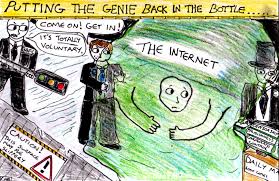
putting genie in bottleThe Wall Street Journal wrote about it last Thursday January 30th in an article entitled ‘How a Family Tragedy Landed on a Retailer’s Mailing’

Forbes wrote about it the week prior – 

 ‘OfficeMax Blames Data Broker For ‘Daughter Killed in Car Crash’ Letter’. 

It sounds ugly and the natural (and correct) reaction is to think ‘those poor people who have to deal with stupid and insensitive marketers.  How could they allow something like this to happen?’  When it comes to data appending, which is the longtime practice of using multiple sources of data to create a more detailed (and more valuable to marketers) individual customer profile, the genie has been out of the bottle for a very long time.

Obviously in this case the act of combining existing data on the parents with this new information went horribly wrong.  I submit that it is extremely unfortunate when things like this occur but it is not criminal, it is not duplicitous and it will happen again and again since there are human beings involved and we all make mistakes.   In this instance there is a good deal of public information regarding the tragic death of a high school student.  The information regarding her passing was not information that was traded behind the curtain.

Being a partner in a marketing services agency that founds much of its actions on what we call ‘Marketing Science’ we are keenly aware of the value of using data and science to help us make smarter marketing decisions on behalf of our clients.   As a long time direct marketer myself I have been deeply involved in using data for more than thirty years. That does not mean I do not value my privacy in fact the opposite is true.

However I am also aware that the appropriate use of data to make offers to individuals (in the internet world it is most often in the form of an IP address not an actual known individual) based on their behaviors and proclivities.   Isn’t it possible that at a future date reviewing the customer profile of the Seay family (the parents of the daughter killed in the car crash) might provide a charity an opportunity to reach out to help the Seay’s emotionally, financially or otherwise?

This is not 1914 it’s 2014.  We are decidedly not going back to the days where everyone’s data will be put back the way it was, behind the curtain with little knowledge of people’s profiles and behaviors. It’s not the data itself, it’s how the data is then employed.

To be clear, I am 100% committed to the protection of one’s own personal data.  At the same time I am committed to best practice utilization of behavioral and attitudinal consumer data.  Customer Profile data appending must be done in both a legal and ethical manner.

Do you believe it is possible?
Posted in Advertising, Best business practices, Consumer Behavior, Data collection, Data driven marketing, Marketing stuff, Technology | Tagged , , , , , | Leave a comment

The last days of cash?

cash03There has been much talk over the years about the irrelevancy of the U.S. penny. The report in 2012 from Bloomberg was that it actually costs 2 cents to make one penny.  With a nickel it’s just as bad – 11.2 cents for each nickel.  Apparently this has President Obama’s attention.

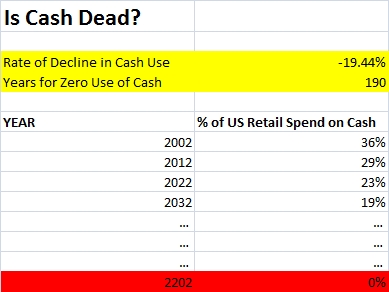
To take that idea a bit further, how long will it be until cash is completely obsolete? I imagine it would not be very difficult for an individual to live a year or more today without having ANY cash at all. Debit cards and credit cards (ok and maybe even Bitcoins) could be used and for those that live in a major city it is not far-fetched to think of many people not using any cash for days, weeks, or even months at a time with no real issue. Paypal wants you to think this way. In an article in the Daily Mail the suggestion from Paypal is that cash could be obsolete in three years.

Granted this is a totally self-serving piece from a company that has much to gain from a completely cash-less society. Maybe you’ve seen the Chase television ad in which the babysitter collects her fee electronically from the cool young parents on the Chase Quick Pay service associated with her debit card.  By the way we had lots of babysitters over the years but none were as cool as Olivia. I have no real attachment to cash except that it is not trackable – or at least easily trackable. I doubt I have too much to worry about when it comes to marked and unmarked bills.  Still it will be a different world indeed if I never have to carry a money clip, loose change or any ‘legal tender’.

What do you think? Are you ready for a cashless world?

Posted in Consumer Attitudes, Consumer Behavior, Living in the World Today | Tagged , , , , , , , , , | 2 Comments

Monthly subscription music services – WINNER!

Puppy-listening-to-music-with-headphonesI am not necessarily proud to admit this but although I have had an iPod for many years, I have never purchased any music in the iTunes library.   I just had the feeling that it was not something that I would value in the long term.   What I did is what most people that feel the way I do have done – I took all my CD’s and moved them to my iPod.  With 2,000 songs (my own eclectic variety), I had plenty of music to listen to.  Until listening to the same 2,000 songs got old.  2,000 songs is not enough.

A couple of years ago I downloaded the free version of Spotify on my computers.   I wrote about it and am no less enamored of the service than I was at the start.   As a ‘free’ service – with ads every few songs or so Spotify is a great service.  I find it (presently) to be better than Pandora since I can search for anything I can think of and there’s a very good chance that I will find the exact song I am looking for or at least ‘a’ version of the song or performance.   Just to be clear not every artist licenses their content to Spotify or any of the subscription music services.

What the free version of Spotify does not enable is to search individual artists and music when using a tablet or mobile device.    Since I was tired of listening to the same old songs (and I mean OLD) on my iPod I made the choice to sign up for a three-month trial (for the price of one month) of the paid service.   At $10/month it’s very affordable and I am more engaged in all kinds of music than I have been in a long time.

I am a bit concerned about data usage when I am streaming music when out of Wi-Fi range but so far that has not been an issue.   What I like most is that I am only limited by my imagination and I am listening to music more regularly than I have been in years.

Beats is coming out with their own subscription service and there are others like Roxio in addition to Spotify and Pandora.   More choices will hopefully mean monthly pricing will remain somewhat steady at least for the foreseeable future.

I think subscription music services are good for consumers and hope that they are good for the artists (there are varying views on that).    What do you think?   How are you buying your music these days?


Posted in Customer Experiences, Entertainment, Streaming Music | Tagged , , , , , | Leave a comment

Remember when Jet Blue wasn’t just another airline?

jet  blue downIt doesn’t make sense to get mad at any particular airline anymore.   To declare ‘I’ll never fly that **!!ing airline again” is counterproductive since the alternative is likely  an airline with higher fares and zero service differentiation.   Sure there are U.S. domestic airlines like Virgin America that offer a higher quality of service – at slightly higher prices of course, but Virgin America does not fly everywhere I or anyone else will need to visit.

Jet Blue used to have cache as a ‘different’ airline with a unique offering and service.   I think many would agree that today more than fifteen years after the founding of Jet Blue in 1998 it’s merely just another airline.

Our daughter came home from Florida State University (yes the reigning NCAA FBS champs) for the holidays.  On the trip to New York City, she drove 2 ½ hours from Tallahasee to Jacksonville to catch a direct flight to JFK on a rainy Monday and everything worked like clockwork.   Good experience.  Her return trip was quite another matter.

Sunday January 5th was a bad, bad weather day for much of the United States.  This was mostly before the ‘polar vortex’ hit the U.S. East Coast.  Ice, sleet and freezing rain were falling over much of the East Coast.   Our daughter’s flight was scheduled to depart at 2:30 and she had to be back in Florida for classes on Monday (and to watch the game with her friends).   Her flight was delayed a half-hour, then three hours, then 8 hours before finally being canceled altogether.   The next flight Jet Blue could put her on was Wednesday the 8th.  There were many people that shared her plight.

The thing that aggravates me the most about the whole experience is that this kind of behavior from airlines is expected by travelers.  Remember when Jet Blue started?  Leather seats, Direct TV, cool snacks, cheeky flight attendant announcements?   Jet Blue was one of the first airlines to hire individuals to answer customer service calls on behalf of the company in their own homes.   It was all a novel approach to the airline business, the planes were clean and new and the public loved it.   The brand value skyrocketed.   And then the brand matured, not like fine wine but more like wine turning to vinegar.

Why does it have to be this way with airlines?   We all know it’s a difficult and ruthless business.   Fare matching, load factors, jet fuel costs all conspire to make running an airline extremely difficult.   Yet the absence of even a basic level of consistent service is the norm and airline customers mostly have no other recourse but to accept the status quo.  Jet Blue once tried to rise above that status but could not sustain its own brand promise.

What ended up happening to our daughter?  She flew on a different airline U.S. Airways (American – one of the airlines I have been mad at over the years), and got stranded in Washington on Monday when her connecting flight was canceled.    Then in a fortuitous confluence of attention and tears she worked her way on to a flight direct  to Tallahasee that arrived three hours before the National Championship game started.   She missed her classes that day but got to experience what will be a most memorable life event.

Weather delays and cancellations when it comes to air travel are to be expected.  But informing a paying passenger whose flight was canceled that they have to wait three days for an open flight with no restitution since it was ‘weather-related’ is just an awful and embarrassing policy.

Where are the upstarts beyond Virgin America?   We should expect and demand better.

Posted in Airlines, Consumer Attitudes, Customer Experiences | Tagged , , , , , , , , | 4 Comments

Regulating personal drones – will they become the property of the FAA?

Great GazooEver since I saw the piece on CBS 60 Minutes last month where Amazon’s Jeff Bezos coyly introduced a product not quite ready for prime time – the Delivery Drone, I’ve again been thinking about personal drones.  A January 2nd, 2013 NY Times article featured a $1,200 personal drone called the Phantom 2 which can be controlled by your Apple IOS device.  The article author Kit Eaton notes that using this drone to take photographs is great fun and it sounded really cool until I thought twice.

Picture a world where the average American has an affordable personal drone.  The drone could be used in a variety of ways to insure the security of one’s house, car, and family.   A drone could be a very useful tool indeed.   But what would happen with the rampant use (and overuse and misuse) of personal drones?   The range of drones has been shown to be substantial.

I have this vision of people using drones to scope ‘talent’ at the beach.  A snowstorm of drones checking things out trying to avoid one another while the buzz and unsightliness of the flying robots drives everyone crazy – and away from the beach.   That won’t work.  Nor will unregulated drones that could be used to crash parties, sporting events and public gatherings.  Will there actually be a need to have signs posted that scream NO DRONE ZONE?    And will venues need to have anti-drones that would be employed to take out privacy invading drones?    Or personal surface-to-air anti-drone kits to protect your domicile from snooping drones?

Wouldn’t the regulation of personal drones have to fall under the (FAA) Federal Aviation Agency?  I looked into it and found some references but no policy as yet – The technology is advancing so quickly that action needs to be taken sooner than later before drones become…a constant drone.

If personal drones did not look so much like flying junk perhaps they might be more acceptable when snooping around. Making a flying personal drone look non-threatening could become important.   I remember growing up and watching The Flintstones cartoons. There was a Martian-like character named the Great Gazoo.   There were times Gazoo appeared to be a somewhat drone-like (but not controlled by anyone or anything else) popping up anywhere and everywhere (and usually messing things up for poor Fred Flintstone).   For the record the Great Gazoo was not regulated by Bedrock City in any way.   The point is that Gazoo was kind of cute, non-threatening but could see and tell all and that seemed to be ok with Fred and Barney (the only ones that could see the Great Gazoo).

So do you feel the FAA will have to have stringent regulations regarding the use of personal drones?

Posted in Living in the World Today, Technology, Uncategorized | Tagged , , , , , , , , , , , | Leave a comment

Don’t be fooled – This Groupon and its restaurant is actually a bad deal

RaspberryGroupon sad faceI have written several times about daily deals.  Yet even I had thought that one of the good things that happen with Groupons is having a restaurant that you enjoy send out a Groupon so you can enjoy a meal that you would have had anyway for less money.  So when one of my local Connecticut favorite restaurants was featured in this morning’s Groupon, the first thing I thought was – maybe they wanted to keep the restaurant staff busier during a slow winter period and by promoting a ‘deal’ they might make less but keep valued staff.  Not a bad idea if that were to be the case.   Whatever the reason, I was ready to pounce.  Then I actually read the deal, navigated to the menu for the restaurant, only to find that the ‘deal’ was not a good deal but a bad one.

Here’s how it was pitched.

Choose from Four Options

  • $55 for a three-course gourmet Italian dinner for two, redeemable Sunday–Thursday ($100 total value)
  • $65 for a three-course gourmet Italian dinner for two, redeemable any day of the week ($100 total value)
  • $115 for a three-course gourmet Italian dinner for four, redeemable Sunday–Thursday ($225 total value)
  • $125 for a three-course gourmet Italian dinner for four, redeemable any day of the week ($225 total value)

The dinner for two includes the following:

  • One appetizer ($19 value)
  • Two main courses ($70 value)
  • One dessert ($11 value)

The dinner for four includes the following:

  • Two appetizers ($38 value)
  • Four main courses ($140 value)
  • Two desserts ($22 value)
  • One liter of wine ($25 value

Checking the menu on dinner for 2 – one appetizer (there is only one for $19), Two main courses (the most expensive main course is $26 so how can it be a $70 value?), one dessert (there are zero desserts for $11).   So if I chose $19 appetizer, Two entrées at $26 ($52), and one dessert $8.50 the total would be $79.50 – not the promoted value of $100.    And if you were to order a less expensive appetizer and not the most expensive entrée it’s a money losing proposition.

So who is at fault here?    The restaurant for promoting a $100 for $55 or $65 (or $225 for $110 or $125), or Groupon for not checking out the true value of their deals?

How about both of them?


Posted in Best business practices, Daily Deals, Social Media | Tagged , , , , , | 2 Comments

Will consumers accept retail credit card surcharges?

Amex-articleInlineLast week I read an article in the December 19th issue of The New York Times describing how credit card companies like American Express, Master Card and Visa are considering altering policies that disallow retailers the ability to charge consumers an additional fee when using one of their credit cards.

From the article “The deal comes less than a week after a judge approved a settlement that included a similar change of rules in a huge class-action lawsuit against Visa and MasterCard, billed as the largest private antitrust settlement in American history.  The changes clear the way for vendors of all types to institute essentially a two-tier pricing system — charging more at the register to shoppers who pay by credit than to those who use debit cards or cash.”

Retailers may not have the nerve to actually be associated with such a policy.  But as the article went on to offer, “Currently, many businesses do pass on to consumers so-called “swipe fees” — which are said to generally range from 1 to 3 percent of the transaction — by building them into the price of the goods and services they sell. That means all customers pay, a system that some contend amounts to poorer consumers subsidizing affluent holders of premium rewards cards.”  I knew this but it still irked me to read this for some reason.

Gas station customers are completely familiar with the cash discount versus the credit card surcharge and have adjusted their behaviors accordingly over the years.   Perhaps people now more frequently swipe their bank debit card, or walk inside the station and pay cash prior to gas stations offering a cash discount (which really means there’s a credit card surcharge).  Or perhaps people just don’t care since they feel they are getting the airline, hotel or reward miles anyway so what’s the big deal about 1-3%?   I will leave it to others to debate that issue.

With retail (and gas stations for that matter) stores operating on such a thin margin, a 1-3% cost saving can have a substantial impact on profits.  For as long as there have been credit cards the charges for use of those credit cards have been borne by the seller and thought of as a cost of doing business.

Will consumers that spend tens of thousands of dollars annually on their credit cards actually think about the fact that in paying with a credit card you directly bore the full cost of $300 on $10,000 of spend instead of having the store pick up that charge?   How about $3,000 on $100,000?  It takes a lot of reward points (hundreds of thousands) to achieve $3,000 in actual value.

I imagine that when it is in your face at the register in the store, (online merchants may sidestep this issue altogether by simply absorbing the cost) that some people may think twice about using their credit card.  Would knowing there’s a surcharge to use a credit card make you think twice?

Posted in Best business practices, Consumer Attitudes, Consumer Behavior, Customer Experiences | Tagged , , , , , , , , | Leave a comment

I’m done with Multi-vitamins

Multi-VitaminsI like to think of myself as an evidenced-based person.     For most of my life) I have taken a daily multi-vitamin going back to One-A-Day and probably even trying a Flintstone multi-vitamin along the way (that my Mom bought of course).    My father offered that multi-vitamins can help round out deficiencies in a diet and that whatever my body did not use would just void as waste.

On Tuesday an article in a publication entitled ‘The Annals of Internal Medicine’ (no don’t worry I did not and do not read this – it was covered in Tuesday’s Wall Street Journal provided what it considered to be conclusive evidence that when it comes to multi-vitamins “The message is simple: Most supplements do not prevent chronic disease or death, their use is not justified, and they should be avoided,” four physicians and public health experts wrote in an editorial accompanying the studies.

So now the evidence is that something that I have taken most every day of my life is both a waste of time and a waste of money.  My children do not take, nor have they ever regularly taken a multi-vitamin.   It appears that my wife and I (who both take a daily multi-vitamin) have been taking vitamins under false pretenses and on some sort of a strange legacy basis.   I kind of feel a bit used and a bit duped.

I don’t believe that it was marketing or peer-pressure that was responsible for my ingesting a multi-vitamin more than 17,000 times.   I really did not notice any difference on the days I did not take one, (why do you ‘take’ a multi-vitamin and not eat one?).   None-the-less I would go back to my routine at the next nearest opportunity.    And maybe that’s the answer.   Taking a daily multi-vitamin became a daily habit.   It seemed odd to not do so.

Yet, despite all that now that I am aware that there’s no reason at all to take a multi-vitamin I will continue to take one until they run out.  Of course we recently bought another bottle so I will be continuing the routine deep into 2014 before finally retiring that ritual.    I don’t think I will miss it at all.

I also think it might be a good time to short companies like Nature Made, Centrum and One-A-Day.  Maybe it’s also time that the Vitamin Shoppe should think about changing its name?

Have you been taking a multi-vitamin?   If so will you stop?


Posted in 50+ market, Brand Advertising, False claims | Tagged , , , , , | Leave a comment

Renting a truck for the day hasn’t changed in forty years and that’s ok for now

rentalWe rented a truck yesterday.   It was a 14 foot truck which is a fairly large truck and is listed as a commercial vehicle.   I don’t have a commercial driver’s license and was not informed by the clerk that I needed to stay off Parkways and other non-commercial roads.  Fortunately it was not my first time renting a truck.    In fact, when I thought about the entire experience, which lasted less than five hours, I could not distinguish it being any different than it was back in the 1970’s.   And that was just fine.

It had snowed several inches the day before and due to the impending storm that was about to descend upon Manhattan, (that being Santa-con not snow), we moved our rental date from Saturday to Sunday.   It was a good call.   By Sunday morning the precipitation in the Tri-State area had abated and the roads were relatively empty.    The clerk at the BP gas station was pleasant enough as well as deliberate, which is to say slow-moving.   The final ‘contract’ had to be printed out multiple times on a printer that might just have been made in the 1970’s.    Finally he gave us the go-ahead to head out noting that he could not answer many questions since that unit did not often rent trucks.

I have no loyalty to any particular company when it comes to renting a truck since the decision is based first upon availability and then upon cost.   Have you ever been to a truck rental unit that rents truck and only trucks?   I don’t recall that ever happening.  Whenever I have rented a truck there’s always some other business going on simultaneously such that the truck rental is treated mostly as an afterthought.   The trucks are always old-ish, dirty, the controls are difficult to read and the seats uncomfortable at best.   You want loud?  Just rent a truck.   How an engine that feels like it has about as much power as 4 ducks running around on a treadmill can be so loud is a mystery to me.   If you turn on the heater or air-conditioner AND the completely up-to-date AM-FM radio, you may, just may be able to fight back the white noise of the duck engine drone.

I actually think it’s a bit odd (and totally great) that truck rental units allow just anyone with a valid driver’s license to walk up and drive away with a large vehicle which they probably have never driven before.  If ever you have driven a 14 foot truck you know what I mean.   It’s not an overgrown Suburban) if you know what I mean.   Another thing I’ve noticed is that I believe that I have never rented a truck that had a license plate from a state within 500 miles of where I am.   Where are all the Connecticut rental trucks?

Do you think there might be a for-additional charge EZ-PASS in the rental truck, (did you say missed revenue opportunity?)  No chance.   And you really have no idea what the charge might be when you go through a toll – sort of toll-roulette game of ‘hope I have enough cash’.  Will the toll cost ten or twenty dollars?

Returning the truck was easy if not, you guessed it, slow.  We traveled 100 miles, rented the truck for a total of five hours and the cost was I guess reasonable at $135.   Plus $40 in gas.   And some unknown amount in tolls but I had less cash than when I left my house.

All in all it was a fine, decidedly low-tech experience, one that I expect will not last much longer as some smart company should be able to figure out how to create and brand a higher level experience for the same overall cost (or less).    When it comes to renting a truck, it would not take much to raise the level of the customer experience.    Any takers?

Posted in Best business practices, Customer Experiences, Living in the World Today | Tagged , , | Leave a comment

Fifteen seconds of morning glory

Shippan pointThe view in the photo is much like that which I see every morning on my commute to New York City by train that for at least part of the ride trails the Connecticut shoreline.   I am finishing my first full year of daily commuting and early in the year I became aware of a beautiful vista that appears each morning for about fifteen seconds.    For whatever reason I find that view to be something I do not want to miss (and rarely do), independent of the weather – winter, spring, summer, fall, rain, shine, snow or sleet.

Sometimes I watch a single skull oaring up the channel toward Stamford.  Other times I notice crew eights rowing at 7:30 in the morning.   I try to sit on the left side of the southbound train in order to have the best possible view.  At times like this I think about breathing and meditation although I’ve not done much more than think about those things.   I know I need to work on that.

Fifteen seconds.   It’s easy to say it goes by so fast – because it does.  However I am able to reflect on those what I consider to be precious seconds at various points of my day.   In the fall and winter when it is dark on the ride home I am disappointed that I am unable to see it for the second time that day.   The sight of the sun setting over the Long Island Sound with the view of Long Island in the distance (as in the photo) gives me a momentary sense of peace.

My 20 year old daughter reminded me that in Florida where she goes to university, so many of her fellow classmates have never even been on a train.   For most of the country a daily train commute is a foreign and unfamiliar concept.   We city and suburban people who ride the train every day have a very different morning routine than most other Americans.

I’m on record that I have little problem with my train commute each day – aside from the frustrations with Metro-North that me and all of my fellow passengers have to endure on a daily basis.   Trains are always late (not usually more than ten minutes though) and there have been major service disruptions along the way.   The view is not all that different if one drives down Interstate 95.  But the effect at least as far as I am concerned is not even close to what I see and feel while riding the train.

Fifteen seconds of morning glory.   Do you have anything you notice or do that offers you that on a daily basis?

Posted in Living in the World Today | Tagged , , , , , , | 2 Comments