Advertising on the side of the road – the brands change but the song remains the same

This week I drove the 750 miles down Interstate 95 from the New York City area into South Carolina. I like driving and don’t make 11 hour drives with any regularity. Since it’s long the scenery is not always riveting I seem to notice roadside advertising – and that’s the point right? OOH (out-of-home) continues to be an active marketing channel to help build brands.

As we drove beyond Washington DC deep into Virginia I noticed there were almost no signs for Starbucks. This was even more so the case in North Carolina. Prior to that it seemed every rest area had a Starbucks sign. In fact I was surprised to notice that it seems to me that there are not as many billboards as there used to be. This is not a bad thing in any way but for me was unexpected. Dunkin’ Donuts was only slightly more in evidence. That same thing could not be said for McDonald’s and Wendy’s (strangely I did not notice as many Burger King signs).

I did not see many electronic billboards on this drive overall but nearly none in after I passed Richmond. The section of the road from Richmond into South Carolina had extremely light traffic on this occasion during a midweek afternoon. What began to dawn on me was how similar things looked over an 11 hour drive except for the trees and vegetation. Connecticut looks something like North Carolina, at least along the side of the road. Ok maybe you cannot get to Waffle House in Connecticut so the brands may change but the song remains the same. I think I might have heard that somewhere before.

Is the United States is becoming so homogenous that it’s becoming kind of boring?

Posted in Advertising, Living in the World Today, Marketing stuff, Media | Tagged , , , , , , , | Leave a comment

Nobody calls anymore – are we less civil?

Remember when it was important to check for messages while you were out of the office for any length of time? I thought of this when I met a friend and business associate of mine recently for lunch and golf. While I checked my phone three times during the round for any urgent email messages (there were none) I did not call the office even once to check my voice mail. Five years ago it would have been different.
I don’t know about you but I don’t receive many telephone calls anymore – at least not without warning.

What I mean by ‘not without warning’ is that I find people increasingly prefer to set up phone calls by arranging a time to speak. The idea of giving a prospect or client a call just to check in is not looked upon the same way it was before there were smartphones. In fact it is often noted that those under thirty years old would prefer texting a message to actually having a conversation.

Here’s what I am not going to do. I will not wax nostalgically for the days when my own cold calls, other calls from vendor, and calls from people I do not know well, would take up a fair part of my day. I really do not like cold calling (never did), nor do I particularly relish calls from vendors that I don’t know well so I don’t miss those at all.

While it’s quite a bit easier to not have to try to call in from the seventh hole on a work day, I feel that all the ‘efficiency’ in planning a telephone conversation is removing some of the important human element in business relationships (and personal relationships too for that matter). We are all in such a hurry to get more things done and be more effective in these times of ‘do more with less’. Yet with all the increases in productivity we answer emails on evenings and weekends far outside of what used to be considered ‘normal working hours’.

So would more phone calls make things better? As we know email communication often makes it difficult to determine ‘tone’. Phone conversations are much better than emails to gauge how someone feels. It’s my opinion that people could spend more time talking with one another on the phone or better yet, in person.

With the advent of the texting generation and overuse of email people seem to have gravitated to talking at one another instead of with one another. Take a look at the United States political landscape if you want to see prime examples of a lack of civility.
Is the idea that nobody calls anymore contributing to an overall lack of civility?

Posted in Best business practices, Communication, Living in the World Today | Tagged , , | Leave a comment

Is buying a 3DTV worthwhile?

We have what at the time was a state-of-the art (back in 2001) Sony 42 inch flat screen television. It is a complete monster – heavy, non-internet enabled and with no HDMI cables. The picture quality remains very good (to my eyes at least), but it is not the television of the future for my family or anyone else for that matter. The amazing thing is what we paid for it back in 2001 – $4,000 installed. It seemed so important at the time. Now it seems to have been overkill even if we’ve gotten more than 12 years out of it. And a larger, less-heavy (by a long way) and better resolution HDTV can be purchased for almost $3,000 less today.

Because we are doing some redecorating we need to move the television (in our new, smaller house) onto the wall as it currently is standing on a display case. It makes no sense to us to attempt to mount the ‘monster’ on the wall when it does not meet our current or future needs. Consequently we’re in the market for a new flat screen television.

In terms of watching television in 3D – I’ve never done that. In fact the only 3D ‘experience’ I’ve ever had was with Avatar which I saw in 3D (not IMAX however) in a movie theater. I enjoyed that experience but it did not exactly make me eager to run and see another movie in 3D.

I suspect that I am in good company when I note that wearing 3D glasses detracts from any movie or television watching experience. Maybe if I were watching alone it would not be as bad but the actual wearing of the glasses is a hassle.

So why would we be interested in a 3DTV? It’s not as if there’s ‘oodles’ of programming in 3D. I have often read that ‘next year’ will be the year of 3DTV. That is reminiscent of the constant chatter that ‘this will be the year for mobile communication’. The problem is that we’ve been reading and hearing about this being the year of mobile for about 4 years. It’s only now that it might actually be true in mobile. I think it could be three or four years before 3DTV has enough programming to make it worth considering.

It seems to me that 120Hz vs. 240Hz is more indicative of the choice we need to consider than 3DTV. 50 inches or something close to that seems appropriate as far as screen size goes. And it has to be fully internet capable with LCD technology.

Which brand will we buy? That’s another story but like most Americans we are looking at a budget and then evaluating the options that are contained within that budget.

If you have any suggestions please share!

Posted in Best business practices, Customer Experiences, Entertainment, Technology | Tagged , , , , , , | 4 Comments

Hey Proflowers – no thanks for the reminder

Good marketers understand the value of a well-timed and relevant reminder email. Reaching a prospect or customer with a value-oriented message when they are considering a purchase decision is crucial to campaign success.

I’ve purchased flower bouquets several times over the past few years from Proflowers.com. In general I have found the site easy to use and the overall shopping experience to be good. In fact after a recent purchase of flowers that began to look shabby after only 4 days I contacted Proflowers and they made good on their guarantee by sending a replacement bouquet within a reasonable time period. Good stuff.
But the email below while well-intentioned contains a fatal error that will be difficult for you to find.

Extra 20% Off
Mark, give Mom a gift she’ll want to show off to all her friends. Order today and get an Extra 20% off* gifts over $29.

Spoil Mom with 20 Rainbow Mother’s Day Tulips with a Free Vase, just $23.99.

Or send Mother’s Day Spectacular with a Garden Green Vase for just $23.99 – a total savings of 52% with your Extra 20% off!

Hint: it’s not the offer or pricing. Actually the offer is a good one and the pricing seems fair. The layout is also fine, clear and not overladen with graphic elements.
Give up? The fatal flaw is that I cannot send my mother flowers for Mother’s Day since she passed away nearly seven years ago. Let’s just say that when I read the offer it did not make me feel anything but sad. I still miss my Mom and think of her every day. I will never feel the same way about Proflowers.com again.

How could Proflowers make such a stupid mistake? It’s hard to fathom. Did they send this same email to all their current/recent customers? If so there are undoubtedly many people who had the same reaction that I did. The copy could easily have been modified to capture the feeling of giving flowers on Mother’s Day. But as soon as the copy read ‘Give Mom a gift she’ll want to show off to all her friends.’ there was no way out of an embarrassment Proflowers created all on its own. Had the copy read ‘Flowers and Mother’s Day were made for each other’ or anything along those lines I would not have been put off at all. Once the email is made personal by mentioning Mom and her friends you’ve entered the twilight zone of stupid marketing.

Is it possible that Proflowers could know if my mother was alive or not? The answer is yes it’s possible but if they knew and still sent the email that makes it even worse! Chances are Proflowers had no idea of my mother’s passing – or if she had any friends or not BTW (she did but still…).
Email marketing is a profitable and important business particularly on the retention side. I find it incredible that Proflowers.com could miss the mark so badly.

Am I oversensitive here? Do you have any good stories on how a marketer tried to get personal and made a big mistake?

Posted in Advertising, Best business practices, Communication, Customer Experiences, Email marketing, Marketing stuff, Personal Privacy | Tagged , , , | 4 Comments

5 Things gas stations do to tick me off

With current gas prices in the U.S. averaging just under $4.00/gallon (of course where I live it is more like $4.20) the customer experience of going to the gas station is an already painful one. Many of the nation’s refiners have sold off their ownership in gas stations to independent operators. While this may make sense for oil giants like Exxon-Mobil, Royal Dutch Shell and BP, what is happening at gas stations is that the experience is not getting better for customers.

Of course the #1 thing customers would like to see at gasoline stations is lower prices. Since that’s not going to happen, and even if it did it would not be the station owners making that decision, brand loyalty to gasoline or a gasoline station is as fleeting as it’s ever been before. Since a good percentage of transactions at the gas station can be done at the pump itself the gas station is about as impersonal a retail place as can be found. I’m not longing for a return of the days of the ‘man with the Texaco Star’, who would fill your tank, wash your windshield and send you off with a smile. But there are an increasing amount of things that are so annoying at gas stations in the U.S. today.

1 – The return of a cash price vs. a credit card price. This was in vogue ten years ago and has returned with a vengeance. Given that a $4.00/gallon price of gasoline is about the highest it’s ever been credit card processing fees (3-4% most of the time) represent $0.12-$0.16/gallon. So far I have seen a $0.09 or $0.10 discount for cash payments. The stations are not even discounting the cash price equivalent to the actual savings they are realizing by not processing credit card transactions.

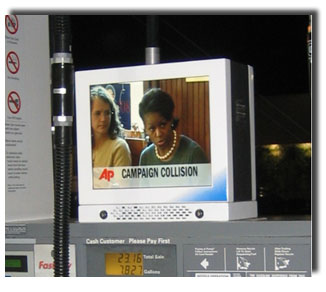
2 – Ads playing on the screen while you pump gas. I admit it’s a clever idea and a captive audience cannot help but be forced or drawn to watch, but after I’ve seen the same ad on the same visit for the 5th time during the same visit I am ready to scream out loud. And there’s no shutoff button like there now is in taxis in New York that play ads while you ride (another clever idea). Please let us turn off the stupid thing!

3 – No I don’t want a car wash. At the gas station I am trying to get in and out as quickly as possible (I am trying everything I can to NOT go in the store). Often I am on autopilot and in hitting yes for a receipt out of habit I have inadvertently agreed to a car wash. I am quite capable of making my own decision on when I want a car wash. And the message flashes independent of the weather. Who washes their car during a rainstorm?

4 – Not being able to print out a receipt from the pump. If you are going to have a one-stop service and allow people to pay at the pump the receipt paper roll should be changed promptly. It happens all too frequently that there is no paper in the pump receipt and then you must go inside to get one. And what a pleasant experience that is.

5 – The pump handle lock is broken. Many people like not having to hold the pump while filling their tank. Why some gas stations either don’t have this feature at all or when it is broken don’t fix it makes me nuts.

There are actually more than five but I will save those for another day when I feel the need for a rant. But I am interested in hearing if you’ve got any others aside from those above that bother you.

Posted in Best business practices, Living in the World Today, Media | Tagged , , , , | 2 Comments

Gen Y has it tougher than it’s ever been before

It wasn’t supposed to be this way. Technology was supposed to make things easier and among other things aid in making twenty-something’s (i.e. Gen Y denizens) achieve more, make more money and contribute faster to society. It could be argued that in some cases that has happened – think Mark Zuckerberg, Andrew Mason, and the two principals of Instagram Dennis Skyros and Mike Krieger who just last week became multimillionaires. But the way I see it, far too many Gen Y’ers have become slaves to technology and devices and actually unknowingly spend a disproportionate amount of their income paying for their technology habits. I believe the need for technology and its expense is a significant contributor to college graduates returning home to live with their parents.

In order to function in today’s society people need to have access to the web, a mobile phone (preferably a smartphone), devices such as a computer or tablet to produce and consume content. When those costs are included in monthly expenses the average Gen Y’er might be surprised at the percentage of his/her monthly income that goes to feeding their technology needs. Surely some will point out how inexpensive technology can be. However can is theoretical and in practice the average Gen Y’er spends more than $100/month on technology.

For example – a new smartphone costs anywhere from $300-$500. Since people tend to replace smartphones about every two years the cost of phone purchase amortized over the two years is about $20 monthly. Mobile service costs are $ 50 or more monthly. Add in the costs of buying a tablet, or computer, any software and subscriptions, home internet service and it’s easy to see how the monthly technology costs can easily exceed $100 or more. And I’m leaving out things like cable television service since the Gen Y’ers I know have little interest in watching broadcast or cable television.

For many Americans in their twenties scrounging up $500 a month for rent is not easy. Moving to a big city doubles or triples that number. Transportation costs (subway, bus, taking care of a car with parking and insurance, rail etc.) are a factor as well. It all adds up to a number that makes subsisting on anything near the minimum wage – impossible. Even at $15/hour which is nearly double the minimum wage, thirty-five hours per week equals $2,200 before taxes.

So it is conceivable that the sum of one’s technology bills at over $100 approaches 10% of take-home pay. That’s an expense that did not exist in the 1980’s when college graduates and young people would shudder at the thought of living with their parents.

There really is not an option to live in today’s society without technology. Surely there will be those that will point out technology does not have to cost as much as I am advancing, but in my experience most people just pony up and pay the costs without really thinking too much about the long term ramifications.

It is sometimes said that city dwellers can spend one-fourth to one-third of their income on housing. Add 10% for technology to that and the total can approach 40% of income before doing anything but paying for housing and technology. It’s no wonder things are tough for Generation Y.

Agree? Disagree?

Posted in Living in the World Today | Tagged , , , , , , , , , | Leave a comment

Having both a digital AND print subscription is best for readers

Enjoy it while you still can since the days of offering a print and digital subscription for the same price are numbered. The main reason is of course that the print subscription is so much more costly to print and distribute. Many publishers of newspapers and magazines are attempting to condition readers to the digital version of their content by offering the print subscription and tagging on the digital version as well at ‘no additional cost’.

I think people are smarter than that and realize that the print subscription is the price driver and the digital subscription is simply riding along. Remember that despite there not being anything to print or mail, there are costs associated with digital publishing. Platform hosting interfaces, programming, digital maintenance would be some examples (certainly there are more) and even the development of specific content for the digital platform is a cost.

The recent buzz about NIM (Next Issue Media http://www.nextissue.com) made me think about the future of printed vs. digital publishing. Actually I think about that all the time. NIM is an e-reading joint venture formed by five major U.S. print publishers. Due to problems with Apple’s publishing platform NIM titles will only be available on Android tablets for the moment with the promise the iPad version is coming soon. The titles are lacking as far as I (and many others feel the same) am concerned. The concept is that you pay a monthly subscription fee for full digital access for up to 30 or so publications for as little as $9.99/month. It’s a kind of Spotify or Netflix for magazine readers. It’s a really good idea that is lacking because there are so many titles which are NOT included right now.

Personally, I would much rather read long form articles in the Economist or New Yorker in the printed version. Yes I am getting over that the more that I use my Kindle Fire or iPad, but that’s to be expected from someone who grew up reading ink on paper. There are things about the printed version that I enjoy very much and cannot get in the digital version. Like having ads catch my eye for instance. The impact of a full page print ad in a printed version is much greater (to me) than a digital ad. True I cannot ‘interact’ with the printed ad as easily (even with a QR code), but the digital ad is much easier to ignore and I suspect I am far from unique in that aspect.

Another cool benefit of the printed published page is that I tend to read things I might pass up in the digital version because all I have to do is move my eye. I don’t have to click, swipe, open, view, go-back or do anything but just read it. In the digital version I don’t find myself doing that nearly as much. Do you find that to be true?

Where it’s all headed is most likely the direction of a substantial premium for the printed version and that prices for the digital versions will increase (not decrease) over time. But for now having print AND digital is the best of both worlds.

Will you miss printed published newspapers and magazines when they are a rarity or (worse?) a luxury item?

Posted in Advertising, Best business practices, Innovation, Publishing, Technology | Tagged , , , , , , , , , , | Leave a comment

Will Instagram be the new Napster?

This past Monday Facebook announced it will pay cash and stock totaling one billion dollars for a company that has no revenue model. Instagram has been around for less than 24 months. It has (reportedly) 30 million users who upload more than 5 million photos a day. The number will be even larger since Instagram last week released an Android version to complement its Apple version.

30 million non-paying users reminded me of music file-sharing service Napster way back in the early 2000’s. Napster too had 30 million users (and users they were since they paid nothing to access a wide variety of music tracks). In 2001 Thomas Middlehoff then chairman and chief executive of Bertelsmann convinced his associates to rescue Napster and turn it into a subscription based service. You can read what was written in the New York Times regarding the deal in 2001 – http://nyti.ms/HujxwZ.

History has shown how that plan worked out – it didn’t. I don’t begrudge Instagram founders Kevin Systrom and Mike Krieger at all for their crafty holdout that ultimately ended up in them shaking loose a $1 billion payout from Facebook. What I cannot understand is why Mark Zuckerberg CEO of Facebook would pay such an exorbitant amount ahead of the Facebook IPO which is rumored to be in the neighborhood of $100 billion. In fact last week a new round of Instagram financing valued the company at $500 million.

Instagram has intimated that it could possibly derive revenue by allowing sponsored photos to be dropped into the stream on user screens. Or they could be paid by brands when users tap something to purchase. But at present that is all conjecture.

I read a number of unfavorable tweets regarding the deal yesterday including one that offered – ‘Today Facebook purchased Instagram. It’s also the day that I stopped using Instagram’. There appear to be many people who have a similar opinion. I also wonder that there will be copyright issues with photos ‘ownership’ and license agreement challenges. Maybe Napster founder Shawn Fanning could offer his opinion?

It’s a known fact that the majority of Facebook users are women. Instagram users also skew female but exact figures were unavailable. Is Facebook heading toward being a women’s social network? Has Facebook jumped the shark here? I guess it could all work out somehow. But for me, right now I am seeing Instagram in the same light as I saw Napster.

What do you think?

Posted in Advertising, Best business practices, Marketing stuff, Mobile Communication, Social Media, Technology | Tagged , , , , , , , , , | 3 Comments

Would my coaching youth baseball when I don’t have a child in the program be creepy?

My children are all grown up now (meaning they are over eighteen). Accordingly my days and nights as a father are quite a bit different from what they were just ten years ago. This is because I was a dedicated coach of youth sports – ones in which my children played of course. Like so many people I coached youth soccer (which I name ‘organized mayhem’), youth basketball and youth baseball. I loved every single minute of it and miss it dearly.

I thought of this when I drove past the baseball fields in my newly adopted hometown. There was a man (presumably a father of one of the boys) hitting grounders and pop-ups to young kids under the age of ten (I only guess this because they were really small). Ten years ago I was President of Wilton Little League and even named district one volunteer of the year. There were unending practices, games, car rides and rainouts. However in the process I got to know many families, and the kids themselves. I miss the dirt in my trunk, carrying equipment in the back of my car everywhere I go and simply just being outside working and enjoying being with the kids.

So as I drove past I thought why are my coaching days over? Is it only because I have no children in the program? And in this politically correct time if I were to volunteer to coach baseball (for example) for a team on which I have no children of my own as players, in a town that I have only lived for 5 months would I even be given the opportunity? Would I be seen as creepy for wanting to spend afternoons, evenings or weekends telling kids to hit the cutoff man, to throw strikes, or slide? It only takes one disgruntled parent to completely ruin a reputation.

My conclusion was that while I don’t feel it would be creepy in the least, it’s not my opinion that counts and surely some people would look at it unfavorably, even nervously. And how sad is that? It’s bad enough that good, smart, and capable people choose not to enter politics due to the scrutiny and glare of the spotlight. But that one has to think twice about helping out in youth sports is kind of sad.

How many people are there like me who only want to contribute but hesitate to do so because of the possibility of some people’s negative perception? Am I being overly cautious or oversensitive here?

Posted in Living in the World Today, Personal Privacy | Tagged , , , , , , | 4 Comments

Procter and Gamble says no to streaming video

This week Procter & Gamble announced http://bit.ly/I262sG that it would ban employee access to Netflix and Pandora in order to save bandwith at the company headquarters in Cincinnati. My first reaction was that banning internet site access never seems to work out like as it is intended. This is true in particular when people can access so much on their mobile devices. Ban Facebook or Youtube? No problem – people will just do in on their smartphone. So often the result of banning just causes a shift in how people access social media and video sites.

As it turns out P & G’s banning access to Netflix and Pandora was more a question of reducing data usage and in fact could save the company money since currently the data spend is as much as $15 million annually. P & G is hardly alone in contending with a skyrocketing use of data at the corporate level that taxes internal servers and slows overall employee productivity.

The recently completed NCAA men’s (and women’s) basketball tournaments displayed the incredible adoption of real-time streaming video. I know this since I signed up for the streaming package from CBS sports for $3.99 and had on the games over the first two days in the background while I worked. Please do not mention this to our IT guy as he is not too keen on streaming video in the office. However somehow I get the feeling he knows anyway. In fact, according to an article in the Huffington Post, a survey released by Modis this past March indicates that increased video streaming during the NCAA Men’s Division I basketball championship greatly slows connection speeds and, in 34 percent of cases, causes the network to crash. In addition, more than two-thirds of the 500 IT staffers surveyed responded that they take steps to “either lessen or block the streaming of non-work content” during the tournament.

I posted last year on the subject of whether or not it’s a good idea to allow employees access to March Madness during work hours – http://wp.me/pJX7l-m2 and I still maintain it’s a good thing for employee morale and making the office more community oriented. However at the same time having employees access Netflix does not seem to be essential to me. Pandora would be fine with me if it were not such a giant data consumer.

Growing data usage is becoming a critical issue at the corporate level. Nobody wants to hear the word censorship, but the expense of larger data streams combined with a perceived loss of productivity will cause situations (dilemma’s) like Procter and Gamble’s to happen more frequently.

What do you think? If you think access should be provided without limitations would you be willing to contribute some of your paycheck to have that access?

Posted in Best business practices, Living in the World Today, Personal Privacy, Technology | Tagged , , , , , , , , , | Leave a comment