Advertising print and mail – the incredible shrinking channel

Shrinking printingI spent more than twenty-eight years working on print and mail (and inserted) projects.   In addition I have not been in a printing facility for almost a year and miss the smell of alcohol, ink and paper.  While I don’t miss the noise of a printing plant or lettershop (mailing facility) I do miss the incredibly professional people in the print and mail industry that always showed that they cared about doing the job the right way.   There are fewer and fewer of them still working in the print and mail industry.

There are a number of LinkedIn groups dedicated to direct mail and printing and production.   Without fail there are daily discussions regarding the relevancy of direct mail as a channel and how it is still a relevant channel with a very attractive ROI.   I don’t disagree but I also feel the cheerleaders do a disservice to themselves and the industry as a whole in not telling the entire story.   That real story has to include the increasing irrelevancy of the print and mail world and too many people remaining in the industry refuse to acknowledge that fact.    Print will never return to prominence, nor will it disappear either.   The same can be said for mail.

It’s true that there are still a number of companies that use print and mail to attract and retain customers.    But do you think there will be more or fewer of those occasions in three years?  How about five years?    If it were not for the fact that people are living longer (the same people that are familiar with and respond to print and mail) the shrink rate of the print and mail channel uses would be even more accelerated.

Personally I still love print and sort of love/hate mail.  However when we talk with clients about the various channel marketing opportunities unless there are dimensional mail applications (i.e. unusual shaped mail packages or boxes) for higher priced items, it is unlikely that we’d ever suggest an acquisition mail campaign as an initial approach.   Now I am certain that there will be concrete examples of companies that are bucking that trend which I will fully be willing to acknowledge, however I’d also ask them – how long does the company expect the print and mail approach to survive?    What are they doing to transition to digital and mobile channels?

Print and mail are still undergoing transition and what is likely to emerge for print is a channel that will be more elegant (tactile, portable, and special) in that it will be higher quality and more expensive on a per piece basis but also deliver higher value to the user (and with hope the marketer) than it has in the past.

My wish for my still-in-the-industry colleagues is to concentrate on the higher end and higher value products since when it comes to print there just won’t be all that much of it – but you knew that already didn’t you?


Posted in Advertising, Advertising to Millenials, Best business practices, Direct Mail, Direct marketing, Printing & Mailing | Tagged , , , , | Leave a comment

How will Americans handle not being #1 in so many categories?

USA vs. World population trendsThe 20th century has been termed the ‘American Century’ by pundits.   There are plenty of good reasons for this notion such as having had the largest economy (this crown was gained around 1900 from Great Britain), the largest military by spend (China has many more soldiers), as well as the immigration champion.

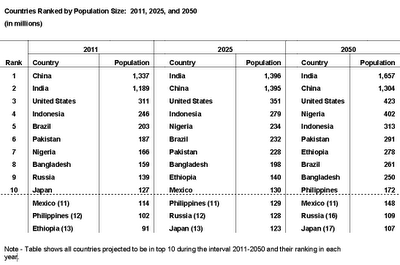
I thought about this when I noticed that Nigeria has a population of almost 170 million, and Brazil about 200 million.   The U.S. by the 2010 Census has roughly 309 million people.   After China and India, the most populous countries are, in order, the United States, Indonesia, Brazil, Pakistan, Bangladesh, Nigeria, Russia and Japan.

I grew up in a world where the U.S. population was #3 (as it is today) was a given, but long term Indonesia, Brazil, Pakistan, Bangladesh and Nigeria all are poised to have larger populations than the U.S. perhaps before 2100.   With China’s economy also on pace to exceed that of the U.S. by 2016 (or thereabout) the U.S. is dropping in the categories of many world rankings.   How will these developments impact the psyche of Americans?   When I was a kid growing up in the 1960’s and 1970’s the U.S. was the country that seemingly everyone wanted to visit and a good number wanted to call home.

The U.S. remains a popular destination for many global citizens (freedom does ring quite loudly) and that is not about to change.   But as a proud American (well most of the time) I am wondering how it will feel when the U.S. is) no longer at or near the top – at least statistically speaking.

Being #4, #5 or #6 in population, being #2 in world economy – those are just numbers right?  Yet I think it’s not insignificant that at least statistically speaking the U.S. will continue to drop down in many rankings (let’s not talk about education – an area that at one time was a source of U.S. pride but not as much these days) and there will be an impact felt in the way that Americans feel about themselves.

Can the U.S. lead from behind – at least as it pertains to statistics?   Does it even matter?


Posted in Business in Asia, Business in China, International business | Tagged , , , , , | Leave a comment

Mobile blogging on how advertising tries to impact me

Heinken adSitting on the 11:39 p.m. train with an hour on my hand, I notice the train ads ( kind off liking OOH BTW), I realize I’ve never mobile blog posted, (can that be written?) and I find the three ads I can see arresting.  And all are brand ads.  Will they impact me?

The first ad is for Three Olives which calls itself ‘The London Vodka’ whatever that is supposed to mean.  Clive Owen looks pensive and serious and he’s pretty cool.  Maybe I’ll think to ask for a Three Olives martini or gimlet sometime?

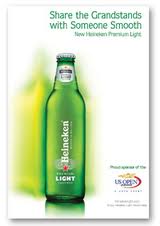
The next two ads that catch my eye are for Heineken.  One encourages you to be ordering Heineken when at the US Open tennis matches which ended almost two weeks ago.  Still, I love tennis and always have had a positive view and like Heineken.  The association does not hurt.  The other Heineken add is for Heineken Light.  No problem there either.

The ad I noticed last is right in front of me – for Sleepy’s, and as I’ve worked in the mattress category for countless years, I’ve a natural affinity even for the 800 pound gorilla we used to refer to Sleepy’s.

Is it just chance that I’d be familiar with the three brands?  Most assuredly.  But at the same time none of those brands did anything except help themselves in my personal case.

This advertising thing is compelling more than a little don’t you think?

Posted in Advertising, Advertising to Millenials, Brand Advertising, Marketing stuff, Mobile Communication, Out of home advertising | Tagged , , , , , | Leave a comment

In flight internet service offers poor customer value

inflight wi-fiMore than three years ago I wrote a post noting that gogo internet service www.gogoair.com was so-so.   I’ve used the service when available and again this past week I flew on a certain airline that offered the gogo internet service.    I’m here to report that there has been zero improvement in three years.

Does this surprise you as much as it does me?  Three years?   Prices have only increased – $ 14.00 for an all-day pass, $40.00 for a ‘monthly’ traveler pass on one airline.   Also offered is unlimited monthly service on any airline for $50.00.

If there are inherent limitations on the speed and signal consistency when traveling in an airplane at 30,000 plus feet, then why do we have to pay a fee that is so out of sync with the level of service?    Are we to expect that if a truly fast and reliable service were to be available on airlines that should cost $25.00 per flight or $100.00 per month for unlimited service?    It appears that in concert with the airlines gogo internet service is simply a price-gouge and you get what you get.   Count me among those that are entirely unimpressed and even a bit aggravated.

Being able to work online, and even watch a web video, is an excellent way to pass what is mostly boring time in the air.   I can see a site like Skype being blocked (nobody I know is in favor of telephone calls in the air being allowed), and I can also understand that an application like Facetime should be blocked( or disabled) so as to deny an online actual conversation.   Trust me when I tell you that none of your fellow passengers have ANY interest in being privy to your in-air conversations any more than they are interested when you are talking at length while riding the train (sorry a personal pet peeve).

When it comes to in-the-air Wi-Fi I ask, ‘Where are the competing offerings?’  I imagine there are complicated reasons involved in the process but accepting things the way they are is not good enough for me.  

How about your experiences using Wi-Fi in the air?      

Posted in Communication, Living in the World Today, Mobile Communication, Travel | Tagged , , , , , | Leave a comment

The Las Vegas brand in one word – FUN!

74px-The_Sands_Casino_SignUntil this week I hadn’t been in Las Vegas for almost five years. I’m here for a client franchise convention and while I like to sit and play a little blackjack and even stand at a crap table for a while I am far from and never have been what you’d call a gambler. Yet I have been coming to Las Vegas for more than forty years. Yes I know that makes me – old, it gives me perspective as I also have been to Vegas twenty times. Several of those Las Vegas visits occurred before I was twenty-one years old.

What would a ten year old kid do in Las Vegas back in the early 1970’s? My sister and I loved being among the only kids in the Sands hotel (‘A place in the sun’) and we found the city to be – fun. That one word can still be used to describe Las Vegas and it is the cornerstone of the Las Vegas brand. I know so many people that don’t like to gamble and yet really enjoy Las Vegas. It used to be a pure gambler’s city but today less than 35% of Las Vegas’ total revenues are derived from gambling.

I remember the early 1970’s Las Vegas being a somewhat elegant place (being a kid, I was not allowed to see the seediness for good reason). People were well-dressed and movie stars and entertainers would be seen walking around the hotel in a matter of fact manner. I distinctly recall hearing ‘Mr. Sinatra, Mr. Frank Sinatra, please pick up a white courtesy phone) while at the Sands hotel. Even then I knew that was cool I even played tennis (ok for like 5 minutes when some guy named Stan had to go to the bathroom) with Don Rickles and Bob Newhart who in their eighties, remain good friends to this day.

Food options Las Vegas in the 1970’s were mostly comprised of hotel buffets with few top-notch restaurants. It was all about casinos and shows. For a time I thought I would love a career as a lounge jazz pianist (the hotel would allow me to sit in the casino in the lounge to listen and I took a liking to the great Bob Sims), but upon repeated visits I noticed Mr. Sims’ skills and his health deteriorated and it did not look like a job I’d want to do for very long. Today there are few lounge acts and I have not seen one in a long time.

The Las Vegas brand went through some rough times in the 1980’sand lost its mojo and became – less fun and even a bit cheesy and the brand was in need of a refresh. In the 1990’s hotels like the Bellagio, The Mirage, and the revamped Caesars Palace brought different kinds of glamour back to Sin City. The Las Vegas brand was back and again it was all about fun.

I’ve written about the lack of fun in Macau casinos. Las Vegas remains for me and for many people a fun place to go and it is no longer referred to only as an ‘Adult Disneyland’ but that’s pretty good company to be in compared to when talking about a brand being fun.

I’ve got so many stories about one of my favorite cities – how about you?

Posted in Brand Advertising, Travel, Uncategorized | Tagged , , , , , , , | 1 Comment

Even making a little effort can go a long way

att-reach-out-touch-someoneDoes this seem familiar?   You run into someone that you’ve known for a long time but have not spent time with them in ages.  You briefly catch up and part with the promise that you’ll get together soon.   And then that does not happen.   In fact it may never happen.

You both meant what you said when you set up that ephemeral future date but as time passes the disconnect increases and ultimately neither of you reach out.    You pass it off with something like ‘well we’re both so busy’ and you only have so much time – in fact not even enough for many of the people you actually do see and spend time with but don’t see often enough.

This year I’ve been trying hard to not let that happen and I’m very glad to be making that effort.   Whether it’s personal or professional it’s far too easy to just let relationships slide.   Showing interest in other people’s lives by reaching out and staying in touch seems to be more important in the digital age.   People do keep in touch with social networks but it can be fool’s gold if you are thinking that the level of connection is the same as talking on the phone or better yet, getting together in person.

In my professional life I’ve always enjoyed going to see people I do business with – or would like to do business with.  I’ve never been one to wait for an invitation and in fact would contact my client and then work out a visit with an ‘agenda’ that was really more of an opportunity for us to stay better connected.   And I always walked out being really happy that I did.  Making the effort made both parties feel better about the relationship.   The same can be said for your personal relationships.

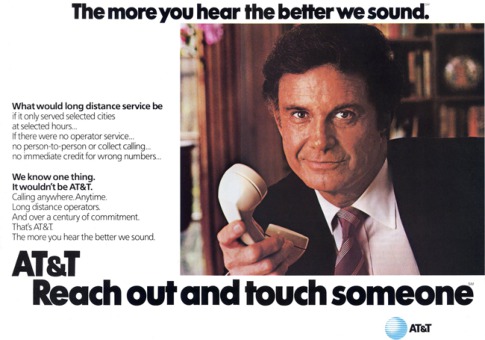
A T & T had a campaign thirty years ago with tag line ‘Reach out and touch someone’.   I think it’s time to bring that idea back to the forefront.  Make that call, (or if you must send that email or message somehow), set up that breakfast, lunch, or dinner with that friend or colleague you’ve not seen in far too long.

Will you give that a try?

Posted in Best business practices, Community, Living in the World Today | Tagged , , | Leave a comment

Acxiom – a huge data marketing company that knows things about you


ACXIOM-1-articleLargeHaving been in the direct marketing business for much of my career I have been familiar with Little Rock, Arkansas-based Acxiom including yesterday when he formally introduced www.aboutthedata.com an Acxiom website that offers consumers the chance to review some of the data Acxiom has collected about them.

This morning’s NY Times article offers details.   Most people are aware that the buying and selling of consumer data – their consumer data, takes place without their knowledge.    This fact makes most people (including me) a bit uncomfortable if not more so.    The allaboutdata.com site is all about making an attempt to mollify an increasingly concerned populace when it comes to the collection, storage and release of what used to be sensitive personal data.   I note used to be because it is the mission of data companies to acclimate the public to the idea that their information is only digitized in the form of numbers and the marketplace is based on the demographics and behaviors of those digitized records.   Companies like Acxiom would like you to believe that in their database you are not recognized as John Smith, but record – 01456xxxx-xxxx, (you get the idea).

Marketers – in particular direct marketers are extremely interested in putting relevant offers in front of prospective customers.  Companies like Acxiom with its data rich records help marketers hone in on a narrower, highly defined and hopefully relevant prospect pool.  This also goes for customers who exhibit certain behaviors so that the most relevant offers for its other products are moved to the front of the line.  

Acxiom (there are competitors like Experian, Dun & Bradstreet and Accenture), has more than 32 billion data records updated each month.   The databases are comprehensive and each week Acxiom (from its own website copy), ‘powers more than a trillion transactions that enable better living for people for our 7,000 global clients’.  Kind of makes your skin crawl a bit no?   They know things about you – or more properly your data record.  Lots of things.   How many kids you have, their ages, all about your cars, house, mortgage, dining and retail buying behavior (via credit card data), vacation spots, and much more.  

The allaboutdata.com site per Mr. Howe will allow consumers to make changes to their data records in the interest of having the most correct data possible.  From the NY Times article – Julie Brill, a member of the F.T.C., described the Acxiom site as “a first step down this important road towards greater transparency.”   Apparently consumers will be able to opt-out of Acxiom’s marketing database but at present it will continue to not possible opt out of every Acxiom product.  After all having a smaller amount of data records would not aid corporate earnings in any way. 

I’m not sure the launch of the new allaboutdata.com site makes me feel more or less comfortable.  How about you?  


Posted in Advertising, Best business practices, Data collection, Data driven marketing, Living in the World Today, Marketing stuff, Personal Privacy | Tagged , , , , , , , , | Leave a comment

What would you do tomorrow if your career today was no longer viable?

Train tracks man standingKeeping one’s business skills up-to-date and relevant has never been more important in this era of ever-evolving technology.    But what if what you had been doing for more than twenty five years was increasingly irrelevant?   I can tell you that after working in and around the commercial printing business for more than those twenty-five years, sometimes despite that you can even see the train coming down the tracks getting out of the way in time is not as easy as it sounds.

I’ve been telling people that for the past couple of years.  I am very aware that I am far from alone.   Last week, I received an email from a longtime friend and colleague in the executive search business.   He and I have not spoken in a few months and while I knew business had become more difficult I did not realize the degree that executive search (everyone avoids calling it headhunting but we all know better), had changed – forever.   Like the commercial printing business and the newspaper business, technology has impacted the executive search business with sites like The Ladders and LinkedIn having changed the way employers look for and engage new potential employees.

I had not really been thinking about the ways successful search professionals were on their own road to irrelevance.    While this is in no way gratifying to know since there is no joy in watching the misery of others, it’s highly disturbing and I will go ahead and say it – patently unfair!     When as a young person you ‘choose’ a career (you don’t always get to choose), it’s not likely that you are concerned at all with the future viability of the chosen industry.  After all, to a twenty one year old, twenty five years seems like a lifetime.

So if you accept that I’ve revealed something important and established the unfairness of it all, you might ask – now what?  With a little luck you at least saw the train on the tracks and have been thinking about what will be your next move.  Getting off the tracks is of course an obvious and very good idea.   But you should also be considering how you will handle your professional convalescence if you don’t get off those tracks in time. 

You may not know exactly what you will do but you can prepare for how you are going to approach your professional future.   It’s a shock any way you look at it.   Will you be able to resist the easy response of withdrawing or worse being mad at the world?   At times I exhibited one or both of those behaviors.   I knew it wasn’t my fault and yet I also knew it was my responsibility to figure out what to do next.  Everyone will tell you (as they told me) that ‘It takes time’.   But it’s not their time.  It’s my time and – well, it sucks. 

Your family, friends and professional colleagues will be invaluable should it happen to you one day (and I hope that it does not).    But what is more important as far as I am concerned is the maintaining of a positive attitude and having a willingness to try and learn new things.   This is easier said than done to be sure, but critically important.   Things move fast, there’s a ton of new information every day and I don’t learn the same way I did when I was twenty one years old.   But I do know I love learning about new things and I don’t believe in the saying ‘you can’t teach an old dog new tricks’. 

What would you do tomorrow if your career today was no longer viable? 


Posted in Career Development, Marketing stuff, Social Media | Tagged , , , , , | 4 Comments

Professional tennis could use a few more personalities

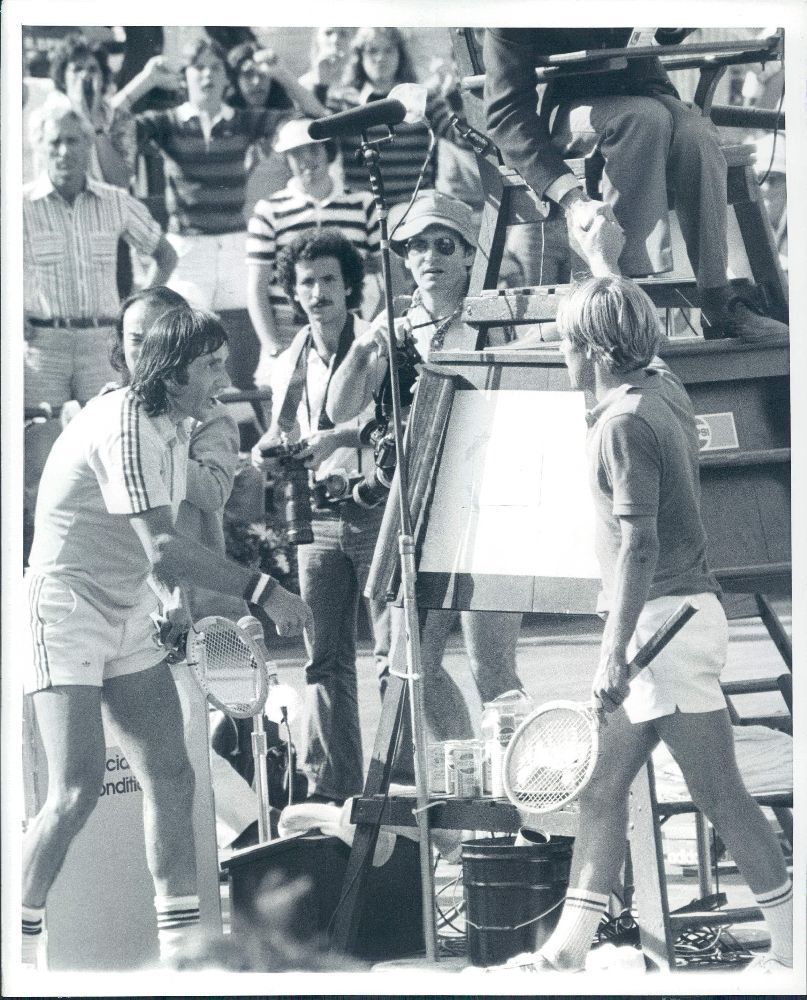
Nastase PohmannDon’t worry I am not going to go all nostalgic here,  even after attending the first day of the U.S. Tennis Open this past Monday for the 37th time in 38 years (or something like that).   Aside from making me feel old, I spent a great day with my good friend with whom I have been playing tennis for more than 38 years.

The U.S. Open is professional tennis’ most successful event.    In the United States tennis is declining in popularity as is attendance at non-U.S. Open events.  While it is expensive to attend any pro tennis event, I think the biggest reason is lack of personalities in the game today.   Serena Williams is arguably the best woman player to ever play the game.   Yet her appeal goes beyond her prowess as she is so compelling to watch because she exudes so much personality on the court.  Today there are few if any other players male or female who exhibit that kind of personality.    It hasn’t always been that way.

My friend Don and I were watching a match between Spanish player Tommy Robredo and M. Matosevic – a player we have never heard of before (this is unusual particularly for Don who seems to know every player).   I checked later and Marinko Matosevic who somehow plays for Australia and has never won a first round match at a grand slam in 11 tries.  But this guy had it – personality.    When he rallied to win the second set (he ultimately lost in four sets) he was gesturing to the crowd as he won key points to break Robredo’s serve and the crowd loved it.    Think about it – a player that I guarantee 95% of the crowd at court 17 had never heard of was entertaining and made a mundane first round match something to watch.

A little personality goes a long way.   Don and I attended the crazy match in 1976 where former #1 Ilie Nastase of Romania finally beat German Hans-Jurgen Pohmann  in three sets but not before not only refusing to shake Pohmann’s hand (due to Nastase’s belief that Pohmann was faking an injury and stalling) but spitting at Pohmann at the net.  While Nastase (like Jimmy Connors and later John McEnroe) frequently went ballistic and too far – you always wanted to watch.   Nastase had the Nickname “Nasty” for good reason.  After the match, Nastase slammed balls into the stands and offered obscene gestures in all directions.  It was the most memorable thing I’ve ever seen at a professional tennis match.

I am not suggesting making professional tennis a circus act.   But today’s players almost universally are dull, boring and exhibit little personality.    #1 men’s player Novak Djokavic is an exception and Rafael Nadal while unbelievably intense is more than stoic when on the court.  And then there’s Roger Federer – wonderful to watch play but so smooth and so composed that you can fall asleep watching a Federer match against anyone other than a top player.

For fans of tennis, tennis is theater, sometimes great theater.    It should be first about the tennis but the aspect of entertaining the paying crowd should not be ignored.   Back in the 1990’s the American-born Jensen brothers Luke and Murphy (Luke is a commentator now) were not the best players on tour by a long shot.  But they were highly entertaining and people would want to watch them play any opponent.

I understand that today’s pro tennis players play for so much more money than ever before and it’s a serious matter.  But Tuesday night #2 seed Victoria Azarenka won her match 6-0 6-0 and Novak Djokavic lost five games in three sets.  I am not going out on a limb to offer that the Tuesday evening session patrons were decidedly NOT entertained.  

A little playing to the crowd by either Azarenka or Djokavic would have made a big difference in perhaps creating a more memorable evening.    It’s called marketing your sport. 

Yes or no on more personality in professional tennis?

Posted in Best business practices, Sports Marketing | Tagged , , , , , , , , , , , , | Leave a comment

Paying for membership does not create a community

communityWhen you become a member of an organization or club you sometimes have to pay for the privilege.   Think of a health club, beach or golf club, or alumni club from your university.  All require payments in order to remain a member in good standing.  Some club memberships require interviews prior to becoming a member and once accepted there often can be a probationary period where you are expected to behave in a certain fashion.   Others like a health club just require that you pay the bill each month.

Memberships to clubs and organizations in which there is not a common goal or cause, does not translate to those members actually becoming a part of a community.    When you decide to not pay for the membership anymore you cease being a member and your absence is barely noticeable.   However when you are a part of a community – a charitable organization you work with, a group project, or even an athletic team, the bonds are much deeper and the members care for one another in a very special way.

I thought of this while watching the Little League baseball players from Westport, CT (near my current hometown) play in the Little League World Series (LLWS).   We locals have read about the exploits of the local heroes all summer and by watching some of the games have become familiar with some of the players and their families.    The experiences, (both highs and lows as the Westport team lost in the U.S. final on Saturday,) of these players and their families have undoubtedly forged a community that will remain connected for many years to come.     The players and families, (brought together only two plus months ago) started as members of a team and ended up with something much greater.   While it’s true that the players and their families may pay to be on the team, (although fundraising for trips to the LLWS is often a big part of the experience), the investment (if any) is modest and the creation of the community borne out of a single shared purpose.   It will not only be a summer the player and families will never forget, it will be a time in their lives that they will always remember fondly.

Think about the organizations and teams of which you are a member.   Churches, Synagogues and other places of worship are largely all about creating a sense of community.   Being an American Express card member does not.   Membership most often means having paid the price to join and continuing to pay to remain a member.    Being a part of a community has a much greater reward and doesn’t feel like it costs anything at all.

Do you see the difference?

Posted in Communication, Community, Customer Experiences, Living in the World Today | Tagged , , , , , | 2 Comments