Facebook wants you to wish Happy Birthday to the deceased

automatic-wish-happy-birthday-in-FacebookThis morning I read an interesting post written by Josh Cline as if it were February 2016 ruminating on the death of Facebook.

While I found the post to be amusing, (if not implausible) the same day it was overshadowed by a ‘suggestion’ to wish a now deceased former classmate of mine from high school a Happy Birthday. It’s not that I don’t understand that someone in the person’s family should have (by now since it’s been more one year) contacted Facebook (FB) to have the profile removed. Maybe the family tried and was unable to reach the right people at FB. Or maybe the family in some way wants to have the profile remain for some reason I will never be able to understand.

Shouldn’t more be expected of Facebook? With all the tracking and data it’s impossible for me to believe that some FB algorithm would not indicate that a FB user has passed away, especially after more than a year. My view is that it is in extremely poor taste to suggest FB friends wish someone a happy birthday when they have passed away.

I am not of the opinion that FB should take down the deceased’s profile page and that appears to be FB’s ‘’policy’ as well. I’ve noticed that family has used my classmate’s FB page to post occasional loving remembrances and far be it for anyone to opine on a family’s way to deal with their grief whether it be short or long term.

But surely Facebook knows when people pass away right? If FB can retarget me contextually based on a website I visited it should also be able to search and match files of the deceased (don’t tell me this is not possible I won’t believe it) to make certain that mistakes like suggesting wishing a happy birthday to deceased FB friend do not occur.

The same is true of other social media profiles like LinkedIn. I had a LinkedIn connection that passed away tragically and yet more than a year later I was asked to congratulate him on his years with the company. Ugh.

Social networks need to do a much better job of stopping this kind of thing from occurring. Hiding behind protocols is not the answer. It just should not happen. Leave the page active, stop the suggestions for wishing the deceased a happy birthday, anniversary or anything else for that matter.

Do agree that FB is responsible for a certain amount of insensitivity here?  Shouldn’t we expect and demand better?

Posted in Facebook, LinkedIn, Social Media | Tagged , , , , , , | 2 Comments

Amazon gets a Twitch and likes it

GamersThe news that Amazon purchased Twitch.tv for nearly a billion dollars last week is now in the category of old news.  It was Amazon’s second largest purchase ever (bonus points if you can recall the largest which was only for a couple of hundred million dollars more).

David Carr of the New York Times wrote his usual good piece about it  earlier this week.   I’ve been familiar with Twitch for some time now as my son is an inveterate gamer and has been talking about the incredible popularity of the platform.   What remains to be seen is how Amazon will leverage the platform into something profitable.  Gamers, you’ll note, are notoriously resistant to efforts of commercialization on their platforms.

That thousands of fans attend live events to watch others play video games is a hard concept for most of those over 40 years of age.  I’ve not attended one of these events but I am interested enough to want to have the experience even though I am not gamer.  The marketer has much over which to salivate when it comes to the opportunities to monetize the incredible passion of the ever-growing gaming audience.   And the numbers are mind-blowing as Mr. Carr notes – citing (ironically) the Wall Street Journal

…’last October, more people – 32 million — watched a championship for League of Legends, on various streaming services including Twitch, than saw the finales of “The Sopranos,” “24” and “Breaking Bad,” combined.’     This was all without commercial interruption.   Apparently gamers were pleased that it was Amazon, and not Google or Yahoo that won the bidding for Twitch although I am not sure exactly why they feel that way.

Gaming has more than come of age and my son and I have talked about an ESPN-style Sportscenter show that would be an obvious outgrowth.  There are many athletes both amateur and professional that love to play games in real time with other people like League of Legends (LOL – really), StarCraft II and Counterstrike (not to mention Dota 2).   The gaming world is more than ready during tournaments for a wrap-up show of the prior match and preview show of an upcoming match to fill what is now dead air.  That’s one of the first places I’d expect to see monetization take hold (i.e. sponsored by…).

You already know that gaming has come of age when Amazon pays nearly a billion dollars for it. How marketers will rise to the challenge of reaching an audience that rejects commercialization will be interesting to watch.  I have a few ideas.  How about you?

The answer to the question is Zappos.com.


Posted in Advertising to Millenials, Community, Internet gaming, Sports Marketing | Tagged , , , , , , , , | Leave a comment

Will Google buy Uber?

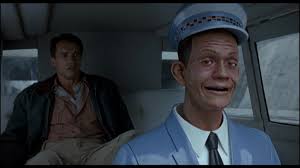
Johnny CabUber is still the lead horse in the car-sharing race (ahead of Lyft and Sidecar for example). I’ve already written about when Google Drives Your Car.  Now I can see that it is only natural that Google can drive you in Uber’s network of driverless cars.

I had a flashback to the original version of the movie 1990 Total Recall.  The movie (which was for my money much better than the 2012 re-make) featured several different interesting thoughts about the future.  One of them (for those that can remember), was the ‘Johnny Cab’.  Arnold Schwarzenegger’s character Douglas Quaid is driven by a robot that takes you wherever you need go whenever you need to go.  While in the movie the Johnny Cabs were hailed the old-fashioned way, they just as easily could have been hailed using a transmitter (read app).  After all, this version of Total Recall was made eight years prior to the founding of Google.

The Uber app is easy to use and tracks an individual’s travel history and habits.   Uber (Lyft and Sidecar as well) right now is primarily used as a taxi app. All the apps have now introduced ride-sharing capabilities within the app.  Users are presented with the opportunity to spend less money (than a single ride) where you pick up or join another passenger as long as the trip does not take you more than five minutes out of your way.

More than half the trips on Uber would apparently qualify as having two people in the same general area going to the same general place at any given time.  It’s all about big data and Google is really good at monetizing big data.

I admit that Google buying Uber is a pretty obvious idea.  So why hasn’t it happened as yet?

Posted in Apps, Consumer Behavior | Tagged , , , , , , , | Leave a comment

What Cable TV companies can do with triple play subscriptions will freak you out

dataTubeWhile we wait for the Comcast/Time Warner deal to happen (or not) the ongoing discussion as to the future of ‘cable TV’ providers (a misnomer to be sure) presents marketers with some interesting opportunities.

The advent of ‘triple play’ options from cable providers began the fight to control the data capture ‘tube’ connected to your home or business.   First it was cable television service. Then people were offered the option of receiving Internet service from their cable TV provider. Finally cable companies came up with the ‘triple play’ option including VOIP telephone service.   Deals were offered for year one (or other various promotion durations) to incentivize people to go for that ‘triple play’. After year one you then paid the full rate, which for many homes today exceeds $200/month.   $3,000 per year for one-stop shopping is convenient – for cable companies at least. It’s simply expensive for subscribers.

Millennials have shown the way since they (nearly always) don’t have a home phone (and never will), and have found there is life without cable TV subscriptions so all they really need is an Internet connection.   We can debate the future of cable TV until the cows come home but the trend is clear – bundled cable TV subscriptions will eventually be a thing of the past.

One reason I suggest you might be frightened is illustrated by something that happened to me this week. The home phone rang early one morning (I was actually home) and the caller ID noted it was from a charity with which we had never interacted. So like most people (ok almost ALL people) we ignored the call. Here’s where it got strange. Most times the call just ends in a hang-up. But this time we heard on the answering machine (for some reason we still have one of those), a live (at least I thought it was live) voice called out my wife’s name – “XXXX, are you there? “ That was something I had never heard before.

Then I started to think, I had been doing some work using the Internet.   Could it be possible that our triple play cable TV provider could see that there was Internet activity on our account from our house where the home phone was and that we had caller ID and did not care to answer? The obvious thought is that giving it a shot by having a live voice ask for one of us by name would increase conversion (donations) rates.  

If that’s the case and I suspect that it is, that approach is both brilliant AND creepy. With so many worthy causes it’s harder than ever to raise donations.   Finding a more targeted way to achieve success is what we marketers work on every day.

As two-way data flows continue to offer more detailed data on data stream behavior (what programs are on the television, web habits and access to your phone), smart marketers will relish the ability to avail themselves of the cool shiny new tools.   It’s our responsibility as marketing experts to our clients to be as efficient and as effective as possible.

But there are lines to cross aren’t there?   Where should they be drawn?


Posted in Cable Television, Internet television, Personal Privacy | Tagged , , , , | 2 Comments

Will users like me be saying good-bye to Foursquare?

foursquare-logomarkI’ve written about Foursquare on ten different occasions on this blog since becoming one of the earlier regular users.  Here are two – an early and a later one. Earlier this month Foursquare unveiled its new logo and new business model that it claims packaged goods companies, ‘love’.   That may or may not be the case but I don’t love it and have this week said good-bye to using Foursquare.

An article in Adweek last week offered the idea that the success of the integration of Swarm (what has now become of the old Foursquare check-in feature) and Foursquare “makes the company “a more attractive buy for brands that are looking to connect with folks they know already have a base level of [interest]. While this is not a new practice, we’re interested to see how deep this type of personalization can go without being creepy or invading on privacy—to truly deliver value on an individual basis.”   Um, sure, ok.

I always liked the idea of check-ins, mayorships and interaction with my (albeit few), Foursquare friends. It was interesting to see where they had been and where they were going. There were times that as a result of a check-in from a friend I was able to meet someone I would have not even known was around. The problem was Foursquare and Dennis Crowley could not create a revenue model from check-ins.  So in 2013 Foursquare began to sell user data to third parties for ad targeting.   Maybe you just missed that.

Now it appears that Foursquare has decided it would rather try to be Yelp. Of course Yelp CEO Jeremy Stoppleman according to Adweek ‘has strongly dismissed Foursquare’s comparisons to his company in the past’ and you can bet he feels no different today.

Foursquare is a puny challenger with stats from the Adweek article – ‘according to comScore, Foursquare’s mobile and desktop traffic in July was 10.3 million viewers, up 13 percent year over year. By comparison, the Reston, Va.-based researcher said Yelp drew 72.5 million viewers in the same month, up 15 percent year over year.’

Would many people care to put reviews up both on Yelp AND Foursquare? While it’s true that Yelp has had some problems regarding authenticity of reviews and what is seen in some circles as retailer strong-arming to pay for advertising, it’s relevance is increasing, not decreasing.   Was Foursquare in such a sorry state that this was seen as the best available move?   I’ll answer that – it appears to be so.

Foursquare was a rather unique application with potential to derive revenue in a number of different ways but even with that the road to success was going to be difficult.   Foursquare’s former uniqueness was primarily limited to cities a(s opposed to small towns where there are fewer available check-in locations). The move to be a recommendation app is a big yawner for me and for some of my foursquare user-friends.

What do you think? Is this the beginning of the end for Foursquare? Or had that die already been cast?   Or am I missing something?


Posted in Social Media | Tagged , , , , , | Leave a comment

Five reasons people hate going to stores

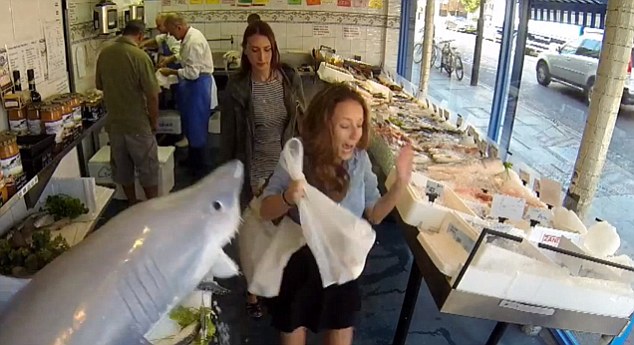
Sharks in storesSoon we will reminisce on when people used to actually go into retail stores.  It wasn’t all that long ago.  It even feels like it was only yesterday.   The Wall Street Journal on Wednesday had a story entitled ‘Shoppers are fleeing physical stores’.  My first thought was that Sharknado 3 had a surprise early release.   After all the vision of shoppers ‘fleeing’ stores was different than not bothering to actually go to the stores in the first place.

I admit that I personally avoid going to stores for the most part.  It’s not just that I don’t care for shopping, I don’t.  As a man I am most interested in buying and leaving a store as opposed to ‘shopping ‘which for many women is a gender team-building experience not unlike going to the ladies room while at a restaurant.

Why do I (and so many men AND women) despise actually going to the store?  Here are five reasons as a longer list was significantly pared down.

Traveling to the stores costs time and money.  And we all know time is money right?  If I know what I want to buy there really is no reason to physically go into the store.  Just between Amazon and Fresh Direct I can pretty much buy anything I want and have it delivered to my residence insuring that I always have the potential to be a housebound agoraphobe.

  1. Carrying around your purchases.  People don’t like to have to carry around their purchases.  As anyone that has ever lived in a five-floor walkup will tell you – the least fun part of buying something is carrying it home.
  2. The staff.  The people that work in most retail stores are overworked, underpaid, and just so unhappy to be there.  You can feel it when you walk into the store.  And it’s not a good feeling.
  3. Returning something at the store always seems to result in standing on a long line of dissatisfied people who are primed and ready to jump ugly at the first sign of resistance to their return.   A little risk management advice – if you ever have to return something to a hunting store don’t do it in person.
  4. Stores run out of the thing I want to buy.   Sure you can check online if the store has your item in stock but it could run out of the item by the time you get there and it should not be any surprise that not all point of sales systems are real-time updated with the local website.  And since you are online already why even bother going there in the first place?  Have it delivered.  Duh.
  5. There are occasions when I don’t mind going into a store.  At the airport it’s ok since my flight is delayed and I’d be happy for the option of as many stores as there can be since sometimes the flight delays are interminable (could not resist).   If we’ve gone out to dinner and want to take a walk around afterward, having some stores to walk into is a mindless and not unpleasant pastime although I sometimes prefer to stand outside and look in while I enjoy an occasional cigar.

The trend is becoming clear.  There will be fewer and fewer retail stores as time goes on.  Do you have any of your own reasons why you despise physically visiting a retail store?

Posted in Consumer Behavior, Internet Shopping, Shopping | Tagged , , , , , , | 4 Comments

Would you be comfortable doing business with your grandfather’s buddy?

Older youngerWhile I tend to stick to subjects having to do with brands, marketing and customer and human behavior I am also keenly interested in human behavior. The world is a fast changing place and human behavior in the industrialized world has had more alterations in the past 150 plus years than ever before. I thought of this while doing business with people that are younger than the age of my oldest child.

That a fifty-something person would interact and do business with a twenty-something is not at all unusual. But with people living and working longer and longer the idea of having a seventy-something person that is doing business with a twenty-something becomes more possible and more common every day. It’s safe to say that there are still substantial age prejudices that go far beyond ‘kids today just don’t understand the value of hard work’ and ‘old people are just dinosaurs’. Yet daily professional interactions between people fifty or more years apart in age are increasing and will continue to increase.

I think that increased inter-generational communication is a great thing and has the potential to foster more understanding between non-relatives of vastly disparate ages.  It’s important to remove the family or blood relative aspect since the way you feel about relatives will by nature be different than non-relatives. As septenagarians and yes octogenarians continue working they will become even less technophobic and the younger twenty-something people might take away two things – 1)‘Old people actually have a lot to offer and I am less afraid of what it will be like when I am seventy-five, and maybe 2) I sure hope I don’t have to work too hard when I am seventy-five.

If you were to ask me, the former is a more likely outcome than the latter.

I am one to always say that I hope to be doing productive things in my seventies, eighties and hopefully beyond.   Sure the older I get, the more I hope to be able to make choices to do things that truly interest me. The more I interact professionally with people in their seventies and beyond the more I realize there’s still a great deal for them to offer and that their take on things is decidedly different than mine and even more decidedly different than a twenty-two year old.

It’s better understanding through diverse interactions.  Agree or disagree?  What problems do you see and/or encounter?


Posted in 50+ market, Human Behavior, Millenials, Retirement | Tagged , , , , , | 2 Comments

New from Amazon – WOOT!

woot!Quietly last week on July 12, 2014 Amazon.com began promoting Woot.com.   I know this because I was ‘invited’ to join. Being curious I did just that. The home page offered what I felt was the burning question – ‘WHAT IS WOOT?’.

This is what the site home page notes:

A discussion of ill-advised efficiencies, failed idealism, and trampled dreams.

Woot is a lifestyle. Woot is a vision. Woot is a pungent aroma that never apologizes for what it is. Woot is the hope in the eyes of a child when that child realizes you don’t have to pay List Price for cool stuff. Woot is an ever-evolving deal maelstrom churning around a tornado circling a mystery. If you haven’t seen Woot since yesterday, you haven’t seen Woot.

Pardon me if the above explanation did not leave me all that satisfied. Checking Wikipedia.com I found the following:

Woot is an American Internet retailer based in the Dallas suburb of Carrollton, Texas. Founded by electronics wholesaler Matt Rutledge, it debuted on July 12, 2004.[3] Woot’s main web site generally offers only one discounted product each day, often a piece of computer hardware or an electronic gadget. Other Woot sites offer daily deals for t-shirts, wine, children’s items, household goods, and two other sites that offer various items. On June 30, 2010, Woot announced an agreement to be acquired by Amazon.com.

Now I get it. Woot is a flash sale or daily deals site. At least that’s what it seems.

More from Wikipedia:

‘Woot’s tagline is “One Day, One Deal”. Originally, Woot offered one product per day until its stock of that item is sold out, or until the product is replaced at midnight Central Time with the next offering. If a product sold out during its run, the next item would not appear until midnight, except during Woot-Off promotions. However, post acquisition from Amazon, if a product sells out fast enough(generally before Noon CST), a new product will be offered for purchase. Products are never announced beforehand. This sales model means that defective products cannot be replaced, only refunded. The company also does not provide customer support for the products it sells; in case of problems, customers are advised to seek support either from the manufacturer or through the online user community on the Woot forums.’

That Woot.com has been around since 2004 surprised me as I was only vaguely aware that there was a site Woot.com but had no idea what it was about. That Amazon.com decided to purchase Woot.com seems like a natural fit.

That it took two years for Amazon.com to promote Woot to me – a loyal Amazon.com customer is head scratching. But then these days Amazon.com causes lots of head scratching.

This week Amazon officially released the Kindle Fire phone.   I have not tried it yet and have heard mixed reviews so far.

Are you a daily deals and/or flash sale aficionado?   Have you heard of or tried Woot.com?


Posted in Consumer Behavior, Customer Experiences, Daily Deals, Innovation | Tagged , , , , , | Leave a comment

Marketers are targeting – what’s it to you?

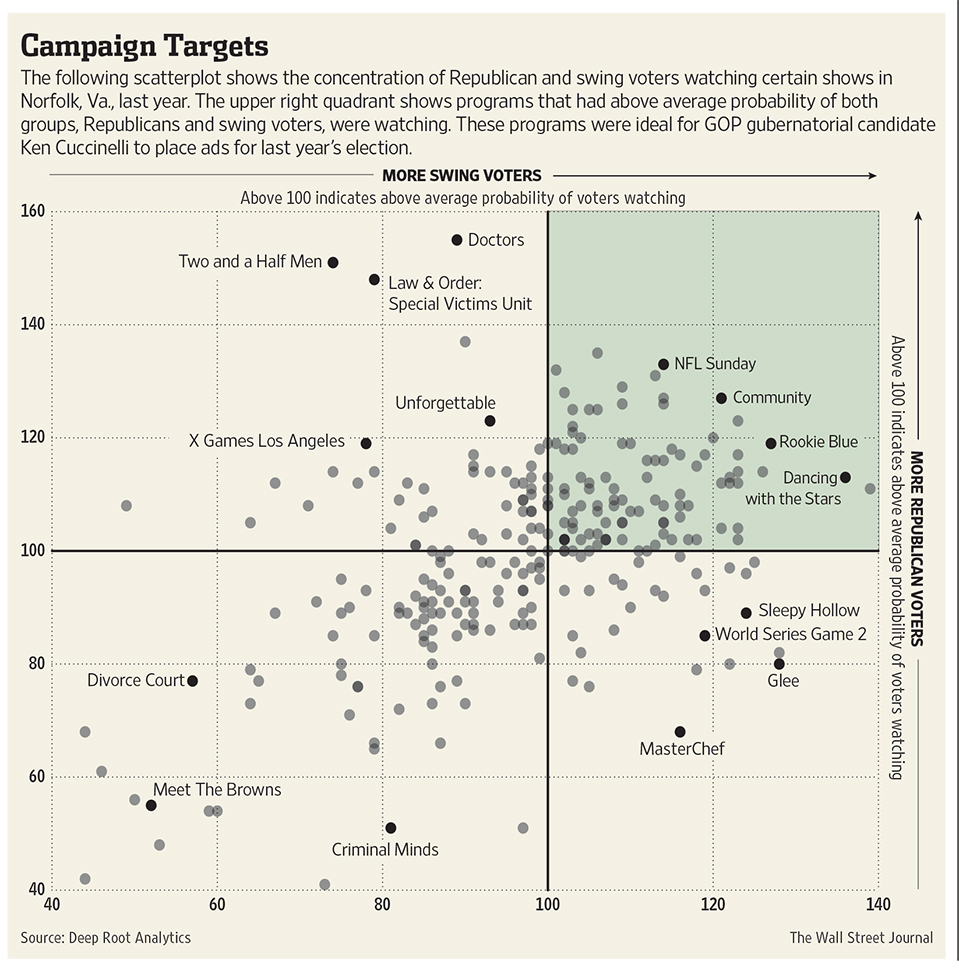
Targeting WSJ BN-DR632_CAMPAI_NS_20140714195702I hesitated to include what is nearly an entire article even from a venerated newspaper (or content provider?) such as the Wall Street Journal.   However since my partners and I continually discuss the nature of successful advertising, effective targeting is at the center of nearly all of our discussions – with and without clients in the room. 

Everyone knows that when online they are being targeted to some degree.   I feel the article below from Tuesday July 15, 2014, has a distinct point of view and goes far beyond what one might consider impartial reporting.

I don’t believe we have a single client that would ask us that we target less precisely, or charge them more money in order to not overly target prospective customers.

It is said that politics makes strange bedfellows. I will ask you to be the judge. Is the article below meant to scare or impress?  Or is it something else?

WASHINGTON—Politicians are moving away from blanket TV advertising, now that they know you better and where to find you.

When New Jersey Republican Gov. Chris Christie wanted to reach Hispanic voters during his re-election campaign last year, a team of outside data crunchers discovered that viewers of “Dama y Obrero,” a Spanish-language telenovella about a woman torn between two men, would likely be more receptive to his message than people who watch “Porque el Amor Manda,” a romantic comedy.

That discovery came from marrying private consumer research with detailed voter information and big batches of ratings data, all compiled by the political consulting firm Deep Root Analytics.

The new technology borrows heavily from traditional targeting methods that use information about where a person lives, how they have voted and what products they buy to predict future political behavior, and combines that research with richer-than-ever data about what shows people watch and when they watch them.

The result, writ large, is revolutionizing the billion-dollar business of political advertising, with implications for those who buy and sell it.

View Graphics

Such specifics about people and how to reach them can help campaigns determine where to find groups of pivotal voters, both large and small, and target them at the lowest possible price.

Targeted ads also can be considerably more specific than going after fans of a certain show. DirecTV Group Inc.DTV +0.43% and Dish Network Corp.DISH +0.28% , the country’s two biggest satellite-TV providers, offer direct access to chosen households. That means one person might see a campaign ad during a certain show but his next-door neighbor won’t, even if he is watching the same show.

“Instead of sending a letter to a post box, we’re sending a 30-second spot to a TV set,” said Warren Schlichting, senior vice president of Dish media sales.

To preempt privacy concerns, political operatives and industry executives are quick to say the identity of individual television viewers is protected through encryption and a process to remove names and other identifying information. A third party uses that anonymous data to match targeted voters with actual television viewers, but not by name.

Media outlets and political campaigns won’t provide specifics about the various costs of TV advertising, but it is undisputed that some shows and networks cost considerably more than others.

Fox News, a unit of 21st Century Fox, draws a huge share of GOP primary voters, but it is expensive given its audience size and it is saturated with ads for Republican candidates. In the run-up to the Texas Republican primary in March, 64% of all the spots aired by Republican candidates ran on Fox News, according to research done by Tim Kay at NCC Media, a cable industry market-research firm.

In the Kentucky Senate race, Deep Root discovered it could reach a similar share of the voters it sought by advertising on HGTV—a house and garden channel—for a fraction of the cost of Fox. Likewise, during last year’s Virginia governor’s race, both sides found the NFL Network a less expensive option to reach swing voters than other cable networks with a larger audience.

This same kind of analysis led the Christie campaign to run ads during ” Friday Night Wrestling” on the SyFy channel, in an effort to reach people who had a low propensity to vote but would likely cast ballots for Gov. Christie if they did.

Similarly, a super-PAC helping Senator Mitch McConnell (R., Ky.) picked “Bones,” a Fox show about a forensic anthropologist, in the Evansville, Ind., media market, right across the Ohio River from Kentucky, having determined that the show’s viewers were highly likely to vote in the Kentucky race and could still be swayed to support a Republican candidate.

(Until the middle of 2013, 21st Century Fox and Wall Street Journal parent News Corp were part of the same company.)

Republicans and Democrats who do this work say they can help a campaign stretch its ad budget by as much as 30%.

“These are calculations we just couldn’t do before,” said Alex Lundry, a Deep Root co-founder who led the data team for Republican Mitt Romney‘s presidential bid in 2012.

Deep Root and other data analysts buy consumer information from data-mining firms, including movie and TV-measurement firms Rentrak and Nielsen, as well as credit-score firm Experian.

And unlike traditional TV ratings, which generally focus on age brackets, these new targeting tools monitor the viewing habits of individuals. Cablevision Systems Corp.CVC +1.87% and Comcast CMCSA +0.29% Spotlight, a division of Comcast Corp., have started providing campaigns with more specific audience information to give them detailed, real-time information about what people are watching.

The analytics firms then use computers to sort through the information and steer campaign efforts, as they do for businesses’ marketing campaigns.

President Barack Obama‘s re-election team in 2012 pioneered these media cost-benefit analytics during his White House race.

His advisers expected Republicans to have more to spend on television, thanks to a collection of well-funded outside groups, and they wanted to maximize their media budget by focusing solely on the 15% of the electorate they believed would decide the election.

“One of the ways we approached the spending disadvantage is that we decided to buy [media] differently,” said Larry Grisolano, the campaign’s top media adviser and an architect of these new targeting techniques, which are now used at the company he founded, Analytics Media Group. “The data gave us the confidence to try something different.”

Since the 2012 election, a number of firms have emerged to offer candidates this service. GMMB, another leading Democratic ad firm, joined forces with other Obama alums at Civis Analytics last year.

A group of tech-savvy GOP operatives launched Optimus from a cramped Capitol Hill townhouse to offer similar tools to Republicans, including a political action committee tied to Florida Sen. Marco Rubio.

In the run-up to the 2012 presidential election, Deep Root built a tool similar to one used by the Obama campaign for Mr. Romney. His media buyer never used it, the Deep Root founders said. ( Stuart Stevens, a top Romney adviser, said the campaign used the products “that were helpful.”)

“Contrary to a lot of public perceptions, Republicans weren’t asleep at the switch,” said Sara Taylor Fagen, another Deep Root co-founder who served as political director under former President George W. Bush.

Politicians need to get with the digital age, experts say. Campaigns will devote about 57% of their overall advertising budget to broadcast TV, according to projections by Kantar Media’s Campaign Media Analysis Group, and another 15% on cable. Digital advertising, meanwhile, will account for just 7% of the average campaign budget, less than half of the amount most candidates will spend on direct mail.

“In politics, as in advertising,” Mr. Grisolano said, “you have to follow people by the choices they make.”




Posted in Advertising, Best business practices, Targeting | Tagged , , , , , , | 2 Comments

CRUMBS turns to dust and it’s not a surprise

oh crumbsThis past Monday Crumbs bakeries abruptly shut their doors.    I cannot resist a little ‘I told you so’ as I wrote about the oddity of the Crumbs IPO when it was announced back in 2011.   Crumbs, like Krispy Kreme and Cold Stone Creamery, will most likely re-emerge at some point in the near future as a scaled-down version with far fewer outlets.

It was in my opinion a huge long shot that a single platform concept – high end gourmet cupcakes could be rolled out as a lasting business model.   The cupcakes are great and all but not enough people went to them regularly.   It’s like that with treats – when they become commonplace they are no longer a treat.   I feel the same about smartphone games like Farmvillle (wrote about that too), and more recently Candy Crush from King Entertainment.

So how can you tell the difference between a fad as opposed to a concept or product that has lasting value?   It’s not easy but there are more visible signs of overall weakness then there are of future success.  I’ve a good friend who is a very successful restaurateur.  He and his partner came up with a restaurant concept back in the mid-1990’s that still exists and is in fact thriving today.   They’ve since added a second and different restaurant concept and it too is successful and growing.

Are my friend’s restaurant concepts fads?  Not in any way.  Why?  Because their focus has always been on delivering a great and consistent customer experience in every single location (combined the number is approaching twenty).   How do they do this?  In their case it’s by actually being IN the locations on a regular basis.  As the company grows that makes it more difficult – and exhausting, but they are adding quality people to the team who share the desire to maintain the value proposition.

One trick ponies like Crumbs, Krispy Kreme and Cold Stone Creamery have a tall order when it comes to lasting success.  I looked into owning a Cold Stone Creamery franchise several years ago but had great difficulty in accepting that being in the U.S. northeast, sales would not die horribly from December through April.  Glad I passed on that one.

As I noted last week I think wearable technology is a fad.   I just don’t see people continually wearing colorful wireless enabled wristbands/watches displaying information moment to moment.   They will try it for a while and like so many fads tire of it and stop. Doesn’t that constitute a fad?

If you have a moment take a look around and please offer your ideas on other things you see as fads and let me know.  I’d love to hear.

Posted in Brand Advertising, Franchises, Marketing stuff | Tagged , , , , , , , , | 1 Comment