Continuity direct marketing in E-books – the song remains the same

BOMCFor a good portion of my professional career I was involved with continuity direct marketing.   We did work for record clubs like Bertelsmann (and Columbia House) and book clubs like Book of the Month Club.   I learned a great deal about continuity marketing from books written by the legendary and still working Lester WundermanBeing Direct is a favorite.   In fact I had the pleasure of having lunch with Lester and his daughter –in-law Lynn a couple of years ago and we talked about the changes in continuity as a whole as it related to online fulfillment.

So I should not have been surprised to see an ad on my commuter train for Entitle Books offering 2 e-books for $9.99.   It appears to be a pretty good deal and in many ways it is, even after you read the fine print.  The fine print details the structure of the offer – free trial for 7 days and if you are not completely satisfied you can cancel and keep the e-books and you are automatically enrolled in one of three monthly programs – 2 e-books/month for 9.99, 3 e-books for $14.99/month or 4 e-books for $19.95/book.    I thought it was a bit strange that the offer did not improve when you bought more books – basically $5.00/book, half the price (give or take) of other e-books.

Reading more than 2 books/month is a continually unfulfilled dream of mine.   Yet it plays into my desire to read more books.   At $9.99/month it’s certainly affordable even if the library of choices has limitations.   Which is reminiscent of the way LP’s, and CD’s via continuity programs behaved when I was both a customer and a supplier of services to those clubs.

But the e-book continuity model is WAY better than fulfilling actual books or CDs.  When I visited Doubleday Book Clubs fulfillment center some years ago I was amazed at the 1950’s Rube Goldberg-like contraption that picked and packed customer orders to be shipped.  Yet the shipping and handling charges for each book was a primary profit center for record clubs and book clubs.   That aspect is lost in e-books.

I did an analysis when I was a customer of the CD clubs and found that if I took the 9 CD’s for a penny and only purchased the CD’s when 2 for 1 specials (or other specials) were offered, even including mailing (yes I know SO old school) the postcard back to decline some shipments, the cost of the CD’s was $9.30 per CD which at that time that was considerably less than retail pricing which ranged from $12-$18 per CD on average.  It was a great way to build my CD library.    Eventually I exhausted all the album choices that interested me and cancelled my membership.   I see that same future for e-book continuity clubs.

The key to continuity clubs is the aspect of negative option billing.   Better known in the industry as ‘fill-to-kill’, i.e. the product is shipped every month unless the customer indicates they do not wish to receive the shipment.   In the case of e-book fulfillment, the 7-day return policy is a good one and protects people if they forget to stop the shipment.   That did not work as easily when you had to physically send back a book or a CD – not to mention the giant hassle it created.   I still have a few books and CD’s that I NEVER listened to because I forgot to respond and never got around to sending it back.  Continuity clubs depend on this sort of behavior to a certain degree.

So are e-book continuity clubs worth your while?    I would offer a qualified yes, IF, and only if you check the library of choices and find that there are a number of titles that you would truly like to read and find time to read.  It can help you build your library even if you do not plan to read the books right now.  But at a certain point you will reach a saturation point and no longer have interest in most if not all of the titles.  At that point bail out and cancel.   The books you pay for and never read are actually the most expensive books you’ll ever not read.

So what do you think?  Would you enroll in an e-book continuity club?

Posted in Best business practices, Community, Consumer Attitudes, Consumer Behavior, Continuity marketing | Tagged , , , , , , | 2 Comments

A real revenue model for Foursquare

Digital footprintFour years ago I signed up (it did not feel like joining) for Foursquare.  There’s still value in checking into various places – $5 off, a free appetizer, or some other special (free drink etc.) that might be offered upon checking in – I like that and have written about that as well as what Foursquare might be considering to increase revenue but nothing has changed.  What is Dennis Crowley and his team waiting for?

There is data provided by Foursquare.  In fact in checking some of the available stats, I’ve ‘checked in’ almost 6,000 times since I’ve joined.  I have 60 ‘badges’ but I could not tell you one of them as they have zero value to me – and to everyone else.

I’m also the ‘mayor’ of something like 3 places not all of which are still open. But I’ve never been mayor of a place where I received something for that distinction.  I can see that I check in some places much more than others and I can also see the types of places that I check in.

Those are mildly interesting stats at best, yet I keep checking in. Recently I began to think about the future value of my check-in’s today and over the past few years.  A way for Dennis Crowley and the Foursquare team to monetize my check-in’s would be to sell me back my own data from past years.  Each day, each individual check in.  I’d be willing to pay for it and you might too.

Why?  Because reviewing your own personal digital footprint is interesting.  Sort of a digital archeology if you think about it.  And as time passes let’s say twenty years from now in 2030 those check-in’s from 2010 would offer you a glimpse at the places you used to frequent. Helping bring back the memory of that great little restaurant on the corner that went out of business years ago is cool.  Remembering the friendly little man at the dry cleaner that you had not thought about in years might bring you a smile.

Being able to reach back and touch a forgotten memory is a cool thing.    Having a digital footprint of your day to day life in a particular year is diary-like I realize but different since the catalog would be more complete if despite not being as prosaic.

Of course Foursquare has to deliver by lasting for the twenty or more years so that you can have that access.   To date Foursquare is still fine tuning its revenue model.  Selling users back their own data at a low price creates value for the user and could be significant revenue for Foursquare.

I invite Dennis Crowley to give me a call to discuss my idea (we are not Foursquare ‘friends’ however) although it would surprise me to have the Foursquare folks tell me they have already thought of it and thanks anyway.

If they have already come up with the idea on their own why hasn’t that been announced by Foursquare?

Posted in Entertainment, Living in the World Today, Marketing stuff, Networking, Social Media, Technology | Tagged , , , , , | 2 Comments

QR codes live on in infamy

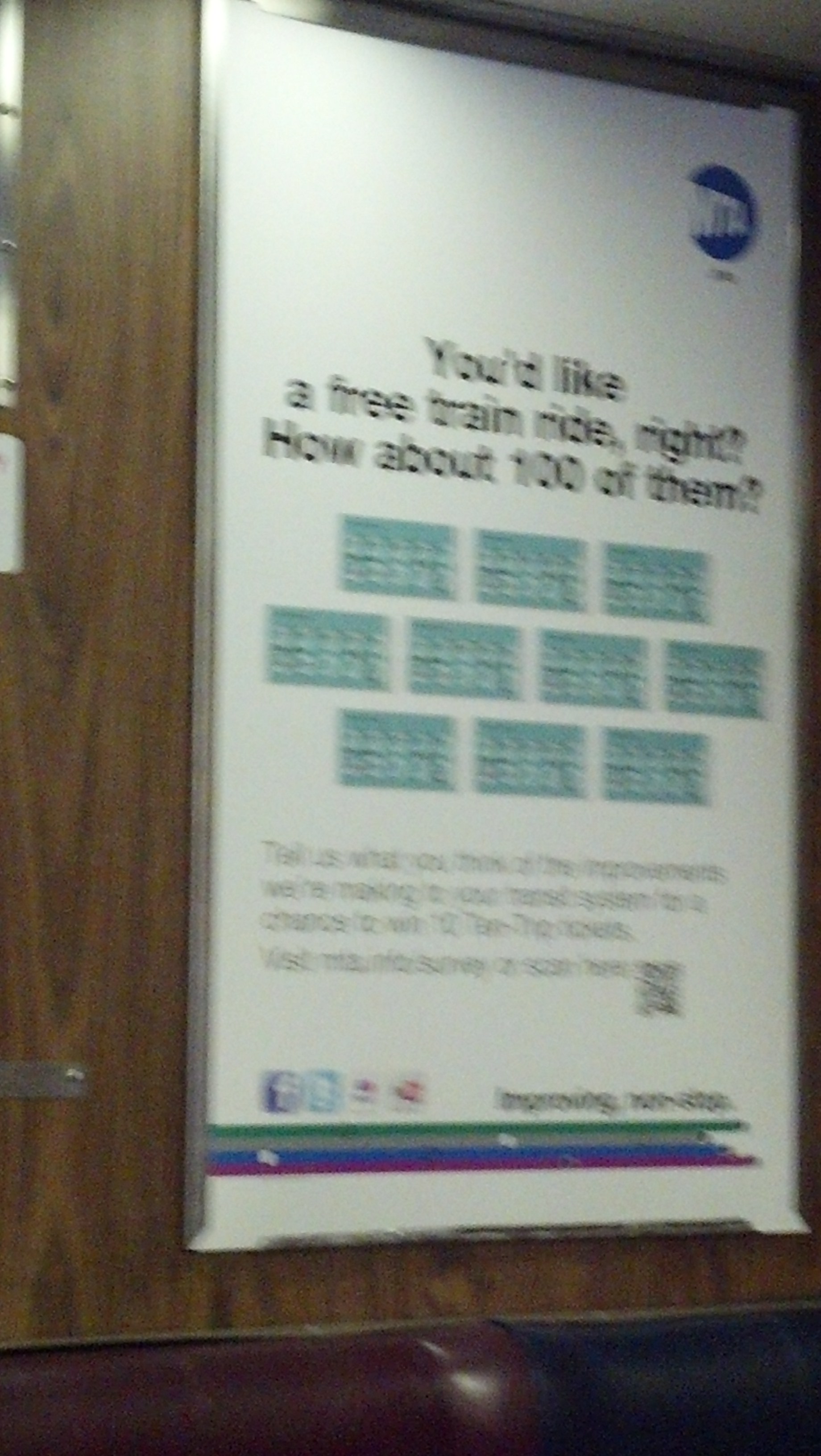
Metro North QR codeBack in 2011 I wrote a post entitled ‘QR codes will die soon – Here comes ‘Near Field Communications’ (NFC)”.  Well more than three years later, not unlike the great Mark Twain, rumors of the demise of QR codes were greatly exaggerated – by yours truly.

While I still feel that QR codes are destined for extinction, there are examples of successful employments using QR codes http://marketingland.com/qr-codes-work-when-done-well-56243 but far too often they are just used as an afterthought and do not suit the media vehicle in which they appear.

This morning I saw an ad on my commuter train to New York City.  It offered a chance to win 100 free train tickets, a prize that caught my eye as at $14.75 per ride with no discount – well you can do the math.  I took the photo shown in this post from my seat which was quite close to the area in which the ad appeared.  I attempted to access the QR code from my seat without any success.

Forget for a moment that the train goes through tunnels on each trip in or out of Manhattan and when one is in the tunnel there is no Internet service so that for some portion of every ride a QR code is – useless.   But isn’t it even worse to create what is a somewhat compelling offer and then merely frustrate the potential user by having the size of the QR code so small that unless you are standing directly in front of it you are not able to access the QR code?  Keep in mind that there are seats directly in front of the where the ad is so it would not be easy to get close enough in the first place.

While it was a good idea to include the actual promotion URL, that is not something that most people will bother to enter in order to be enrolled in the contest promotion.  In this instance my problem is as much with the way the QR code was depicted in the ad as the technology itself.

If anyone can offer any example with verified statistics that show a positive ROI in using a QR code please do share it with the rest of us.   I’m betting that there will not be many if any.

Posted in Augmented Reality, Marketing stuff, Technology, Uncategorized | Tagged , , , , , , | Leave a comment

People with big dreams of success don’t think about vacations

VacationWhen you are excited about what you are building, doing, and learning, vacation is the furthest thing from your mind.  Vacation in and of itself is a rather new concept within the framework of man’s development.  I tried to find information on when the idea of a vacation became commonplace.  I suspected that the whole idea of vacation is a rather recent concept.

Author Cindy Aron wrote a book published in 2009 called ‘Working at Play – the history of vacations in the United States’.  Here’s a description of the book that I found to be interesting:

In Working at Play, Cindy Aron offers the first full length history of how Americans have vacationed–from eighteenth-century planters who summered in Newport to twentieth-century urban workers who headed for camps in the hills. In the early nineteenth century, vacations were taken for health more than for fun, as the wealthy traveled to watering places, seeking cures for everything from consumption to rheumatism. But starting in the 1850s, the growth of a white- collar middle class and the expansion of railroads made vacationing a mainstream activity. Aron charts this growth with grace and insight, tracing the rise of new vacation spots as the nation and the middle class blossomed. She shows how late nineteenth-century resorts became centers of competitive sports–bowling, tennis, golf, hiking, swimming, and boating absorbed the hours. But as vacationing grew, she writes, fears of the dangers of idleness grew with it. Religious camp grounds, where gambling, drinking, and bathing on Sundays were prohibited, became established resorts. At the same time ‘self improvement’ vacations began to flourish, allowing a middle class still uncomfortable with the notion of leisure to feel productive while at play. With vivid detail and much insight, Working at Play offers a lively history of the vacation, throwing new light on the place of work and rest in American culture.

I have only read excerpts from the book which was generally well regarded on Amazon at least.  It’s a subject that I have thought about on several occasions when I realized that unlike the Flintstones cartoons set in the Stone Age, for almost the entirety of human history there simply was not time for vacation.

The word vacation stems from ‘vacate’ which means ‘to leave’ or a period of time that a person spends away from home, school, or business usually in order to relax or travel.  Americans in particular think they are quite adept at vacationing but we know deep down that the Europeans are much better at it than we are since they seem to take the entire month of August off – a concept unthinkable in the U.S.

People take vacations from routines, to spend time with families, to visit new places, or just to relax.  These are all luxuries of this modern age heretofore unavailable to the average person.   Yet when I think about people that are highly engaged in things they are doing professionally, building a business, developing a concept, working toward a goal that can at times seem unreachable; I know these people are not thinking about vacation since the only thing vacation can accomplish is delaying the achievement of their goal.

To avoid living from vacation to vacation maybe it’s not a vacation we need but a new challenge?


Posted in Living in the World Today | Tagged , , , , , , | Leave a comment

Apple’s arrogance drove me to stay with Android

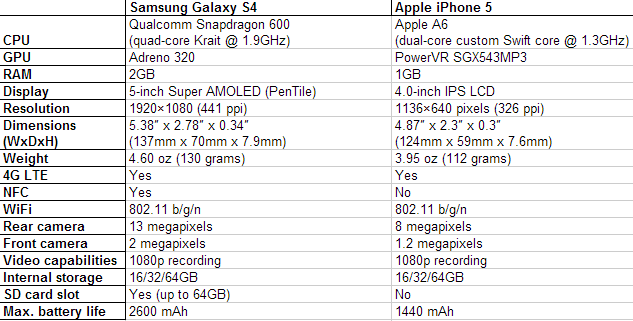
samsung galaxy-s4-iphone-5-specs-tableIf you are familiar with a recent post where I asked people to help me decide which new phone to get you may be interested to know that I finally decided on the Samsung Galaxy 4S.  There are a number of reasons that swayed my decision as it was a difficult choice between the iPhone 5 and the Galaxy 4S.

In the end the combination of better battery life on the Galaxy 4S, the Swype typing feature (I LOVE this) were two primary reasons to stay with an Android device, Apple’s arrogance was a third reason.  Keep in mind that at work I use a Mac every day and like the platform very much although Mac Mail is just ok.  So I had every reason to try to stay within the Apple world for what would seemingly be the most seamless integration between various devices like phones, tablets and computers.  In fact it seemed a foregone conclusion that were I to get an iPhone (we have an iPad already), my next laptop or notebook would have to be a MacBook Air or something along those lines (another really good machine).

So why do I feel Apple is arrogant (yes I realize I am not alone here)?   That Apple does not really want to play in the sandbox with the other platforms is a major frustration.   The Apple iCal function does not integrate well with Google but it does do better with MS Outlook.  I use Google Calendar and I like it but apparently iCal does not.   Another example is that just this week I logged into my Android app for Hopstop which offers mass transit advice and best directions for subways and buses etc. in New York City as well as a host of others.  I had not logged on in quite a while – in fact long enough that I had forgotten that Apple had purchased Hop Stop last fall.    What I had not realized is that Apple in its infinite wisdom had decided to pull Android support for Hop Stop making the app no longer functional.

Exactly how does taking the Hop Stop app out of the Android platform make things better for people?  Or Apple for that matter?  Why does Apple feel the need to take things away?   Remember the fiasco with Google Maps?  How did that work out in the end?  *Spoiler Alert if you’ve been sleeping for more than a year – Apple reversed itself and put Google Maps functionality back into the Apple Store.

As I will say repeatedly, in general Apple is a great platform and has been an amazing innovator although not so much lately apologies to Mr. Cook.  That Apple has a legion of fanatics that can only see – a Red Apple is well documented.   And at times those same ‘Apple is everything’ attitudes come off as being – well, arrogant.   Google pitched the slogan ‘Don’t be evil’.   Apple’s might be – ‘Up your nose with a rubber hose Android’.

The Android OS users know what I am talking about.  Would any of the Apple acolytes admit its platform arrogance?

Posted in Mobile Communication, Technology, Uncategorized | Tagged , , , , , , | 4 Comments

Binge watching makes me wonder how people find time to watch all these great shows

Binge watching Breaking BadThe blurb from www.gawker.com asks the following question –  Did you watch all of the second season of Netflix’s House of Cards this weekend? Good. So did I. Let’s talk. Spoilers ahead. 

I’ve not watched House of Cards yet.  Don’t get me wrong, I’d like to see it.  I’d also like to watch Orange is the New Black, and I am a bit embarrassed to admit that I’ve not seen more even one full episode of Breaking Bad.  I do watch and am completely up to date with Mad Men and Homeland, and even though it is a network show I enjoy The Good Wife.   But I’ve never watched Boardwalk Empire, Girls, Veep, Walking Dead, Game of Thrones or Dexter.  For whatever reason I feel a bit guilty about that even though I know I should not.

I know the above shows are all shows that I would enjoy watching but the daunting task of catching up via binge watching is something that in my case will likely never happen.   Ok, it will never happen.   For starters I have this job.  I commute nearly three hours total per day and so maybe you would think that I have ample opportunity to watch those programs on my commute.  Not really since I pass the time on the trip into work reading news both relevant and irrelevant to our business.  Most return trips are passed replying to emails (i.e. working) studying Mandarin (don’t ask), and trying to keep up with the all the communications I did not have time to respond to during the work day.  I also have a number of books that I am reading simultaneously and my goal is to keep a list of the books that I have finished in 2014.  So far there are four.

When I return home there’s time for dinner, doing whatever I need to do work wise and then, maybe, just maybe there might be an hour to watch a program of some sort.  At that rate I would finish Boardwalk Empire in the year 2020.  Exactly where would I find time to catch up on a series that has been out for years?

I don’t deny that in many ways we live in a golden age of new and interesting television programming content.  And there’s more good content being developed with each passing day.  Yet I have to admit that I am amazed at how so many people are able to keep up with all of these shows such that the morning after watching the original airing people are discussing the program and often rhapsodically.   These are people with families and jobs.

Where do they find the time?

Posted in Advertising, Consumer Behavior, Customer Experiences, Internet television | Tagged , , , , , , , , | Leave a comment

Are you ready to blame 2014’s winter weather for making business tougher?

Winter 2014 U.S. economyMy informal poll of some of our clients and associates paints a very different business picture than the rosy one on Wall Street.  This past Friday the Dow closed at its highest level for 2014 – so far.   Yet what I am hearing and feeling is a large veil of caution when it comes to business investment.   It’s as if there are many people waiting for the other shoe to drop.  While I try to avoid attributing business challenges to external factors, the weather in the U.S. this winter has been miserable.  By one reporter’s account $50 billion has been lost due to the harsh winter weather.  

That was $50 billion, not $50 million by the way.  I’m still very impressed by a number like $50 billion and in all honesty I find it difficult to believe that one season of weather could negatively impact the U.S. economy by that large of an amount.

From the CNBC article:

Severe winter weather this season may have cost the economy as much $50 billion and 76,000 jobs.

A CNBC Fed Survey of 19 Wall Street economists, strategists and fund managers puts the total weather impact at about a third of a percentage point on the $16 trillion US economy, or roughly $50 billion.

The big hit to the economy comes this quarter, where survey respondents estimated that bone-chilling cold and driving snow shaved about four-tenths of a point off total growth, including lost work hours and lost sales.

That’s on top of a loss in the December quarter of 0.16 percent. But there is also an expected snap back next quarter of about 0.23 percent in part because of pent up demand — houses that still need to be built and cars that Americans had hoped to buy. Add it all up and the net is about 0.3 percent.

Is that a good enough explanation for you to conclude that $50 billion has been lost?  And then do you also buy that the economy will ‘snap back’ in Q2 because of ‘pent-up’ demand?   I love that expression by the way.  When it comes to many businesses there is no such thing as pent-up demand.  It’s true that things like buying a car, or having work done on a home or apartment are postponed and not canceled when travel is impossible.  Yet retail visits to malls, grocery stores and retail shops, are a mix of discretionary spending as well as necessities.   Even more impacted by bad weather is the restaurant business for example, where a lost opportunity is rarely reclaimed.

The bad winter weather has impacted productivity in offices all around the United States.   Today, working remotely allows team members to be productive even when people are not in the office.   But in no way is it the same as having the team working together and sharing ideas on a people-to-people basis.  Productivity is lost plain and simple and it too will not be reclaimed.

With travel and work schedules running amok, many people who remain out of work have found it even more difficult to have those phone calls and interviews.   This year, old man winter is clearly not interested in aiding an economic recovery.   Since there’s nothing to do but complain I will instead hope that as the winter season heads to a close the words of Mr. Hugh Johnson will ring true:

“It seems reasonable to conclude that the weather is impacting growth and equally reasonable to anticipate that it will be offset in Q2,” said financial advisor Hugh Johnson.

I will be sure to look up Mr. Johnson in July.

How has the bad winter weather impacted your business?


Posted in Consumer Attitudes, Consumer Behavior, U.S. Economy | Tagged , , | 2 Comments

People still watch NBC Universal’s coverage of the Winter Olympics even when they know the results

Sochi 2014Like many people I watch sports to relax and distract myself from the day to day stresses of my life.   As I have written in the past I have always enjoyed watching the Olympics whether it is the summer or like right now the winter games.    Since this year’s events are in Sochi, Russia a 9 hour time difference from Eastern Standard Time, unless people forsake their normal work schedule or are willing to get up at 2AM many of the events televised by NBC and its various affiliated stations are long over when they are broadcast in the main network in prime time.   What has surprised me is that even though I may have heard the results of a competition I still am willing to watch it anyway.  Apparently so are many other people.

When it comes to watching sports like professional baseball, basketball, football, or even hockey, there’s virtually zero chance I would ever watch a game about which I already knew the result.   Not much of problem since the games take place in my time zone or within three time zones for the most part.

With the Olympic Coverage whenever the games take place in Europe or Asia, in the past I would do all I could to not listen to the radio or hear anything about the events that had taken place earlier in the day.   It’s much more difficult to avoid learning about results today since things like computers, tablets, and smartphones have people connected at all times and noteworthy news items (like Americans winning medals in Sochi) are released on a constant basis.

Yet when it comes to the Olympics that’s somehow ok.  Learning about the individual athletes from whatever country they hail from is always interesting to me.  It’s quite a bit more interesting for example than just about any regular season game between any two teams in any of the four North American professional leagues.  Interest is added to the mix in that the Olympics occur only once every four years.  The human element of trying to get back to the Olympics is just one thing that makes the Olympic Games so special.  Take for example, an athlete like the U.S.’s Hannah Kearney who was a heavy favorite to win gold in her moguls event in Sochi.   An early mishap cost Ms. Kearney the gold and the silver medals which went to the Canadian Lapointe sisters.

Ms. Kearney the top-ranked and most consistent skier in the world over the past four years, was kept from becoming the first back-to-back winner of an Olympic freestyle event.  Ms. Kearney, the 27-year-old from Hanover, N.H., spent all night trying, unsuccessfully, to find her footing on a tricky bump that came directly after the first jump. She was inconsolable after finishing third.  “No one in life wants their best part of their career to be behind them,” she said. “And unfortunately, that’s what it feels like right now.”

Ms. Kearney’s emotions were raw, honest and fascinating.   At the same time I was happy for the elated Canadian sisters who skied well but were reluctant to acknowledge that their success was dependent on a less than stellar performance from Hannah Kearney in order for them to win gold and silver medals.  I knew the result of the race prior to watching the coverage but it was great television to watch.

With regard to NBC’s coverage of the Olympics to this point AP writer Anick Jesdanun had an interesting and accurate take on the coverage  The conclusion I come up with is that the ways the Olympic Games are covered and watched today are likely to be very different once the networks and cable companies eventually lose their stranglehold on distributing the content.  True, NBC Universal paid $775 million for the rights to broadcast the games, so there will be advertising now and forever.  But the way I’d like to watch the games is much the way Mr. Jesdanun suggest – picking whichever event I want to watch, whenever I care to watch and be able to go forward or back in the coverage at MY discretion has to be part of the future coverage menu.

I will watch the men’s downhill this Sunday evening even though I know American Bode Miller did not win any medal much less a gold.    It’s the event and the stories that make it special and while I root for my countrymen to win, it’s not the only reason to watch.

Are you watching?  Live or otherwise?

Posted in Advertising, Sports Marketing, Television advertising | Tagged , , , , | Leave a comment

Interesting idea from Steve Wozniak on Apple and Android together?

I posted this week that I was looking for help in determining which smartphone to get – http://wp.me/pn6jX-Sq.  Apparently Apple co-founder Steve Wozniak was one or two steps ahead of me.  No surprise.  

From an article in Wired:

http://www.wired.com/gadgetlab/2014/02/woz-interview/?cid=18163944


Posted in Uncategorized | Leave a comment

Here’s your chance to help me decide on which new smartphone to get

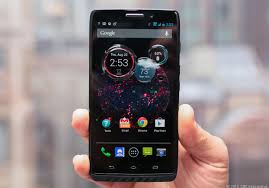
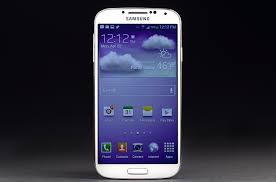
Motorola Droid MaxxSamsung S4iphone 5I am a big fan of crowdsourcing.  Not for everything as sometimes you need to just go your own way and forsake popular opinion.  At least that’s what I do sometimes.    However when it comes to deciding on a new smartphone I believe the collective wisdom of the crowd is the best option for having a solid amount of data on which to make a decision.   So here I am asking you for your comment on the three options that I have selected in order to narrow the field.

I am also interested in having this be an open conversation and what I ask is that if you do care to comment and or simply offer an opinion to please do that on my blog itself such that everyone can read what everyone else is offering.   Of course it will be a sad thing if I only get one or two comments; which is a risk I am wiling to take.   This is merely a request as often people make comments on my blog on the social network in which they received the feed and I am always grateful for any one who actually reads and comments so it’s my hope to really have this be an interesting and lively conversation.

Background:  I have been using a Google Motorola (yes I am aware that Google sold Motorola to Lenovo last week) Droid Razr for the past nearly 2 years.  What drew me to that model was it’s compact nature as it fits in my pocket rather easily – more so than an iPhone by a bit, and I wanted to try the Android OS.   In general the phone itself is pretty good although I did plug in an operating system called Aviate about six months ago, (which probably has impacted performance) but I do like the interface more than the factory set Droid OS.    The phone today just does not perform well and I am not sure if it is the Aviate OS, the fact that the phone is now old, or both.  Or neither.

My choices:

Motorola Droid Maxx – same size as my current phone.  But my Motorola experience has been just ok.

Samsung S4 – the S4 is the right size as the S5 is just too big.

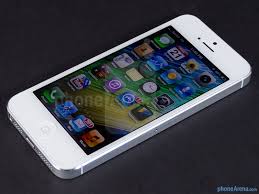
iPhone 5 – everyone in my office (except for one) uses an iPhone.  We all work on Macs.  There are many good reasons that an iPhone makes sense but the fact that so many of us do not use the Android platform makes me concerned that we will not have much first-hand experience in the Android OS which is still extremely popular.  How will we know what people are experiencing if we are all fish in the same pond?

So there you have it – three distinct choices, price wise the iPhone is the most expensive which should be taken into consideration.  The Motorola phone and Samsung are similarly priced.

Which should I choose?   And what are the reasons?  I will post the results here on my blog as well.  And if you have a different suggestion I will be interested to read them.  Xiaomi? Huawei?  Lumina?  I have considered those but for various reasons have eliminated them.

I will decide by February 15 and thank you for indulging my request!

Posted in Mobile Communication, Technology | Tagged , , , , , , , , , , , , | 16 Comments