I don’t want or need a ‘relationship’ with EVERY brand

rate-your-experienceWhen traveling to and from New York City I prefer mass transportation whenever it’s practical – which is most of the time. Upon occasion I do drive the hour or so into Manhattan and park. With the advent of parking apps and the real-time ability to compare pricing between garages, (as well as make a reservation), it’s easier than ever before to know where you are going to park and have it all worked out in advance.

I recently used one of the apps to make a reservation. The next day I received an email from the app asking me to rate my experience at XYZ Parking. My experience? What? I came to the garage, showed them the bar code and parked my car. When I came back they brought me my car and we all got in the car and then left the garage. Is that really an experience?

Was the intent to learn whether the attendant was prompt and courteous? OK, he was or they were, at least I think so. Our interaction could not have been for more than ten or fifteen seconds either coming or going.   It probably went something like ‘When will you be back to get the car” “3PM.”   I don’t know if we even spoke on the return to the garage since I showed my prepaid ticket, the attendant brought the car and, well, you already know the rest.

I don’t think the purpose of asking me about my experience was to learn anything at all. Sure I could respond and give it a rating – I gave it four out of five stars just to see what would happen. I don’t know what a five star rating to a parking garage would look like, but I don’t think this one was it. After ‘rating’ my ‘experience’ the thank you page offered… a thank you and noted that my feedback helps them give better service. Not a big payoff if you ask me.

There’s nothing abjectly wrong with the parking app’s desire to brand as well as create a conduit for customer feedback. It’s calling parking in a garage ‘an experience’ that is the problem. Then there’s the thought I had that if every interaction with a digital platform results in an email asking me about my experience, I might stop responding to ANY email asking me about my experience. Except when there was a problem in the delivery of service. That actually has happened to me recently as I reached out to an upscale steakhouse brand noting a poor experience, and have had ongoing interactions with that brand on how they might make amends. I will write about this in a separate post.

Do you buy on Amazon.com? I do and somewhat frequently. Every time I order anything on Amazon, the vendor/retailer asks me about my experience. For example I bought earbuds on Amazon Prime, the vendor shipped them to me and it arrived within the promised delivery period, and when I opened the package the earbuds were inside. Is that a good experience? The next day I was, of course, asked to rate my experience.

E-commerce has been around for more than twenty years and in the past five years it has evolved much more rapidly. Intuitively online behavior is NOT the same as off-line behavior. It’s fine for a server, cashier, store clerk, or parking attendant to ask you if everything was ok. But online retailers and service providers have to do a better job of showing they are interested in their customers beyond just sending a form email asking people to rate their experience. Or don’t send anything at all.   How about that?
Posted in Customer experience ratings, Customer Experiences | Tagged , , , , | Leave a comment

23 books I finished in 2016

the-undoing-projectThere’s a part of me that believes ‘You are what you read”.   Some years ago I realized that I was not reading much aside from magazines, newspapers, and marketing and advertising industry articles.   I set a goal to read 2 books per month and have managed to come close the past few years.

I read about half of the books digitally on my tablet through Amazon Kindle, and the other half is a combination of library, borrowed from friends, gifts, and purchased hardcovers and paperback books.   One thing I have noticed about Kindle books is because it is not a physical book, I am not as aware of the length of the book. It’s quite a bit easier to read a 500-page book on a device than it is to carry it around so I am paying closer attention.

Even if you cannot find the time to read 20 or more books, reading half or less that amount is still in your best interest. There’s something about reading and considering longer narratives that to me at least, is more important today than it has been. Attention spans are narrowing. Taking time to think about a complicated subject is sometimes tiring but almost always worthwhile.

Here are the 23 from 2016 – each review in ten words or less.

Superforecasting – Daniel Gardner and Philip E. Tetlock

Predictions are easy. Forecasters are often inaccurate. Made me think. 

I Was Right on Time – Buck O’Neil

A veteran star of baseball’s Negro Leagues tells his story.

Between the World and Me – Ta Nehisi Coates

Written with a raw, disturbing, yet brilliant narrative style.

Mind’s Eye – Douglas E. Richards

Internet surreptitiously implanted inside the hero’s brain. Compelling story.

A Farewell to Arms – Ernest Hemingway

First read 1975. More a period piece than I recall.

Final Jeopardy: Man vs. Machine and the Quest to Know Everything – Stephen Baker

The building of the IBM Watson computer. All about AI.

Making Habits, Breaking Habits, Why We Don’t, and How to Make Any Change Stick – Jeremy Dean

Am partial to the subject matter. Didn’t change my life.

Notes from a Beijing Coffeeshop – Jonathan Geldart

Interviews with various Chinese people living and working in China.

Influence: The Psychology of Persuasion – Robert B. Cialdini

Psychology of why people say yes and how to apply.

Tooth and Claw Stories – T.C. Boyle

More great stuff from one of my favorite authors.

Water – The Epic Struggle for Wealth, Power, and Civilization – Steven Solomon

Took me two years to finish. Worth sticking with.

Disrupted – Dan Lyons

Fifty-something journalists ends up at HubSpot, doesn’t love it.

The Second Machine Age – Erik Brynjolfsson & Andrew McAfee

Optimistic, accessible – it offers an interesting view on labor demand.

For Whom the Bell Tolls – Ernest Hemingway

Enjoyed this. I knew little about the Spanish Civil War.

The Everything Store: Jeff Bezos and the Age of Amazon – Brad Stone

Was a Bezos business fan prior to reading. Still am.

Invisible Influence – Jonah Berger

Since I am interested in learning what influences my behavior. 

Stolen Season – Peter Lamb

Late 1980’s writer travels to minor league parks. Somehow nostalgic.

Flash Boys – Michael Lewis

Another of my favorites always makes complicated subjects accessible.

Pressure Makes Diamonds: Becoming the woman I pretended to be – Valerie Graves

How an advertising legend rose above life’s challenges. Good read.

Ask: The counterintuitive online formula to discover exactly what your customers want to buy…create a mass of raving fans…and take any business to the next level – Ryan Levesque

Bit overly-encouraging but its heart in the right place.

The Power of Habit – Charles Duhigg

Surprisingly and delightfully provocative with real tools for changing habits.

The Undoing Project – Michael Lewis

Khaneman and Tversky – tricky subjects, but not for Michael Lewis.

This year I am planning on focusing on another 20th century American author. There’s a lot to choose from. Happy reading!

Posted in Marketing stuff | Tagged , , , , , , , , | 2 Comments

Technology gifts that have changed my life

amazon-echooculus-rift-vs-htc-vive-vs-playstation-vr-1
A high school friend who I’ve not seen in several years posted on social media about a new Fit Bit she received as a holiday gift. My wife and I like to give Fit Bits as gifts because I believe they have the potential to be life altering.

I know this since I received a Fit Bit last Christmas and I am more aware of my moving around (or lack of moving around sometimes) than ever before. Since I am a naturally competitive person I am interested in reaching new milestones and making sure that I don’t backslide on my activity. I have not the patience nor interest to list my food/calorie intake. I know when I am overdoing things eating and drinking wise. This year it started before Thanksgiving.

But the Fit Bit has also led me to using a standing desk in my office. Now that I have been using it for nearly a year I cannot believe how conditioned I was to sitting down all the time. These days I get so tired of sitting that I have to stand up. People see me standing up in the office and tell me that they are thinking about getting one for themselves. So technology is potentially changing the lives of those with whom I am interacting. Not bad, right?

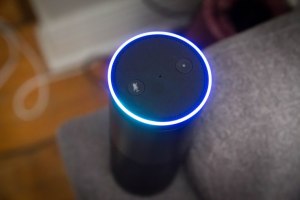
This Christmas I received two tech gifts that already I can see will have a lasting effect. The Amazon Dot (which my secret Santa – thanks Lindsey) got for me, is something I put on my wish list and I am really glad I did. The utility is good right from the start and I am only scratching the surface. I don’t know if I am ready to order things on Amazon via Alexa just yet (although my Prime account is set up for that to happen) but I am sure to at least try it out very soon.

The Amazon Dot uses are many and go beyond ‘Alexa – what was the score of the Knick game last night?”. But even that alone is useful, and easy. Definitions of words and questions via Wikipedia about ANYTHING are also fast, easy and accurate. Instructing Alexa to play “Black Friday, Steely Dan“ on Spotify delivers quickly and again, accurately. Do not underestimate the value of accuracy as part of overall utility.

I don’t mind typing but am already surprised at how easily I would curtail some of my typing. I like Google Now very much but saying ‘Alexa’ just feels better than having to say ‘Ok Google’. I felt the Amazon Echo was too visible and can Bluetooth the audio to external speakers so not having the larger Echo speaker is not a problem. One review of the Amazon Dot can be found here.

Keep in mind that Alexa is always listening or as Amazon puts it ‘ready to listen’. The Amazon Echo is already potentially material evidence in a murder case , although it is unclear if that is Alexa recorded voice data that could later be used as evidence. I feel it’s unlikely that your casual conversation from last night is recorded for posterity. Mainly due to data storage – as in how much data could be saved and accessed?

The other potential life-changing gift I received is the Samsung Oculus Virtual Reality device. Designed to be integrated with my Samsung smartphone (hey not everyone has an iPhone), I’ve not yet used the device all that much due to a glitch that caused my phone to overheat and reset. But while I was using it the VR was sharp if not a bit disorienting since you have 360 degree POV in whatever you are watching but you cannot see yourself move within the virtual ‘room’.

I’ve used Google Cardboard and the Oculus is much better. The potential uses for VR are many and well documented. In my case real utility of VR will also come in the form of my being able to have virtual dinner with my daughter who lives in another city. That’s still a bit into the future but it’s so close, yes I can almost taste it. But already I can tell that Oculus will change the way people have certain experiences.

Google Maps changed my life a few years ago since now I almost never travel to any place without checking Google Maps as to how long the trip is predicted to take, and then I keep it on while I am traveling (mostly longer distances) so that Google Maps can redirect me to a faster route if one is available (I always say yes to a faster route – who doesn’t?).

How is technology changing your daily behavior? I’d love to hear. Happy New Year!


Posted in Consumer Behavior, Technology, Virtual Reality | Tagged , , , , , , , , | 3 Comments

Christmas music makes it better for marketers AND people too

holiday-music-3It’s less than two weeks before Christmas Day 2016 and for over a month the sounds of Christmas music (it’s ok to call it that right?) have filled the air all around New York City. As a would-be jazz pianist, Christmas songs are a big part of the repertoire. But unlike years past in which I quickly tired of holiday music, this year I am enjoying listening to the classic songs done in a variety of styles on Spotify.

And it’s ok that I like Christmas music even thought I was born Jewish right? Admittedly some Christmas music is very……Christian, (think Silent Night), in case you hadn’t noticed.

Marketers LOVE Christmas but you knew that already. The ‘holiday spirit’ is the real deal when it comes to retailers and charities. It’s common knowledge that both retail and non-profits do a disproportionate share of revenue during the holiday season. Walk into just about any retail store and from Halloween through New Year’s Day you will hear familiar music that makes people feel good. And buy more. Happy people buy more. It’s not complicated. This year for some reason I am ok with it more than other years.

The retail sales environment that’s created with store design, merchandising, and music are critical components of maximizing sales during the holiday season. Retailers should think more about the part that music plays outside the holiday season in creating the kind of environment and vibe that best represents their brand. It’s too often an afterthought.

Here in the United States the rancorous election season has ended but the rancor has not. In New York City it’s busier than ever with people walking EVERYWHERE. For a native it just takes longer to get from point A to point B attempting to avoid ever-gawking tourists.

Yet, for me at least, this holiday season the tree at Rockefeller Center shines a little bit brighter. Perhaps it’s that at this time all of us “Need a little Christmas” right about now. The spirit is real and if there’s a piano around I can play you a few bars.

Happy Holidays my friends. My best wishes to you for health and happiness this season and for 2017.

Posted in Holiday marketing, Non-profit marketing, Retail marketing | Tagged , , | Leave a comment

Gadgets can still offer value – just don’t call them that

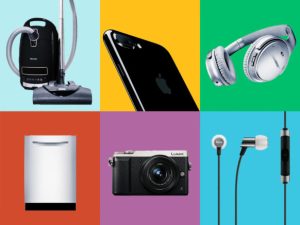
mosaic-gearta-582x437NY Times writer Farhad Manjoo had another excellent column this morning “The Gadget Apocalypse Is Upon Us”.

I agree with the idea that gadgets are losing the battle to software.   Consumer behavior plays a critical role in determining the success of gadgets not to mention mobile applications. As a Fitbit user over the past twelve months, I can tell you from personal experience that my daily activity behaviors have changed. This has happened because I’ve become keenly aware of my day-to-day activity. Or sometimes lack thereof.

As a naturally competitive person I am competing most days to – outdo myself. I think about walking anywhere I can, taking stairs instead of elevators when possible, and I think more about the calories I am (continually) consuming, and even have started feeling less energy on days that I don’t move around as much. With more intimate knowledge behaviors have more opportunity to be changed.

I’ve written about health apps as it pertained to first Samsung’s SHealth app, then again when I tried the Pebble Watch (and this week what’s left of Pebble is being acquired by…Fitbit).

I still feel that the ultimate health app is something that goes behind your ear (a tab or patch, not noticeable sort of like a tiny hearing aid) that monitors your health 24/7. Sleep, steps, vital signs etc. Having a fitness monitor that people take on and off (like a watch or Fitbit One in my case), is counterproductive to the mission of truly monitoring one’s health.

Semantically the word gadget suggest something fun yet inconsequential. A 24/7 health-monitoring device may look a little like a gadget but provides resounding utility. Are you worried about having your sensitive personal health data hosted on an app and in the cloud? I have my concerns but not enough to offset what I feel will be the benefits of having a chance to review and better understand my own personal health baselines and trends. I suspect my doctor would feel similarly.

The 1970’s began a time when gadgets became both fun and sometimes useful. As Mr. Manjoo writes, the iPhone changed everything and now functional mobile apps are where innovation is flying. But the combination of useful hardware (NOT gadgets!) and application based data collection point to the ways consumers will behave in the future.

Posted in Gadgets, Personal Technology, Technology | Tagged , , , | Leave a comment

Gap learns a few things from Zara – me too

gap-zara-11-28-16-wsj

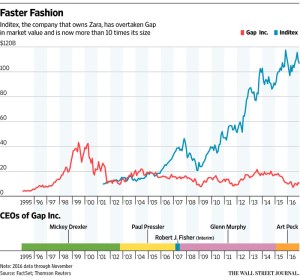
I read a very interesting article in this week’s Wall Street Journal – As Gap Struggles, Its Analytical CEO Prizes Data Over Design

Khadeeja Safdar’s November 28th WSJ article:

I was quite surprised to learn that in terms of market value, Zara is four times the size of Gap. From Steven Rosenbush’s WSJ November 28th blog:

“Gap’s market value has shrunk to about $10 billion, from roughly $40 billion at its 2000 peak and revenue has stalled at about $16 billion—flat from a decade ago, the WSJ says. The company faces a new generation of successful rivals such as Zara, owned by Spain’s Inditex SA. “Zara, by comparison, sends small batches of apparel to stores and waits for consumer reaction. Using real-time data, the company airlifts additional products to stores within days to meet demand. The chain is also known for few markdowns,” the WSJ reports. “Orders at Gap require corporate approvals, while Zara permits an employee or agent to authorize new stock on the spot, according to a supplier who makes garments for both companies.”

In response, Mr. Peck is putting more emphasis on data and establishing mechanisms for faster response. He has shifted some manufacturing from Asia to the Caribbean and he also wants to stagger product releases throughout the year and shorten the time it takes for items to go from the drafting table to stores to take into account the most recent data trends, according to the WSJ. “

The ever more challenging brick and mortar retail environment has become all about speed.

 Again from the article:

 “Executives still see the company as a cut above. Mr. Peck recently announced plans to ramp up marketing, including the first national TV ads for the Gap brand since 2014. Banana Republic is revisiting its catalog tradition. “I think the product is better than the business right now in Banana Republic and Gap,” said Mr. Peck on a conference call with analysts. “Not perfect by a long shot but better than our business.”

Mr. Peck’s comment does not inspire confidence.

One final but telling quote from a Millennial shopper:

 “Gap’s brand is not terribly cool, and it’s overpriced,” said Andrew Martin, 24, a shopper from Los Angeles. “If I’m going to splurge on clothes, I would be so much more likely to buy things I think are cool.”

At $10 billion in market value it’s not as if Gap is on life support. Many companies apparel and otherwise would be happy with 10% of that kind of market value. But when it comes to investors the future is what it’s all about – but probably not more than three or six months is the ‘future’ when it comes to investors. Clearly the investing future isn’t what it used to be.

Can Gap return to its former glory? I wouldn’t want to bet on it. Would you?

Posted in Advertising, Advertising to Millenials, Brand Advertising, Retail marketing | Tagged , , , , , , | Leave a comment

Bad data is worse than no data

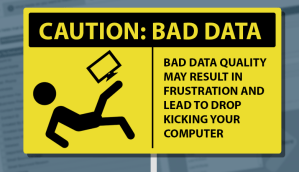
bad-data1Last week’s Election Day here in the United States was a bad day for data modelers, not to mention data overall. One thing that interested me (and many people) very much was that almost EVERYONE got it wrong. As we know the data leading up to the election did influence both candidate (Hillary Clinton felt she had Wisconsin in the bag) and voter behavior (the support for President-Elect Trump was under-reported as was the lack of overall enthusiasm for the Clinton campaign).

Imagine if there had been little or no data regarding the electability prospects of the candidates. Do you think they would have campaigned differently? Haven’t you always been a bit questioning of exit polls and their validity?

As data-driven business strategists and marketers, we absolutely LOVE data. Flying blind is never a good business strategy. Yet at the same time we’re also careful to question the validity of decision-driving data. Is the sample size large enough? Were time frames truly long and comparable enough? Can we truly have confidence in the conclusions we are making on the basis of the data we’re collecting?

I’ve always maintained a certain amount of skepticism when it comes to data and statistics. After last week it’s even more the case (if that’s possible).   I don’t love data any less, it’s more that I now want to dig deeply into the question – “what if the data is wrong?”

Bad data is comparable to disinformation. It often leads to the wrong conclusions and outcomes. No data is just that. In the absence of data all that is left are hypotheses. Those hypotheses without supporting data then become the launch pad for a series of tests to try to determine the potential success of one over the other.   That’s inefficient, not easy and will generate a lower level of success.

It is often heard in financial circles that ‘past history is no guarantee of future results’. Of course we use past history to help guide our future decisions. That’s never going to change. But taking all data at face value is dangerous and maybe more importantly not doing the entire job of vetting the prospects of success.

Here’s the irony. I am counting on data reporting and correlation to continue to improve and will never turn away from knowing more about what’s going on in order to aid strategic business and marketing decisions. But after last week my eyebrows arch a bit higher than they did previously.

Do you have the same, more or less confidence in data reporting today than before the U.S. Election of last week?


Posted in Data collection, Data driven marketing | Tagged , , , , | Leave a comment

Be uncompromising but willing to compromise

compromise-settling-our-differences-in-agreement-thumb19097297Having a personal value system is how individuals make decisions on what to do and what not to do. From a very young age we’re taught to be uncompromising when it comes to your core values. I could not agree more with that concept. At the same time there’s a big difference between being uncompromising yet having the ability to compromise on individual issues in order to reach an acceptable solution to a problem or situation. It seems to me that there are more people than ever before that have difficult in understanding the difference.

A few things that I am uncompromising about:

  • Being a good husband, father and uncle
  • Being on time
  • Avoiding any physical violence at all costs

Yes there are more but let’s take those three as simple examples.  The more complicated ones are just that.

Being a good husband, father, and uncle:

While I am uncompromising when it comes to my overall sense of what I need to do to achieve the above, there are compromises I make all the time in order to keep my family life on track.

Sometimes (ok probably more that that) I have had to work late and in doing so I did not make a family dinner or event, or a dinner with my wife or children. One could interpret being uncompromising in this area to mean that you’d NEVER miss a family meal or event on the way to being that good husband, father or uncle. Impractical as it may seem there are people that can only see things in black and white.

Being on time

This is truly important to me. And I’m good about it more than 95% of the time. But sometimes, unexpected things happen and I’m late for one reason or another. If the option is to drive at 90 miles an hour to try to deliver on my uncompromising ideal, the outcome could be that my life is compromised! So I don’t do it. My ideal remains uncompromised but sometimes the result has to be a compromise.

Avoiding physical violence at all costs

This does not mean I will not fight. But I will spare no effort to try to solve a problem or situation without violence. A friend of mine who’s a black belt in Tae-Kwan-Do told me once that he was taught that if you are in a fight you’ve already lost to a degree, but if you find that you are in a fight –fight to win. Fortunately I’ve had little occasion to have that play out in my life. Again I am uncompromising in my ideal but acknowledge that there could be a situation that my ideal has to be set aside out of necessity.

It’s impossible to discuss compromise without making a political reference. In the United States the political climate has been incredibly polarized for the past seven plus years (and longer than that really). The idea of compromise appears to have become a four-letter word to so many politicians. For that matter changing one’s mind is somehow an anathema even after receiving and assimilating additional information that offers a path to a more informed decision.

I want me to be, my friends and family to be, and our leaders to be…uncompromising in their ideals and beliefs. However, I also think it’s critical that all have the ability to understand that a compromise to achieve a mutual agreement is not a bad thing, and in fact it’s the way that things actually get done. I don’t expect anyone and everyone to agree with me on any given subject, particularly a sensitive one. What I hope for is that parties on opposite side of an issue can acknowledge there are different points of view so that there’s the possibility of reaching some sort of agreement. It’s called compromise and without that getting things done become nearly impossible.

Do you agree there’s a difference?

Posted in Living in the World Today | Tagged , , , | Leave a comment

Direct Sales and Direct Response – they are not the same thing

peopleinvolvedindirectsellingShould you market your great new product or service via retailers or sell direct to the consumer? That’s a question that gets asked every time an entrepreneur considers how to bring their product or service to market.

On one hand, having a retailer sell your product is easy or easier in that you make the product or deliver the service and the retailer (or in some cases the distributor) is there at the point of sale to the customer. No individual orders to fill, less inventory headaches. But the retailers take a hefty cut of your profit in providing that service.

On the other hand, direct sales puts you in control of the customer relationship in every way. From customer acquisition, delivery of product/service, to customer satisfaction and a future customer relationship.  Direct selling also includes (but is not limited to) multi-level marketing companies such as Amway, Young Living, and Herbalife to name three.

I have often found that people really do not understand that direct sales – (i.e. selling directly to consumers or corporations organizations or institutions with no retailer involved), is an overall “strategy”, whereas direct response as a practice employs specific strategies and tactics such as claims, offers, guarantees etc. to generate customer response and sales.

You can use direct sales without using direct response strategies and tactics. Let’s say you have your product up on Amazon.com. A potential customer finds your product, purchases it, and you ship it (or have it shipped FBA – Fulfillment by Amazon) to the customer.

How did the customer find you? Good question! That’s where the marketing comes in. Of course you don’t have to market the product or service. You can put up a website with some nice photos or your great product, a cool story, have your own Amazon store page, and wait for the customers to find you. Good luck with that.

When coming up with the idea for this great product or service, there were clear reasons for doing so. There had to be distinct advantages or innovations that made your idea viable and potentially desirable. This is precisely where many entrepreneurs fall down. Here are six examples how and there are many more:

  1. The company does not find ways to talk about the POD’s (points of differentiation), or promote the benefits to the consumer or corporation.
  2. There aren’t product or service claims (the only, largest, fastest, most elegant etc.) that help explain the value proposition to the prospect so they can make a more informed (and better) decision.
  3. There’s no offer or guarantee of customer satisfaction, (and yes I understand that REFUND is a four letter word to many companies).
  4. There’s no-follow up strategy for unconverted leads.
  5. There’s no effort to increase the size of the customer purchase and CLTV (Customer Lifetime Value).
  6. There’s no re-engagement strategy for lapsed customers.

Smart direct response marketers know that the days of YELL and SELL (think Billy Mays and I wrote about that almost seven years ago) are over. That does not mean that creating your brand and positioning your product/service for direct sales should ignore direct response marketing strategies and tactics.

And contrary to popular belief, your direct response marketing does not have to be cheesy. The techniques noted have been successful and will be successful because they acknowledge the way people behave and process ideas.

In creating your new product or service you’ve done the most amazing thing – coming up with it in the first place. A direct sales model can be the right approach for many brands. Using direct response marketing strategies and tactics is essential to helping you achieve the goal of having a successful business.

Posted in Direct marketing, Direct response, Direct sales | Tagged , , , , , , | Leave a comment

Marketing 101 – Use evidence of success to drive decisions

evidenced-based-decisionsData-driven marketing, Big Data, and all the related terms should be at the forefront of the minds of marketers.  73% of all digital spending in 2016 will be purchased programmatically.


http://www.pymnts.com/news/retail/2016/is-the-future-of-advertising-already-here/.

Do more of what works, less of what doesn’t. Today while marketing attribution of exactly knowing where success is being found is better than ever (but still not perfect), evidence-based decisions offer the most consistent path to marketing success.

I have the pleasure of talking to many entrepreneurs who all became entrepreneurs because they had passion for an idea or cause. It’s one of the most interesting things I get to do on a regular basis. Often entrepreneurs are doing many things in order to get their venture to the next level and marketing is considered a necessary or unnecessary endeavor depending on the business and individual.

A typical conversation might go something like “So we came up with this great idea to create X which will revolutionize industry Y. People love it and are buying it already. But we are having trouble scaling and getting the word out to enough people. We don’t know a great deal about marketing so that’s why we’re talking with you. The budget is limited but if marketing success can be proved there will definitely be more money to invest in marketing. How might you approach helping us”

Our answer as marketing consultants that execute plans is always the same. We will deeply research the category (if we are not familiar), make certain the ‘house’s’ brand is built on a solid foundation with an excellent user experience whether online or at retail, and emerge with a plan that enables us to test hypotheses, measure effectiveness and make changes based on what’s working and what is not working.

It’s always important to keep in mind built-in bias (even on my own part) which can negatively impact what and how ideas should be tested. Sometimes taking the outlier strategy is the best path, yet there are other times it’s critical to be compared to others in the category. When considering how to most quickly get evidence that will enable more refined testing, I often consider whether I myself am employing System 1 or System 2 (System 1 and System 2 are two distinct modes of decision making: System 1 is an automatic, fast and often unconscious way of thinking. … System 2 is an effortful, slow and controlled way of thinking) as depicted in his excellent book Thinking Fast and Slow by behavioral economist Daniel Khanamen. Keeping our own biases under control is a critical aspect of idea development.

It’s also important to remember that evidenced-based marketing decisions do not eliminate the need for creativity. Understanding the behaviors of people in the context of why they might be interested in your product or service and how to convey the value allows the creative approach to have a much better chance for success. There are times when a great creative approach can prompt people to try a product. Of course if the product does not live up to customer expectations there will not be an opportunity for lasting success. I had a business partner once tell me “You can’t polish a turd.” Too true.

I don’t want to leave out that when I talk with businesses and don’t end up feeling that there’s a high likelihood of success given their product and its potential in the competitive landscape, I either try to help find a path to a higher likelihood of success before marketing or pass on the opportunity altogether. See my comment in the above paragraph.

Of course you could just wing it. Good luck either way.

Posted in Best business practices, Marketing Attribution, Marketing stuff | Tagged , , , , | Leave a comment