Vistage – a CEO network that gets personal

For the past almost six years I have been a member of a CEO group called Vistage – www.vistage.com . I’ve alluded to my participation in the group on more than one occasion on my blog. My original reason for joining was to gain perspective on running a small business that would be difficult to obtain simply by reading newspapers, magazines, and the like. Vistage gives you the opportunity allows the CEO of a small business to get out of their fishbowl, (and committee of one), to see how others in similar situations deal with their opportunities and challenges. Before I joined the CEO that invited me to consider it mentioned that the other members of the group would ultimately become friends and confidants and he could not have been more right.

Our business has had a tough year and my company continues to undergo many changes and as such I felt the need to step away from the group to completely focus on the issues we are facing. This was not done without careful consideration. It is not inexpensive to be a part of the group. However in today’s business world every business conversations seems to begin with three letters – ROI and I can tell you that the value I have received from being a part of the group has far exceeded the financial investment.

For those of you that do not know – a Vistage group meets monthly for an entire day. Think about setting aside one day a month where you would not go to the office but actually sit in a room off-site all day, not answering emails or phone calls (or at least not constantly) and discussing issues related to everyone’s individual business. It’s always intense as we regularly have an outside speaker for 3 hours who will talk on any number of subjects, and then we meet as a group for the balance of the day going around the table updating our personal as well as individual company statuses. The meetings last 7 or 8 hours and I often found myself exhausted from processing issues and thinking deeply about subjects that were discussed at the meeting. We feel the responsibility to be accountable to one another as peers and that responsibility is not taken lightly by any of the members. It’s one big reason why it works so well.

Each CEO also meets with the ‘Chair’ or group facilitator once a month for 1 ½ hours to tackle issues directly related to our business. One responsibility of the Chair is to get a CEO to do things that he or she would prefer not to do but knows that they should. It’s probably akin to herding cats at times.

The bonds I have formed over the past six years with my fellow members run deep and that was evidenced today by the groups abject refusal to accept my stepping down in what they consider a time when I could use the collective intelligence of the group more than ever. Not only did they implore me to come back to report as a ‘guest’ and keep in touch with the group, I walked out feeling that I have 14 very smart, very dear friends for life. And that’s very personal.

What do you do to get out of your own fishbowl?

Posted in Best business practices, Community | Tagged , , , , | Leave a comment

Western Union hangs on and then some

I heard a radio spot last week from Western Union (WU) regarding singing telegrams. The first thought I had was – Western Union? Is that company still even around? A little research divulged that not only is Western Union still around, in 2010 the total revenue was $1.3 billion. If you are wondering, WU has not delivered any telegraphs since 2006.

Back in 1851 in Rochester, NY what today is Western Union was created as unified telegraph system called the New York and Mississippi Valley Printing Telegraph Company. That company competed with New York and & Western Union Telegraph company – which was purchased out of bankruptcy by Ezra Cornell (yes that Cornell). By 1855 the two companies merged into the Western Union Telegraph Company which operated in much the same way until 2006.

In 2006 Western Union announced that it would discontinue all telegram and commercial messaging services. However telegram services continued in the United States via iTelegram and other companies none of which I have ever heard of.

Yet Western Union still exists today primarily as a company that allows users to send and receive funds to others, pay bills or to purchase gift cards. Western Union also has a mobile money transfer service where a sender goes to a Western Union office and presents funds (plus fees) for either a ‘Next Day’ or ‘Money in Minutes’ service.

Personally I have never used Western Union for a telegram, money transfer or any other service. If you visit their website http://westernunion.com they note that Western Union is ‘connecting families around the world’. And that ‘Western Union helps you provide for your loved ones almost anywhere in the world. Whether it’s for education, healthcare or groceries, we offer Consumer-to-Consumer Money-Transfer Services to get resources to members of your family quickly.’

A publicly traded stock (WU on the NYSE is trading at under $ 18.00/share), just yesterday Western Union announced that it had its Expanded Payment Suite with Western Union Small Business Payments Targeting Small to Medium Sized Businesses although there were no other specifics. In fact, Western Union has a number of branded payment services that are offered through a network of ‘approximately 485,000 agent locations in 200 countries and territories’. In 2010, The Western Union Company completed 214 million consumer-to-consumer transactions worldwide, moving $76 billion of principal between consumers, and 405 million business payments.

On December 1st WU restarted its singing telegram business http://wu-singingtelegram.com now executed as your own personal mashup duet with a choice of famous singers. At the moment it is free but it is slated to cost $ 2 or $ 3 beginning in January.

I think Western Union may offer an object lesson in morphing a dying business and finding ways to not only keep it relevant, but have it thrive. Agree or disagree?

My reaction was – who knew? Did you?

Posted in Advertising, Communication, Customer Experiences, Entertainment, Marketing stuff, Mobile Communication, Technology | Tagged , , , , , , | Leave a comment

Affordable portable mini-printers are useful now but not for too long

Last night as we traveled back from the airport I was hungry and decided to order a small pizza. There’s a place www.PlanetPizza.com that makes good pizza near to our house. On their website they always have coupons for discounts and we use them nearly every time we go there. However on the road without a printer we were unable to print one out and get a discount on whatever might have been available. Unfortunately Planet Pizza like most local retailers does not allow you to show the coupon on your mobile device in order to use a coupon to get a discount.

Small portable printers have been around for several years. Of course what might be considered small and portable are adjectives that are best viewed through the eyes of the people that will use them. If you’ve rented a car anytime in the last few years you are probably familiar with the car rental company’s ability to print out your receipt on the spot. The devices they use to process the transaction are held in their hand and the printer often clipped on a belt. The print quality is acceptable but nothing great. This is the kind of device that would be practical for people to carry around in a car or even a briefcase.

When I started looking around for a small portable personal printer I was surprised to find there were not many reasonable options. The products were either too large, too expensive or both. Just to be clear I am looking for something small that could be held in one hand, and something that would cost under $ 75.00. A website www.planon.com advertises that it offers their PrintStik product as ‘The World’s Smallest Mobile Printer’. And small it is but it also costs $ 199.00. So far I have been unable to find anything that meets my small criteria at any price close to $ 75.00.

The other thing to keep in mind is the ultimate obsolescence of portable printers. After all with mobile communication sharing using things like NFC (near field communications) on the horizon it should not be too long before the need to print out a coupon is non-existent. It’s already happening with airline boarding passes and the trend is clear that ink on paper is fast becoming a relic.

Do you have any thoughts on using a miniature portable printer? Would you use one if it were affordable and available?

Posted in Customer Experiences, Innovation, Technology, Travel | Tagged , , , , , , , | Leave a comment

Airline upcharges – there appear to be no limits

I am not exactly certain when the implementation of supplemental airline fees such as bags, seat choices and food came to be standard operating procedure. I believe it was the food first, and then the bags and now seat choices. One thing is certain, supplemental fees have become paramount airline profitability and are not going away ever.

The United States is the undisputed champion when it comes to implementing fees for just about everything on airlines. It appears to me that now if you want the lowest cost seat on the plane it will be in the middle, in the back (probably last row) and the likelihood of finding space in the overhead bin for carry-on luggage nearly zero. Of course the airline then will be happy to check the bag for you – something that they are not yet charging for but I am betting they will eventually. Spirit Airlines even tried to charge $ 45 to use the overhead bin a couple of years ago.

As many people know there are even ‘opportunities’ to change your position in getting on the plane – an express lane option that gets you on the plane with the ‘Elite’ status and first-class passengers. This can secure your place in an overhead bin. As I now only take carry-on it is of particular significance to me personally, (I recently returned from 2 weeks in China and only took carry-on – you can do it too folks) but I am determined to not pay the airlines ANY additional fees to board the plane sooner.

Movies, food, internet access, legroom – there seem to be unlimited opportunities for the airlines to make that $ 150 or $ 200 one way fare increase by $ 25% or more. What’s more the additional fees are pure profit – they go straight to the bottom line.

The worst thing is that there is nothing people can do about it. The airlines have not yet begun to charge for pillows and blankets but you can bet they have discussed those ideas. Changing a flight has resulted in additional fees for several years, but now even if you are stand-by for an open seat airlines are beginning to charge a fee.

What’s left? Well my associate and I were joking about charging for bathroom access on planes. And then it was not so funny since what’s to stop them? Once price for #1 and another for #2? It seems to me that if a fee can be imagined it’s not far from being implemented.

Air travel today in the U.S. (and don’t think the rest of the world isn’t taking notes) is nothing more than a flying bus in the air.

Do you have any other odd airline fees that you’ve been charged?

Posted in Living in the World Today, Travel | Tagged , , , , , | 3 Comments

I’m a new mover yet marketers are ignoring me

Having been in the direct marketing business for more than twenty five years I (like nearly all of my colleagues), am all too familiar with new mover data and its value to marketers. For those unfamiliar with direct marketing – new mover data is a highly valued commodity and the names and postal and email addresses are bought and sold at premium prices.

It should not be all that surprising that contacting a new home, co-op or condominium owner gives the marketer a golden opportunity to offer the right product or service at the right moment to people that have just moved into the neighborhood. Local eateries, services such as dry cleaners and tradesmen often tap new mover data in order to reach potential new customers. Even car dealers like to use new mover data in order to drum up new sales. New movers data can be segmented rather rigorously so that marketers can better target what they hope are the most likely new customers.

So it comes as a surprise to me that in the nearly four weeks that we’ve lived in a ‘new house’, there really has not been much in the way of offers for local (or even non-local) products and services for us – new movers. We are all too familiar with the data on both new and existing home sales here in the United States. All the more reason I say that a new mover should be more highly coveted than ever before.

I remember when we had just purchased our first home a number of years ago. At one point the Welcome Wagon lady (she had to be pushing seventy-five) came to our house while I was home alone painting. I answered the door and she asked if the owner was home. Nice. We both regrouped and she offered a basket of ‘goodies’ from local businesses (hair salon, pizzeria, dentists etc.). It was nice to get that and we definitely used the coupons and began to patronize local businesses – some that we even still patronize today.

Despite the fact that I’ve spent many years in the direct response industry I am on the do not call list. I imagine that I am far from unique in this aspect even for people in the industry. So that precludes our being called at home by local businesses. Email could be a way to reach us. But email data is not as easily matched to a new mover address – at least not anywhere as seamlessly as a postal name and address and corresponding mail piece.

Mail volume is down substantially and set to continue that trend. Perhaps we don’t make the grade as a good prospect to mail. However I sincerely doubt that.

Are there any other new movers out there? If so have you been seeing offers from local business that you can tell are aimed at you because you recently moved?

Posted in Advertising, Direct Mail, Marketing stuff | Tagged , , , , | 5 Comments

Hope between Black Friday and Cyber Monday

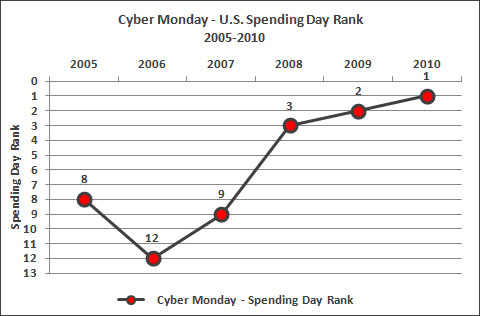
Did you shop ‘til you dropped this past weekend? Apparently many Americans did something close to that. Over the past weekend retailers saw ‘record numbers’ as reported in the New York Times this Monday morning http://nyti.ms/vqWO0f . ‘The National Retail Federation said Sunday that spending per shopper surged 9.1% over 2010 increase since 2006 – to an average of almost $ 400 per customer.’

A bit sobering the article also noted that it’s possible the gains may not last. With today being Cyber Monday there is also the expectation that internet sales numbers this year will far outpace those of 2010 or any prior year. ComScore expects Cyber Monday spending to increase well beyond the $1 billion level achieved in 2010 http://bit.ly/ujX71u . Last year more than 13.7 million items were ordered on Cyber Monday – a record breaking 158 items per second.

I can’t say that I helped internet or in-store sales at all this weekend. I much preferred spending the time with my family. I did receive an Amazon Kindle Fire and have been enjoying my first tablet and am highly impressed with the functionality and features of a $ 200 device. I will review more in depth in a future post but early returns are very positive.

Global stocks have reacted positively to the early shopping numbers. The trend is likely to be followed in the U.S. markets today. But will it last? One comment that gave me pause was from Margaret Taylor, VP and senior credit officer in the corporate finance group at Moody’s Investors Service. “They could be willing to take on more credit” Mark Vitner, a senior economist at Wells Fargo Securities, said in a note to clients that he expected that “consumers will dig into savings” or “temporarily tack on a little more debt” during the holidays.

Those comments do not resonate with me as offering reasons for long term optimism. With a 9.1% reported unemployment rate (the real number is more likely between 10-13%) it’s hard for me to believe that credit based consumption is still seen as desirable.

How many of you went out after Thanksgiving dinner to hit a store opening that evening? If not, what about shopping in stores on Black Friday? What was it like? Were the savings as good as advertised? Were you jostled, pushed and elbowed trying to get the best deal?

Posted in Best business practices, Living in the World Today, Marketing stuff | Tagged , , , , , , , | Leave a comment

In the U.S. risk is not just another four letter word

For a country founded on taking a risk (think taking a trip to the new world on the Mayflower) it seems to me that many Americans have lost their appetite for taking chances and assuming risk. This is particularly true in business. With increasing frequency people will only invest in a ‘sure thing’. Nice work if you can get it as the saying goes but when looking for reasons why the U.S. economy is struggling, aversion to risk should be considered a key factor.

In the U.S. (and in some countries too) there are tremendous amounts of money on the sidelines unwilling to get into the game by investing in ideas and businesses. And it’s not as if there are opportunities for great returns in safe havens like money markets and fixed investments. In fact risk diversification has come to include asking the idea-people and marketers to put up their own money as part of the compensation package. That shows that the owner of the product or service lacks some confidence in its viability.

Would you agree that risk and speculation are underlying to a capitalistic economy? Is the entire business world fixated on creating something that would be too big to fail? Risk is a part of life, managing risk is even more important. There are many things people consider doing every day that involve some degree of risk. Sometimes the risk is worth taking, sometimes not. But eliminating risk entirely is a duck and cover reaction that will bypass innovation and curtail new ideas from becoming a reality.

Shared risk is not an unreasonable approach to doing business. However I am finding that companies that say they are interested in shared risk are primarily interested in hedging their investment and often are unprepared to pay the higher rate of return commensurate with a shared risk plan as opposed to a pay-for-hire model.

Starting a business is certainly a risk. But these days taking a job at a corporation is a greater risk than it has ever been. I wonder if people still understand what risks they are taking as opposed to the ones that they are not. Staying in the same dead-end job because it’s comfortable and things are tough out there could turn out to be a greater risk than leaving to start or join something that does not appear as established.

The U.S. continues to be a land of opportunity. The country was built on a ‘can-do’ and ‘let’s build it’ attitude. Yet if people are averse to taking risks to build something new and hopefully better that particular freedom is in name only.

Taking a risk does not mean everybody has to build a Groupon, Zynga or LinkedIn. I am suggesting being mindful of the risk you could be taking – by not taking a risk.

Happy Thanksgiving folks.

Posted in Best business practices, Innovation, Living in the World Today | Tagged , , , , , , | Leave a comment

What the 99% can be thankful for

Thanksgiving is seen as the true start of the annual ‘Holiday season’. Certainly retailers both online and brick and mortar have been pushing the ‘buy now’ button since Halloween. As the Occupy Wall Street movement carries on into month number three, it would be easy to think that the 1% have so much to be thankful for, while the rest of us slog on in our mutual and collective despair. Well I am one of the 99%, and 2011 has been a very difficult year for me professionally, but despite that I still have much for which I can be thankful.

1) I am in good health. It is the single most important thing there can be as well as is the
overall health of the people closest to me. Remember that it could be worse folks – it could
always be worse. Being healthy (or mostly healthy) is the single most important thing isn’t
it?

2) I have people in my life that I care about and that care about me. Professional success is
uplifting but without having people around to share it with would feel hollow – agree or
disagree?

3) While the U.S. has its problems, our national spirit of innovation and can-do still make the
U.S. and its citizens a place and a people to look up to. We’re not done yet. Not by a long
shot.

4) Americans continue to use their right to complain and protest – peacefully for the most part,
that exemplifies what free speech and freedom in general are all about. This is not to be
undervalued.

5) Most Americans have flat screen TV, and iPod or digital music player and soon will also have a
smartphone. Before you laugh, keep in mind that citizens of many countries in the world cannot
say the same, but they wish they could. And in fact it’s the U.S. way of life that many people
around the world aspire to achieve.

Americans are disgruntled. Whether it is with the Wall Street folk, our political leaders, or an overall lack of good job opportunities, it seems to me that we’ve developed a culture of complaint – not complacency. As families come together this week of Thanksgiving, why don’t we think about the things for which we can be thankful instead of all the things we don’t have or wish we did?

If you can sit back after Thanksgiving dinner with a full belly and watch some meaningless football game, things could be a whole lot worse – couldn’t they?

Posted in Living in the World Today, Uncategorized | Tagged , , , , , , , | Leave a comment

Modern Warfare 3 is a juggernaut movies can only dream about

To me the number is staggering: US $775 million sales for Modern Warfare 3 (MW3) in just 5 days. Techcrunch.com reported this on Thursday http://tcrn.ch/uGzouB. I don’t play the game but I have heard complaints from players of Modern Warfare 2 that the new game does not offer much more than an opportunity to plunk down another $60. Others feel that Activision/Blizzard the creator of the MW franchise has apparently done a good job of addressing the issues associated with MW2. Either way the success is palpitating.

Could you imagine a film release that generated even 25% of $775 million in 5 days? Granted movie tickets are less expensive than $60 (although creeping up constantly), but film producers can only dream of having the kind of connection to a franchise that Modern Warfare has managed to create.

For some reason I began to imagine what could be done with three-quarters of a billion discretionary dollars. With budget cuts for essential services being felt all around the U.S., it’s difficult (for me) to not think about what could be accomplished had people not purchased the new game and collectively combined those financial resources to address what might be considered a more pressing need. There are too many to mention all, but hunger, education, and healthcare come to mind quickly.

OK I know I am dreaming, and am not impugning or indicting those that purchased MW3. A baseball game ticket costs the same amount and is no less frivolous and may be more so. But in a time where people are struggling to make ends meet it seems a bit incongruent that more than three-quarters of a billion dollars could be spent on pure entertainment – I wonder if any of the MW3 buyers are the same people that are part of the OWS – Occupy Wall Street movement?

Video game entertainment is important as a release from everyday life and it creates jobs – a good many of them for an industry valued globally at US $65 billion (as of June 2011 from Wikipedia).

If you are a gamer how much do you spend annually on buying games?

Posted in Entertainment | Tagged , , , , , | Leave a comment

Allstate’s new offer is even better than Mayhem

Many Americans (particularly those that watch televised sports) have watched the Allstate ‘Mayhem’ ads. It features a character that deems himself ‘Mayhem’ and is to be avoided, however when mayhem occurs Allstate is the insurance provider of choice. Here is a link to a recent effort – http://bit.ly/vGytOH

In my mind Allstate was never the lowest cost provider – that’s a sandbox best left to others to play in. Service and reliability are Allstate’s hallmarks. GEICO’s direct-to-consumer approach has resulted in it being one of the most recognizably advertised brands on television (radio and outdoor as well). GEICO’s efforts have forced Progressive, State Farm and Allstate (as well as others like Farmer’s) to raise the stakes to create and run more advertising.

I don’t think much about automobile insurance advertising but was impressed by the Allstate radio spot I heard over the weekend. Starting in October 2011 Allstate began offering free lifetime roadside assistance ‘membership’ to non-customers – that is FREE to everyone. Towing, flat tires, dead battery jumps, locking oneself out of the car, all would be included. This offer is extended to people who do not have any policies with Allstate whatsoever. All you need to do is to call a local Allstate agent.

I love a good offer as much as anyone and as I listened to the spot I have to say I was impressed. For those of us that have children driving that are under the age of 25, the opportunity to have them covered with a tow at anytime (for free) is enticing to say the least.

Several questions immediately came to my mind. How can Allstate afford this? Will premiums have to be raised to pay for the program? What about existing Allstate policy holders? Do they get a rebate or premium relief? Well to begin with users of the service will need to pay a deductible or co-pay each time which will mitigate some of Allstate’s expense. In reality the promotion is a lead generation campaign and will only be as successful as Allstate’s ability to write new policies as a result.

As I mentioned I love a good offer and Allstate has an attention-getting one as far as I am concerned. It certainly beats mayhem wouldn’t you say

Posted in Advertising, Communication, Marketing stuff | Tagged , , , , , | 2 Comments