
Steve Jobs has also changed video games forever

I try to follow the developments in the videogame industry since my son is finishing up his course work to become a video game developer and designer. Much of the talk of the past week (aside from hurricanes) was about Steve Jobs and his monumental contribution to the way people live their lives. A small article over the weekend did a nice job of summarizing the impact – http://nyti.ms/qM62BEOne could argue that traditional video gaming systems are becoming obsolete – at least in terms of mass appeal. Mobile gaming platforms are improving and while I initially had doubts about people’s willingness to play games on a small screen I have concluded that I greatly underestimated the power of mobile gaming. Inexpensive iPhone apps have inexorably altered the course of the gaming market.

It also has me wondering about overall the impact that the new mobile life will have on behavior and commerce. Movie attendance continues to slide even if the overall dollar take is slightly higher (due to higher ticket prices). Will enough people still be interested in sitting at home and playing Xbox, Playstation and other console games to have those companies continue working on the platform?

From the L2 blog over the weekend it appears gaming in China is changing rapidly as well and yes attributing this to Mr. Jobs is not far-fetched. http://bit.ly/nMx65e

‘China is fast-becoming the second-largest market in terms of downloads for many developers including companies like Rovio, but it lags behind in terms of monetization. The country came in just behind the U.S. in page views on Google’s AdMob advertising network in July, according to statistics the network shared at an iOS developer conference in China this past weekend.

The promise is there, but how do mobile developers take advantage of it?
Over the past two weeks in Beijing and Shanghai, I’ve had the chance to talk with several mobile developers like High Noon-maker Happylatte, PapayaMobile, PopCap Games and other companies being incubated in former Google China head Kai-Fu Lee’s incubator Innovation Works.

It’s an incredibly complex and different market from the U.S., but here are a few insights into developing and marketing iOS and Android apps there. (Inside Mobile Apps)’

Many videogames are based on the effort to hit a constantly moving target. My son has learned a great deal about computer programming and coding. But what may be the most important lesson is learning how to hit that moving target when it comes what to develop next. At least that’s what I am hoping.
So who out there plays console video games? And if you do, are you playing more or less? How about mobile video games?

Posted in Entertainment, Innovation, Marketing stuff, Mobile Communication, Technology | Tagged , , , , , , , | Leave a comment

Marketing in the age of specialization – can it hurt to be too specialized?

One of the great things about being in a city like New York and working in Soho in particular is the endless amount of good and great restaurants. The availability for virtually any kind of ethnic or type of cuisine is limitless. New York is hardly unique in this aspect but I can’t think of another city I’ve been to that has more choices when it comes to food.

Restaurants are known for their specialties. Whether it’s a signature dish from a top chef, a new approach from an up-and-comer, or a particular kind of cuisine that the restaurant is known for, people are drawn to the unique aspects of the food and the experience. Consequently they often specialize in a few things that become part of the restaurant’s reputation.

Today, marketing agencies also have a penchant for specialization. The specialization could come in the form of different approaches to email marketing, new ways of media buying, cutting–edge creative solutions, or counter-intuitive marketing strategy – just to name a few examples.

I thought about that while I was having lunch Thursday at a restaurant that has only been open six months in Soho – http://www.themusselpot.com. From the name it is apparent in what area they specialize. When I saw the name I immediately thought about all the delicious options the menu could have for mussels (I love mussels). I was not disappointed in any way.

The restaurant was really attractive, not crowded on a beautiful Thursday afternoon (that concerned me a bit) and the people working there were very pleasant and into the somewhat unique concept. The mussels were great by the way. I started thinking about who I’d bring there and realized that there are many people I know that either don’t eat shellfish or don’t like to eat mussels, (although I will never understand why).

The menu did have a number of non-mussel, and even non-seafood choices – fried chicken, a pasta dish, a steak and a burger. However to the non-mussel lover the name of the restaurant would probably stop them from ever walking through the door. And if you did not know what’s on the menu you would be hesitant to invite a non-mussel lover to join you in your quest for the perfect bi-valve.

So can a restaurant be too specialized? I hope not but it’s possible. Can a marketing agency be too specialized? Again I think it can be as well. I am certain the chef at The Mussel Pot can prepare many things well beyond mussels and in fact would be disturbed if the perception was all he or she could do was make great mussels. Marketing agencies can specialize and have a reputation for a ‘specialty’; however its talent has to go beyond one or two specialties in order for them to best serve their clients.

Specialization isn’t a bad thing, but at the same time it can end up being a pigeon hole from which it is difficult to be extracted.

What do you think?

Posted in Best business practices, Customer Experiences, Marketing stuff | Tagged , , , | 2 Comments

Utilities during power outages need to better use technology to communicate

Our office was without full power in our office for nearly 48 hours following the aftermath caused by Hurricane Irene. We had lots of company. Local municipalities have gotten smarter about communicating with residents during major local events like snowstorms or hurricanes. I wish I could say the same for utilities.

In no way do I mean to knock the efforts of all the great linemen that have come to help restore power after the hurricane. But these people are seemingly forced to run around like chickens with their heads cut off to help wherever it’s needed. Why are things done the way they are when it could be so much better? It’s not like they did not know a hurricane was on the way.

For example – crews came into the Northeast both in advance, during and after the storm. I asked one of the crews near my office how they were receiving information on what to do and where to go next and he shook his head and said that he received many different contradictory messages from various levels of authority. Now it was my turn to shake my head. Today’s technology allows for the lightning fast creation of small topical websites, mobile distribution lists and even groups that could act as an aggregation platform for local community, county and state communication for officials and crew before, during and even following significant events.

It cannot be a question of expense. The cost/benefit of having a centralized communication platform for disaster relief is tremendous and at times could be life-saving. With all the money available for state and federal disaster relief I cannot believe that the cost of creating a simple website combined with a small team to aid in administering it to monitor and send out messages would more than pay for itself in helping teams be more prepared as well as efficient.

Adding a mobile site would be a great way to communicate since SMS texts could be deployed to communicate with everyone in the field or sent to individual people or crews on demand. Every lineman on every crew has a mobile device that would support SMS campaigns. For those that have smartphones they could easily be directed to the mobile site for more information.

I don’t expect my thought here is anything revolutionary but I am amazed that it’s not already SOP – standard operating procedure. Maybe it is SOP in some locations but it should be universal.
Do you agree?

Posted in Best business practices, Communication, Mobile Communication | Tagged , , , , | Leave a comment

Mother Nature and Irene trump technology

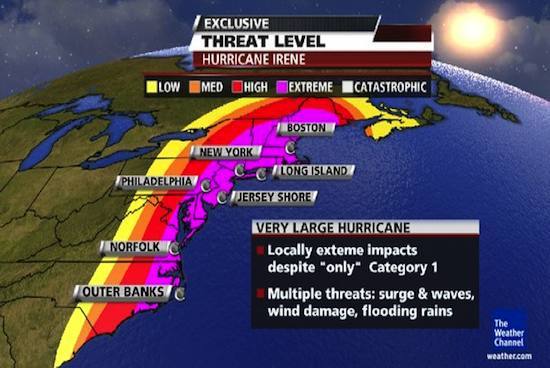
If you are anywhere in the Mid-Atlantic toward the Northeast you have woken up this Monday morning to at least some partial disruption to your normal routine. Here in Connecticut more than 750,000 ‘customers’ are without power. Being that there less than 3,500,000 total residents in the entire state the impact is going to be historic – in part because it could be days or even a week before power is fully restored.

During the storm mobile phone networks were active and Facebook and Twitter (much like they were during the east coast earthquake last week) kept people in touch and apprised. Radios again became important for those that had their cable, satellite or other television connections taken off-line.

For residents of Westchester County north into Duchess County as well as those in Connecticut – Metro-North is out until further notice so on this beautiful post-storm Monday the conditions are somewhat akin to that of a snow day with regard to power outages and work disruptions – except for 80 degree temperatures and bright sunny skies.

David Meerman Scott writes a great blog and had a good post today on the pre and post-Irene performance of New York City Mayor Michael Bloomberg http://www.webinknow.com/ – and I agree that Mayor Bloomberg did a good job of communicating during the entire event.

We’ve all come to reply so much on technology in order to perform our daily work tasks. I said many times that nature always wins and once again we were all reminded of the truth of statement. If there is no power or no internet service much of the technology is neutralized.

If you are not in the areas impacted by Hurricane Irene (ok it was a tropical storm when it hit the New York City area), be patient with us this week – things do not appear likely to get back to normal for at least the better part of this week.

Posted in Communication, Living in the World Today, Technology | Tagged , , , | Leave a comment

Facebook video chat – do you know how good it is?

It took our now college age daughter to suggest using Facebook video chat instead of Skype. Up until now Skype has been my video chat go-to option. Two nights ago we video chatted on Facebook and it was impressive in many ways. It is simpler within the Facebook application since permissions are already taken care of. If you’ve not tried it – you should. I learned later that Facebook is using the Skype platform for the service and I cannot understand how the results could be so different.

The download was fast and easy – we were actually corresponding while entering the request for video chat, and the download took less than one minute. The next thing I saw was a real-time video of my daughter and the quality was the best I’ve experience when it comes to video chatting. It was as if we were looking at each other right in person.

There is also a group video chat function that works just as well. Important to remember is the fact that you need to be FB ‘friends’ in order to engage in FB video chat – so it’s not as if it will replace Skype or other video chat applications (like ovoo.com), but for my friends that I wish to video chat with, Facebook has become the new default choice.

Here’s a questions – why doesn’t LinkedIn have a video chat option? It may not be appropriate for most LinkedIn interactions but it seems like it would be a simple yet high value enhancement for that platform. Keep in mind that should you wish to not video chat, you as the operator always have the option to decline to video chat.

But for family and friends that are not nearby, video chatting is better than – well than not having video chat. Facebook has done a really good job here and I am very surprised as to how I was unaware of that feature up until now.

How about you? Have you used video chatting? Do you like it? Is Skype your normal choice? Have you tried FB video chat? And if not what else might be you be using?

Posted in Communication, Social Media | Tagged , , , , | Leave a comment

Real-life social networking – Facebook changes college sorority rush

How do I know this? Our daughter is a freshman and is interested in joining a sorority. She told us that all of the girls that are already in sororities and charged with recruiting incoming freshmen have to deactivate their Facebook accounts during sorority rush. If that does not demonstrate both the ubiquity and power of Facebook, nothing will.

Even with social networking ‘Greek’ life on college campuses around the United States have retained their appeal to many students. The friendships and connections can last a lifetime. It is a uniquely North American ritual most popular in the United States. While ‘pinning’ has gone by the wayside, the Greek system is representative of many of the things that take place on Facebook and other social networking sites, except that it is not virtual. However if you are familiar with hazing in real life you should also be familiar with virtual hazing on social networking platforms. It happens and it’s not good.

The fact that sorority recruiters are forced to deactivate their Facebook accounts (one assumes that for now Google+ accounts are allowed much to Google’s chagrin?) demonstrates the way college students interact. Mark Zuckerberg doubtless would be proud and aggravated at the same time.

A Ryan Tate article Monday on Gawker http://gaw.kr/oqbE0y highlights how colleges and schools can turn people into Facebook maniacs. I assume that asking current sorority members to deactivate their accounts during rush is some sort of defense against turning the rushing frosh’s into maniacs. I presume that fraternities are not doing the same thing but maybe that’s my gender prejudice.

While Greek life during my undergrad days was very popular I chose to not participate yet had many good friends who enjoyed their experience so I am not judging the positives or negatives of being in a sorority. Up until now I have given little thought to how online social networking might impact real-life social networking. The power of Facebook has met with the power of the Greek system. Facebook appears to be the loser in this round. Or is it?

Posted in Living in the World Today, Social Media | Tagged , , , , , , , | Leave a comment

Foursquare has moved off beta – did anyone notice?

Being a regular user of Foursquare I have been wondering for quite some time when the ‘Beta’ emblem would disappear. Last week that happened along with a host of other reported changes (Lists, events, photos – all of which I am not likely to use but are kind of cool in and of themselves). Betabeat wrote about it last week – http://bit.ly/oCgLRj. Unfortunately, the GPS is still fairly inaccurate and you can still check into places that you have not entered – this has to be fixed and Foursquare is working on it.

The offers at nearby places on Foursquare are slowly getting better and more frequent. Yet in the lighting fast world of the social web I am surprised at how long it is taking for a truly enhanced version of Foursquare (for users) to be offered. CEO Dennis Crowley seems to be focused on creating value for merchants – he would be wise to keep in mind that the users might be getting a bit impatient with the slow rate of progress toward what I think is still a good platform with strong legs.

One big question I have is how much more social Foursquare will get. Aside from checking into places where friends might ‘meet-up’ and offering nearby potential customers a reason to come into a particular establishment I am not sure people will embrace and interact with yet another social media platform. Mr. Crowley and his team are counting on that – what do you think?

While Foursquare was making its changes location based Yelp.com made a few changes in its application as well. I use Yelp when looking for nearby eateries, bars, or movies wherever I am in the United States (it does not work outside the U.S. nearly as well).

Last week an update to the application popped up and I installed it but since then the application has suddenly lost its ability to recognize where I am currently located. Good thing I am not depending on it. And before you go asking – all my other GPS based applications are working just fine and I changed nothing in my Yelp profile. Not good. In fact I ended up using Bing to find a restaurant near me this weekend and it worked out satisfactorily. For Yelp that is also not good.

In order for social media applications to continue to gain in value they have to deliver the basics – they have to work (always), be fast and accurate. Once users lose confidence in a social media app’s ability to enhance their lives the downward spiral is underway. I hope that Foursquare and Yelp respectively fix what ails them.

Are you using Foursquare or Yelp?

Posted in Mobile Communication, Social Media, Technology | Tagged , , , , , | 1 Comment

Mobile phone batteries are horrible – why can’t they be better NOW?

I just spent a couple of days out of the office with some business associates who are also friends. Since we were not at a desk or even carrying around an iPad we naturally used our mobile devices as our primary means of communication. As the day wore on our mobile phone batteries wore out. It’s nearly impossible for me to believe that there could be any explanation for how a rechargeable mobile phone battery could not keep a charge for 24 hours or more even when in use.

Mobile phone (or cell phones as they were formerly called) batteries are most often rated on their ‘talk-time’ ability to hold a charge. CNET offered comparative ratings last month – http://cnet.co/nevDmr and a brand named Somin came out on top at more than twenty hours talk time (good luck finding it) with a Nokia model coming in second at fifteen hours (which may actually last longer than the company). I don’t know anyone that would use their mobile phone for twenty hours (talking) without charging it but things happen.

Outside of talking what drains power on mobile devices is the mobile web – data transfers, uploads and downloads. That’s no secret to just about anyone. Those apps you have running in the background are running down your power so you can get all those Facebook, Yelp and other social media updates in real time. While all that is going on the battery is running down all day and at the most inopportune time (like when you want to actually make a 2 minute phone call) – you may not be able to because the battery is almost dead. The measurement should be data usage – not talk time.

I carry two extra batteries in my briefcase. However my briefcase is not with me at all times and I don’t always remember to stick an extra battery in my pocket just in case. The question I have is – why has there not been an advance in mobile phone batteries such that there is literally no way a battery could run down in a 24 hour period?

Marketing companies want people to do more commerce on the mobile internet. QR codes are cool but NFC (Near Field Communications) for mobile phones are a better technology and much more user friendly. Alan Mutter wrote a great blog piece on this recently – http://bit.ly/o4igym. Yet if we are to do more on our phones the least of our problems should be the fact that by using them more our phones will run out of power before people can charge them.

When I was young I heard people say – ‘If they can put men on the moon why can’t they…?’ I feel that way about mobile phone batteries. I’m not being naïve here – I am sure it isn’t easy to make a more powerful mobile phone battery as there are surely dangers in having too much power that could leak or catch fire. But that gets me back to – ‘If they can put men on the moon…’

How about you – have you had your mobile phone battery crap out on you at a bad moment? How many times? Does it aggravate you too?

Posted in Innovation, Living in the World Today, Technology | Tagged , , , , , , , | 2 Comments

Are we heading for no smoking anywhere ever again?

New York’s Governor Andrea Cuomo is the son of one of the more popular and liberal governors the state of New York has ever known. In his brief time in office Governor Cuomo has shown that the apple does not fall far from the tree. I always thought his father was a bright and interesting man and a pretty good governor. While I don’t live in New York State anymore (I do maintain an office in New York City) I remain interested and aware of New York issues and politics.

This past Monday Governor Cuomo signed an executive order banning smoking on Metro-North and Long Island Railroad platforms. The ban begins in 90 days. Full disclosure – I do not smoke cigarettes but do enjoy the occasional cigar. I have never smoked a cigar on a train platform but now I am thinking about it.

I am not sure if there is a law against self-immolation but that might as well be included too. Where does this kind of thing stop? New York City Mayor Bloomberg has banned smoking in New York City parks. There’s no smoking at outdoor stadiums and no smoking in restaurants and bars. I still cannot understand how taxpaying establishments are subject to this particular law – if you don’t like smoke and you are an employee – don’t work there!

Yes there are valid arguments that smokers cause illness not only to themselves (and to a lesser degree those around them by way of secondhand smoke – the claim is that 2,500 New Yorkers die each year due to secondhand smoke), they also contribute to higher insurance rates for everyone else. I am not a scientist but am a bit skeptical regarding the impact of secondhand smoke which is somewhat inconclusive.

I don’t like secondhand smoke. I don’t know anyone that does. Yet in the same breath, (or wheeze?), I am concerned that America’s penchant for legislation in the name of the public good is getting out of hand. Smokers need to be sensitive to people around them and the people that I know who like to smoke are just that, at least from what I have experienced. The anti-smoking movement has become a crusade.

I remember when airplane passengers could smoke on the plane (and trains and buses too for that matter). That was not good and banning it was a good thing that made sense. In a restaurant why can’t there be an area where smokers can enjoy their dinner away from the non-smokers? And as far as bars go, if you own one and wish to allow patrons to smoke, I say fine, if you don’t like the secondhand smoke – go someplace else.

So where does it end? Will there be a time when people are not allowed to smoke in their apartments since there are other people in the building that could be affected by second hand smoke? Will there be smoker’s retreats where attendees can blissfully puff away without the feeling like social pariahs?
I admit I lean left on a number of social issues but on this one I am not on board.

Do you see this as a liberal vs. conservative issue? Or one of personal liberties?

Posted in Living in the World Today, Personal Privacy | Tagged , , , , | 2 Comments

Social media can enhance life – except when it gets out of control

Most people know that Facebook (and vanishing MySpace) were conceived to appeal to college age and even pre-teen and teenagers respectively. It did not quite work out that way. For quite a while now the fastest growing segment of FB users (I could find no stats on Google+ on audience makeup) has been the age 35-50 set. Mom and Dad are flocking to social networking which for many teens and college age kids is totally NOT cool.

As one of those not cool Dads I have engaged quite a bit with social networks – primarily Facebook, LinkedIn and more recently Google+. There are drawbacks such as the great time suck that occurs when perusing people’s posts, photos and threads to videos and articles they suggest you read and feel are of interest.

The ability to connect with people you have not seen in many years, or people that live in faraway places is the obvious benefit of social networking. Over the weekend I attended a mini-reunion of people I went to high school with a long time ago (I’m talking late 1970’s). There were many interesting facets of how it all came together but social networking and Facebook in particular were integral to making it happen. There was no reunion company specialist arranging the get together (I posted in 2009 about those reunion companies possible extinction due to the advent of social media – http://bit.ly/piT6in ) and it was the work of a couple of cool people – thanks Barbara and Dave that made our event happen.

The invitations were made on Facebook, for those that paid attention there was a list of attendees and everything came together without a hitch and the evening was intimate and fun. Afterward there were photos that were posted and tagged (BTW – I don’t know about you but I don’t love being tagged in photos on FB).

On the other hand over the past few weeks I was opted into a group (without my consent) of people from my hometown under the ‘you know you are from…if’. The flood of posts from people I did not know about things I did not care about or relate to became a deluge. I reset some my notification settings but even that only stemmed the tide a bit. I finally left the group entirely – perhaps prematurely since my guess is the initial creation of the group prompted seemingly constant updates that would eventually (hopefully?) die down.

It did make me shake my head on how much time people have to spend reading and responding to social media posts. And while there are mobile social media applications my sense is these people were working from a tablet, desktop or laptop computer.

We tell our children to be careful about what they post on social networking sites – photos, comments etc. since what’s posted lives on the web forever. What we don’t tell them is how much is too much – is that because nobody really knows? At least until it becomes too much. And I bet you know will when that happens.

Posted in Social Media | Tagged , , , , , | Leave a comment