An extinguished Kindle is of no use

When I travel with my original Amazon Kindle I am content to know that I have more ‘content’ than I could ever read if I did nothing but read for two weeks straight. It’s still a bit aggravating that during takeoff and landing (or below 10,000 feet altitude) Kindles have to be put in the ‘off’ position. That’s when non-digital magazines/newspapers and non-digital books elbow their way back into play. There can only be a problem if the Kindle (or any e-reader or tablet) doesn’t work for whatever reason.

So there I was on my way to Asia, fully loaded up with books on my Kindle that I wanted to read on the 15+ hour flight. I opened the cover only to see an unwelcome image – the Kindle works no more. The current Kindle I have is my third one as the first two I had shortly after the launch in November 2007 (oh yes – Happy Birthday Amazon Kindle) did not work and the third time was the charm. Until now that is.

I haven’t tried as yet but it’s hard for me to believe Amazon is going to replace the now nearly four-year old Kindle with one that works. In fact I have posited that Amazon missed opportunities to re-market to me when ‘newer’ versions of the Kindle arrived. Perhaps a discount for a newer model might have motivated me to upgrade to a newer and supposedly better model.

I was already going to order a new Amazon Kindle Fire; I just did not think that it would be requirement for me to read the books I had already purchased on the Amazon platform. Amazon has done a good job of vertically integrating the new offerings with a Kindle tablet at as little as $80. Apparently Amazon loses money on each Kindle it sells as well as it loses $ 11/subscriber to the Amazon Prime $79 shipping service. It’s mildly interesting that Amazon has been able to leverage the idea of ‘Lose money but make it up in volume’ idea.

David Pogue of the New York Times writes in Monday November 14th’s paper http://nyti.ms/tuhYMT about the benefits of the Kindle platform. I agree with much of Mr. Pogue’s feeling on the entire Kindle platform – but he neglects to mention what happens when one’s Kindle or Kindle Fire is extinguished.

Kindle’s breaking down has to happen to other people doesn’t it? Can I be the only unlucky one – three times?

Posted in Customer Experiences, Entertainment, Marketing stuff, Technology | Tagged , , , , , | Leave a comment

China’s pushing to get ahead

It goes without saying that with more than 1/5th of the world’s population China will be at the top of many lists. As the world’s #2 economy it is just a matter of time (some say by 2025) before China has the world’s #1 economy. The Chinese are pushing forward all the time which is in concert with the way the people are moving from place to place.

I’ve spent nearly the past two weeks traveling around the Middle Kingdom. I have traveled to seven cities in eleven days. Whether it be planes, trains, buses, cars, (no boats this time but on other trips), if you want to get around in China it does one no good to be meek. This is was bit alarming at first as since I am a New Yorker born and bred and New Yorkers have quite the reputation for being rude. When it comes to traveling in China you had better be willing to push through – literally – or be left behind.

The Chinese do not appear to have a culture of deferral. People cut right in front of you, elbow past you if you hesitate, and are generally most interested in getting where they are going as quickly as possible. However on the few occasions when I looked lost or out of sorts there was always a Chinese person willing to help – sometimes going out of their way in a manner that would probably never occur in the U.S.

Driving is harrowing and being a passenger even more so. I assume there are some traffic laws in China but they appear to be suggestions more than laws. I’ve seen things, eye and hair-raising things from the passenger seat. There were a few instances in which I actually closed my eyes, but alas nothing untoward occurred. One cannot be a deferrer when operating a motor vehicle as you will be cut-off and immobilized. And the Chinese LOVE to use their car horns. Keep in mind that for many Chinese, cars were scarce ten years ago and they did not start driving until they were adults in their thirties or older. China is learning how to drive all at once.

If you are shaking your head and thinking you’d rather not experience China for yourself you could not be more wrong. China is an amazing place and getting more so all the time. The new Central government is soon to be in place and there is much trepidation on how the new Central Government will behave. Like the U.S. and other western countries China has its own problems and challenges to face in the near future. But the Chinese are positive about what they can do and be and pushing hard to make it happen.

I am eager to get back even though I haven’t quite left yet.

How about you? Have you been or are you interested in going to China?

Posted in Business in China, China, Living in the World Today, Travel | Tagged , , | 1 Comment

Advertising in China – it’s noisy and in your face

<img src=”https://markkolier.com/wp-content/uploads/2011/11/lebron-china-print-ad.jpg” alt=”” title=”Lebron China print ad” width=”250″ height=”192″ class=”alignleft size-full wp-image-1992″

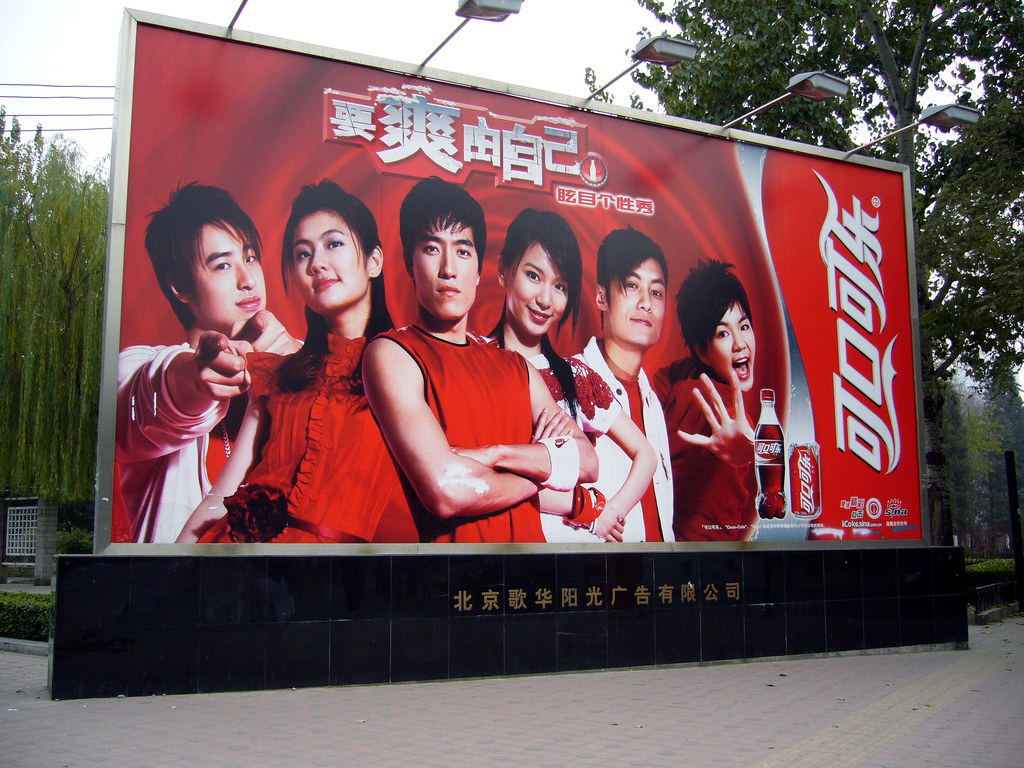
chinese_coke_billboard2
Chinese advertisements on television, radio, newspapers and magazines make Ron Popeil’s television (“Set-it and Forget-it”) advertisements for direct response products runaway Clio winners. This is of course my (and shared by many) opinion due to American and western advertising professionals provincial, desire for advertising to be an art. One of the reasons might be that some advertisements are so well done it lifts the entire profession. Of course we also are hoping and expecting that the ‘cool’ looking ad or commercial sells products or services. China ads on all channels are busy, noisy and – different.

And that’s the most important thing to keep in mind. Any experienced marketing or advertising professional knows that what might work in the United States probably won’t work anywhere else but in the United States. Local culture can and should play a significant role in helping determine the most effective styles in delivering advertisements.

Yet I cannot help but be surprised that their approach works when I watch, drive-by, and read advertisements in China. Actually that could be said for much of Asia as I have noted the same trends in Japan, Korea, and Vietnam. Would they not respond to a western-style ad – dry humor, bizarre demonstrations or lush graphics and photographs? It appears we have our answer since the ads just keep on running.

The literal sounds of bells, dings, whistles and cartoon–like sounds used in advertisements in Asia no doubt are effective. I do sometimes wonder how much testing is done in Asia to be assured that the current style is the only effective style. Of course the converse should also then be in play – Chinese-style ads in the U.S. Hey it’s only fair. Testing the effectiveness of a completely different advertising style is unheard of. Creative and sales approaches evolve slowly overtime and what is revolutionary (think Apple 1984 ad) doesn’t seem to be as much a generation later.

The one thing that has not happened to me is that when I see most Chinese ads I really have no desire to watch them again an hour later – bowing to an old an incorrect stereotype.

Watch or listen to a few Chinese broadcast sports, and look at the ads and billboards. Would a U.S and generally western style of advertising be better and more effective?

Posted in Advertising, Business in China, China, Communication | Tagged , , , , | Leave a comment

Chinese people want to know – is it really that bad in the U.S.?

As an American traveling through China for two weeks visiting five different cities plus Hong Kong the one overriding question I am asked is – ‘How are things in the U.S? It looks really bad.’ Think about being asked that question when you are 8,000 miles away from home and how you might answer.

While pondering an answer to the question of the decline in the U.S., in stark contrast is the increasing wealth in China. Inflation has begun to have a real impact in daily life China despite the Chinese Central Government efforts to hold inflation in check. The opportunities however remain substantial and a well-heeled upper class is emerging in China. I find that fascinating under the umbrella of living in a Socialist country.

As a marketing and business development agency the luxury market in China is exploding. The nouveau-riche in China demand goods that are authentic and are willing to pay for them – and at ‘bust-out’ retail prices. If you segment out 1% of China’s population as the top earners and holders of wealth, that represents more than 13,000,000 people. It’s safe to say that there are incredible opportunities to market to people within this segment. That’s a big reason western luxury goods companies are clamoring to gain a foothold in China.

Is China’s bubble possibly going to burst? The central government will continue to try to do everything it can to stop that from happening – or to at least minimize the impact. But for now the aura of positivity in China (and Hong Kong for that matter) continues to energize, intrigue, and impress me.

The Chinese people (and Hong Kong people too) often remark about the consistent stream of negative news from the United States. I have been in China nearly a week and have not been reading the U.S. newspapers as usual. Consequently I am missing my daily dose of what has been bad news on top of bad news. It’s making me think about cutting back on reading the depressing dailies. I have learned that I am not missing as much as I thought and I have a much more overall positive attitude being in China.

So back to the question – is it really that bad in the U.S.? Well things are not going well but if you were to view the U.S.’s situation from overseas by reading the news you would probably begin to feel sorry for the Americans. And since when did the United States become a county to pity?

I am not suggesting Americans act as if everything is fine and dandy. But I am coming to believe that we Americans are becoming prisoners of our own media’s desire to highlight what is going wrong with the country. Do all the ‘experts’ that forecast the likelihood of a ‘double-dip’ recession hope that it actually happens so they can boast that they called it right?

We all have the power to change the dialog and attitude. Why don’t we start by focusing on making things better instead of complaining about how bad things are?

Posted in Business in China, China, Living in the World Today | Tagged , , , | 2 Comments

When it comes to Global warming China is a contradiction

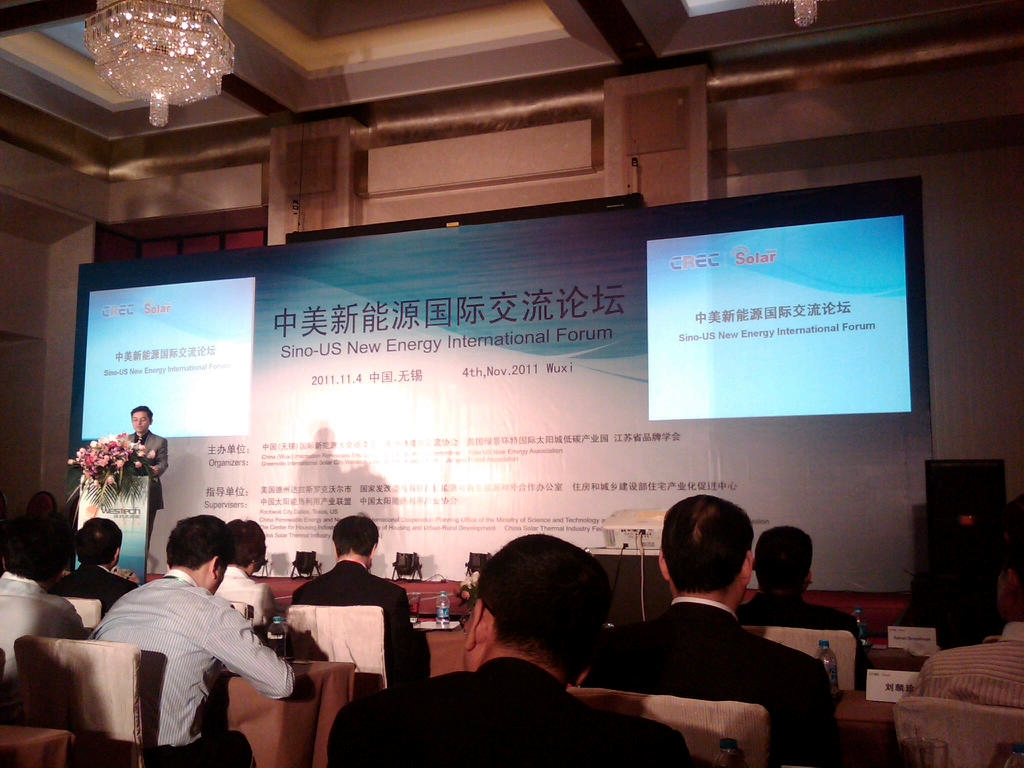
Today (my Friday which is now ending here in Wuxi (pronounced woo-shee), China) I had the pleasure of speaking at the 3rd annual International Renewable Energy Conference. I attended the same conference in 2010 as an invited guest. I was honored to be asked and as usual in China I was treated with such great respect and courtesy – something that no longer surprises me but still impresses me.

The focus of the conference was solar energy which offers a contradiction in itself since the sun did not shine during the 2+ days I spent in Wuxi. My Hong Kong friend Tom was in Beijing this week and texted me that as he landed in Beijing the haze was so thick the pilot could hardly see in front of him.

And there is a major contradiction. That a developing industrial country like China relentlessly building and that has factories spewing coal smoke into the air seemingly 24/7, would at the same time have such a large an dedicated group of scientists, intellectuals and business people trying to drive the country to ‘Go green’ – and do it fast.

What I find also to be contradictory is that the Chinese government is supportive of these conferences and the initiatives promoted by its growing anti-global warming community. As with most things when it comes to governments and development, money plays a significant role in driving behaviors and outcomes. China’s coal-burning factories burn cheap fuel and in an increasingly competitive world economy will be slow to change to cleaner burning and non-fossil fuels. That combined with the dust and sand that blows off of the Gobi desert makes Beijing one of the smoggiest cities in China – but not the smoggiest – http://bit.ly/tYLErr. That distinction may be awarded to Xi’an or Galin.

China builds many buildings complete with solar panels mounted on the roofs whether they are industrial or residential. China is a leader in producing and using highly efficient LED lights – and more than once I heard someone say that they notice in the U.S. they see energy saving-lights on outside during the day. Kind of defeats the purpose doesn’t it?

Buildings in China are warm when it’s warm outside and cold when it’s cold outside. This is in part due to a government conservation requiring people to sweat inside even if there is air-conditioning or freeze when it’s unusually cold as many places in of southeastern China do not have central heating as wintertime temperatures rarely dip below 40F or 9C.

Obviously there are many other contradictions in China when it comes to social and political issues that are well-publicized. I believe China wants to and is doing the right things to move toward a green economy but any expectation that they will shut down factories for good (as China did for a month or so before the 2008 Beijing Olympics) is completely unrealistic No country would throw away its development any more than China will.

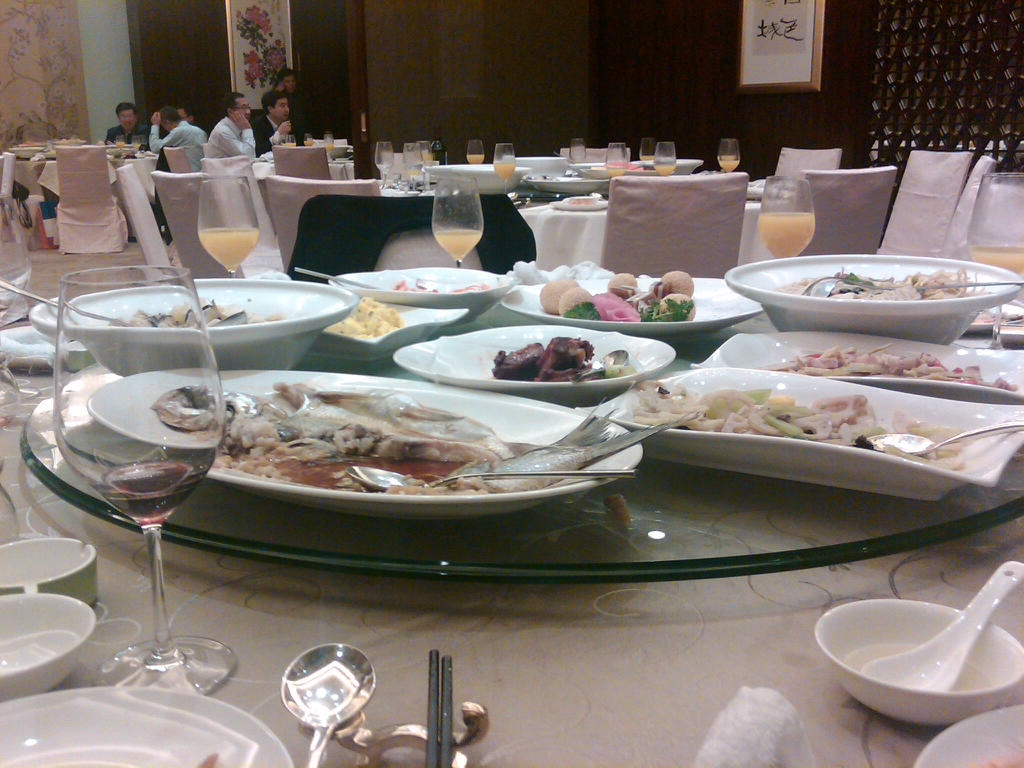
I will end on one note of over-consumption and that comes in the form of the photo of the aftermath of tonight’s post-conference banquet. The food was very good but never-ending. In a way that’s a type of contradiction too.

Do you feel the U.S. has its own contradictions?

Posted in Business in China, China, Green Products | Tagged , , , , , , , , | Leave a comment

China needs no excuses like the phrase ‘That’s China’

I arrived without incident in Shanghai Tuesday afternoon after a 14 ½ hour flight from Newark. The flight was just the way I like them – nice and boring. Before leaving I had decided to take the train to my hotel since daytime traffic in Shanghai can make the trip more than an hour by taxi. When I mentioned taking the train to both Americans and Chinese people I was met with mostly surprised reactions. It seems there are still a fair amount of successful New Yorkers and Shanghainese that do not take the subway.

As it turns out I took a Maglev train (8 minutes from point to point to go 30KM or about 18 miles), then connected to the subway line and took the subway to a stop near my hotel. The entire trip took about 40 minutes and was one-fifth of the cost compared to taking a taxi. I was impressed at how easy it was. The one moment I had when I was a bit confused as to which subway stop I should take was met with a Chinese person ready to help and in broken English (and my basic Mandarin) I was able to buy my 4 RMB (U.S. $ .70) ticket to the right station. From there I was able to easily walk to my hotel – one that I stayed in on my last trip to Shanghai (love the Marriott Executive Suites near People’s Park).

So far even thought I speak at least a little Mandarin now, I have noticed that English is prevalent and widely spoken here in the PRC. Street signs are in both English and Mandarin. It is remarkably easy to get around. Today after meetings I will head to the Hongqiao train station by subway to catch a fast train to Hangzhou – a city renowned for its physical beauty, the wealth of its denizens, and also the home of many successful companies.

Spending the next ten days here in China I am very focused on making this a successful business trip. This is my fifth trip to China (ok 4th as the first trip was to Hong Kong) in a little over 18 months. As yet I have not been able to generate a substantial engagement with a Chinese company looking for marketing expertise and campaign executions in the U.S. The phrase ‘That’s China’ is for some responsible for my slow progress. While I am well aware of cultural differences in doing business in China versus the U.S., I will not use that as an excuse. Nor should the Chinese use that excuse either. It’s too easy to hide the real reasons for not engaging with a western company behind a westerner’s inexperience.

To some degree the whole idea of marketing and branding is partially responsible for the problem. The Chinese are cautious in general and particularly so when dealing with foreigners. While that caution is understandable using a cultural barrier as a reason for not doing business is a bad policy and something the United States and other western countries have come to avoid.

Things are ever-changing in China – and that’s China.

Posted in Best business practices, Business in China, China, Travel | Tagged , , , , , | Leave a comment

College Parent’s weekend – a mobile experience

Our college freshman daughter is attending school in Florida which is a long way from where she grew up in Connecticut (which got dumped on by a freak late October snowstorm this weekend). For her, having her parents come to visit for parents weekend was even more important than it was to other students since most of her classmates are Florida residents and see their families more regularly.

Something I noticed over the course of the three days was how frequently the students and parents were using their mobile phones to communicate and to find things over the weekend. Our daughter would text her friends to find out where they were, where they were going, and who they were with. This coordination was important in making the experience better for all. In turn the parents (me included) and students would search out restaurants, movies and other activities).

Even at the football game I observed both parents and students checking their mobile phones at various points during the contest (there are many television time outs which means no real on-field action is being missed). After the game we knew exactly where and when to meet up with some of our daughter’s friends and their parents.

The moment to moment usage of mobile devices has inexorably changed college parent’s weekend forever – and for the better. When we are on our way to pick up our daughter we can text her when in the past you’d have to pre-arrange the time since there was a time not too long ago where there were not even phones in the dorm rooms much less mobile phones. Thankfully I did not see evidence of Moms, Dads and students all sitting around a table NOT talking and staring at their mobile phones. But I am betting that happened, I just did not witness it.

The mobile experience also allows for information to be shared between parents of fellow students that have just met. Discussions of future living arrangements are not practical during a whirlwind parent’s weekend and sharing contact information is easier on a mobile device and allows for a conversation at a less hectic moment.

I got a sense of a close knit community at parent’s weekend that I had not considered before. It’s a far cry from when I went to college and had the weekly phone call with my parents from the dorm hallway. In those days the calls were considered ‘long distance’ and the cost of those phone calls was a substantial consideration. I know that might be hard to believe for today’s college students.

Our mobile lives are getting more so. Do you think this is a good thing or bad thing?

I am on my way to China for the next two weeks so my next post will be from the other side of the world.

Posted in Communication, Mobile Communication, Technology, Travel | Tagged , , , | Leave a comment

The future of Yahoo.com is cloudy

Carol Bartz has been gone from Yahoo for nearly two months and there has been spotty news on management other than Timothy Morse being named interim CEO and Yahoo founders Jerry Yang and David Filo remaining ‘chief Yahoos’. Wednesday of this week David Kenny resigned as president and director of Akamai Technologies. Mr. Kenny is already on the board of Yahoo and there is speculation that he could possibly be the next chief executive.

This all comes as a backdrop as Yahoo appears to be both on and off the market. Last week Jerry Yang Yahoo.com co-founder and former CEO Jerry Yang said that while Yahoo’s board is famously exploring all its options, it’s not necessarily up for sale. “The intent going in is not to put ourselves up for sale. The intent is to look at all the options,” Yang said on stage at the AsiaD conference in Hong Kong. http://bit.ly/vGcKmQ

There are apparently many potential suitors interested in Yahoo and Yahoo’s still impressive reach. The list moves from AOL’s Tim Armstrong, to Microsoft, to Jack Ma of Alibaba.com (Yahoo owns 40% of Alibaba.com, a stake that Jack Ma had been trying to buy back from Ms. Bartz before her departure).

The real question many people (including me) are asking is, (despite what Mr. Yang is saying) does Yahoo have an independent future? Or will it need to be part of another company’s platform? In the case of Microsoft (think Bing) – Yahoo and Bing would together comprise nearly 35% of the search market (the balance is nearly all Google) and would be a formidable player in the search marketplace. I don’t see as good a fit with AOL (two somewhat tried and tired brands) or Alibaba.com but they have their reasons for wanting a piece of more than 100 million Yahoo unique monthly users (includes email).

Right now the valuation to buy Yahoo is as much as US $20 billion. The three leaders as noted above all have the wherewithal to make it happen. And of course Mr. Yang is a potential buyer himself.

How will this play out?

Posted in Marketing stuff, Media, Social Media | Tagged , , , , , , , , , , , , , | Leave a comment

Happy Holidays – have Americans finally learned how to do more with less?

Most Americans have been impacted by the difficult economic times that have occurred since 2008 (or even earlier for some). Being a very resilient sort, Americans have adapted to the difficulties in many different ways. American consumer holiday spending has been one of the most impacted areas.

A report that came out this morning regarding plans for spending in 2011 was eye-opening to me. According to the National Retail Federation’s 2011 Holiday Consumer Intentions and Actions Survey, conducted by BIGresearch, holiday shoppers say they plan to spend out an average of $704.18 on holiday gifts and seasonal merchandise, down slightly from last year’s $718.98. The report is forecasting overall holiday retail sales to grow 2.8% during the months of November and December to $465.6 billion.

Average Holiday Spending

Year Spend
2004 $699.98
2005 734.69
2006 750.70
2007 755.13
2008 694.19
2009 681.83
2010 718.98
2011 704.18
Source: NRF/BigResearch, October 2011

In addition, a new shopping poll conducted by Ipsos Public Affairs shows that given the current state of the economy, 45% of U.S adults plan to spend less this coming holiday season than they did last year.
Women are more likely than men to say that they are going to be cutting back their holiday shopping budgets (49% vs. 39%), as are adults ages 35 and older compared to younger adults (49% vs. 35%).

Consumer Spend Planning 2011 Holiday Season

Plan % of Respondents

Same as last year 42%
More than last year 11
Less than last year 45
Source: Ipsos, October 2011

There are several things that I find surprising. First is that consumer holiday spending dropped from over $750 million in 2007 to $681 million in 2009 rose in slightly in 2010 and is predicted to drop once again in 2011. Second is that 45% of consumers plan to spend less in 2011 than they did in 2010. Does the idea that nearly half of Americans will spend less on holiday gifts this year than they did last year strike you as significant and interesting?

Is there a better example of how the far the U.S. is from the go-go 1990’s and early 2000’s? I hope that if there is any positive thing to be gained from recessions and economic uncertainty, that it comes in the form of people becoming less focused on simply having and receiving more ‘things’.

There’s nothing wrong with living a little more simply is there?

Posted in Customer Experiences, Marketing stuff | Tagged , , , | Leave a comment