Jeremy Lin has made the New York Knicks ‘America’s Team’

At least for now. Only two years ago a friend of mine was completely joking when he was asked about his favorite pro basketball team (and mine) – the New York Knickerbockers when he said – you mean ‘America’s team?’ It was pretty funny at the time considering the Knicks of 2009-2010 were woeful and nearly unwatchable.

Unless you’ve been living under that proverbial rock you are no doubt somewhat aware of the NBA’s newest sensation Jeremy Lin (who is also on the cover of Sports Illustrated this week – no not the swimsuit issue although I imagine Mr. Lin would have been happy to pose with Kate Upton). The accolades are deserved and the story is irresistible (just ask anyone). However underneath it all is a very interesting development when you consider the dramatic change in the Knicks from being a bunch of guys who were on the court together at the same time, into a team that plays for each other and gives supreme effort all the time. And they play in a city that has fully and completely embraced them. Of course if they lose three in a row….the boo-birds shall return just as quickly.

New Yorkers are a hard-to-please and cynical bunch. And when it comes to basketball they know their stuff. I don’t recall ever seeing another crowd cheer defense the way they do in New York nor cheer when a point guard decides to run time off the clock by not penetrating or shooting near the end of a game rather than throw up an ill-advised shot or make a bad pass.

But it’s not only in New York that Jeremy Lin and the Knicks are causing people to pay attention. The Knicks are not only fun to watch (for the moment) and winning (seven wins in a row for a team that was languishing at 7 games under .500) they are playing with a spirit and intensity that have not been seen from them in a long time. Even more interesting is the all-for-one and one-for-all spirit that has been imbued. Lin’s teammates genuinely seem thrilled for him and are enjoying the ride nearly as much as Lin and the fans. The Asian community both in New York and around the world is nearly apoplectic in a way that was never quite the case with recently retired NBA star Yao Ming.

Boxer Floyd Mayweather’s tweet this week on Jeremy Lin – “Jeremy Lin is a good player but all the hype is because he’s Asian. Black players do what he does every night and don’t get the same praise.” was just so off base it makes him sound stupid and jealous. If Lin was black, had gone to Harvard, been undrafted, cut by two teams and then sat on the bench for over a month as a 12th man, then come into a game and turned an entire team (and city) around he would be every bit the hero he has become -not to the Asian-American community necessarily – but just about everyone else.

Lin’s humility and bemusement at the sudden turn of events over the past two weeks is endearing and genuine. That plays both in New York as well as on the national and international stage. Let’s see, an American-born Taiwanese playing in the nation’s biggest media market in the ‘World’s most famous arena’ with a team of guys both black and white that are united and (for now) indefatigable and unbeaten with a host of new fans as well as old who cannot wait to watch or listen to the next game so they can root for their newest heroes. And they seem to be having fun by working together and giving it all they’ve got.

Sounds like America’s team to me. Hey as a huge Knick fan let me dream a little longer and I hope I never wake up from this one.

If you have 4 minutes you can watch a video that outlines Lin’s development from college into a pro basketball star. http://www.youtube.com/watch?v=XFCZ01Hiv8o&feature=player_embedded

Posted in Community, Living in the World Today, Media | Tagged , , , , , , , , | Leave a comment

Cutting the cable cord but not the network cord – the crowdsource knows the score

Today (Valentine’s Day 2012) a company called Aereo announced (Barry Diller of IAC did the announcing) in the NY Times Media Decoder blog from Brian Stelter http://nyti.ms/y5uJfZ it will begin offering a new television service that will stream local television stations to internet users. It will cost $12/month. Many people already have ditched their cable television service so it’s not exactly ground-breaking. In fact what I found most interesting were the comments from readers.

Here are samples of a few and I found them to be extremely interesting and indicative of an audience that has a both a good understanding of the landscape as well as some interesting alternative solutions.:

“This could work in Manhattan. Antenna’s do not pull in hardly any channels for many of us in the city. I would happily pay $12/month for network television only.”

“I own a television machine, but I haven’t used it in years (I do dust it occasionally). But I do have basic cable through Time Warner only because I need to have that in order to get my high speed Internet service (talk about lousy deals).“

“On those very rare occasions I might feel compelled to watch a broadcast, I have Windows Media Center on my computer, which is hooked up to a $5 antenna (I bought that at the dollar store in my neighborhood and it works quite well). I pick up all the broadcast networks, their sub-networks, and several radio stations. Seems like a much better deal than yet another service like Aereo.”

“I use Remote Potato (an iOS app) with Windows Media Center to do this and it cost me the price of an antenna, digital tuner, and the app.”

“Good-bye TWC!”

“This is going to completely change the way cable service providers do business. NYC today, nationwide tomorrow. It will be interesting to watch how cable companies change the way they engage with their existing/ new customer base in order to remain relevant.”

“TWC doesn’t advertise it, or make it easy to use, but if you ask they will sell you basic broadcast channels only for around $18 a month. I’ve been using it for a few years, connected to a dedicated computer which I use as a DVR, netflix streaming box and blu-ray player. I tried an antenna but it didn’t work for me because I’m on the wrong side of the building. My total cable/internet bill is $53 a month. “

“TV service for $12 a month? That will soon double. Still, every cable TV outfit around will try to destroy these guys immediately. And I wonder how they plan to keep it only in NYC. Of course they will feature the same low quality programming and the same “all or nothing” menu that is the norm today. Let’s see what happens!?

“I don’t understand – they’re “offering” to make me pay for channels I can get over the air for free?”

“Bravo. Living in an area without cable. Satellite is the only available service. The monthly cost is too high for a very light TV user. This service is an answer to my prayers. “

“Add this to the list of streaming services that choke my cable broadband connection. Let’s take OTA HD programming (which is free and which already has its own spectrum) and stream it needlessly over the internet, doubling the overall bandwidth that it takes to watch TV and increasing the costs. Great idea!”

I actually learned a few things just from reading the comments and that’s the most interesting thing about the article itself. A $5 antenna? And who refers to their set as a ‘television machine’? Reader comments are not always that interesting but often are don’t you think?

Like Yogi Berra says – you can observe a lot by watching.
Posted in Advertising, Communication, Entertainment, Innovation, Living in the World Today | Tagged , , , , , , , , , , | 3 Comments

Better employee productivity should create new ‘new’ jobs

But it hasn’t quite worked out that way.

Last week’s news from Pepsi-Cola CEO Indra Nooyi that the company was planning to cut (for a change they did not use the word ‘layoff’ so these folks are not coming back) 8,700 workers http://www.investorplace.com/2012/02/pepsico-to-cut-8700-workers/ was greeted with little surprise. The total number will be achieved over several years and represents roughly 3% of Pepsi’s global workforce.

Companies reducing their workforces are in no short supply since the ‘Great Recession’ began in 2008. For the people that manage to hang onto their jobs, the constant cutbacks only mean they will continue to be required to do more with less – people that is. Longer hours, more responsibility await for those that remain.

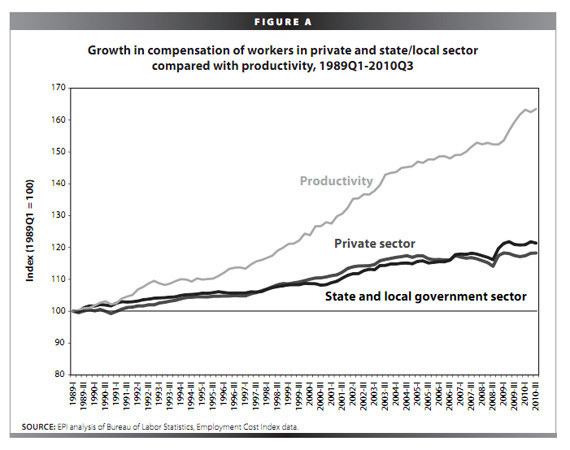
Worker productivity as a result of technology (starting with computers) here in the United States as well as around the globe has enabled the jobs of many to be inherited by the fewer. This too should not be met with much surprise but for whatever reasons befuddle both economists and politicians.

Why would a company want to grow from a total employee standpoint? Everyone who’s anyone in business knows that employees are expensive. The industrial revolution was the beginning of less relevance for employees.

Think about accounting and bookkeeping today versus forty years ago? Bookkeeping was a laborious process of physically entering data into a ledger with a good old-fashioned writing utensil like a pen or pencil which today has been replaced by electronic spreadsheets and computer applications. How much faster and more accurate (well, not always more accurate) is today’s bookkeeper versus one from 1972? Three times faster? Four or five times faster? Do you need more or fewer employees to perform the tasks? The ability to use fewer people to do the same or more work goes straight to the company bottom line.

Why hasn’t the explosion in productivity resulted in the creation of more new ‘new’ jobs? After all eight years ago who would have thought there would be a job such as social media community managers? And that the need for them would become so important? The problem is that the rate of old ‘old’ job loss is far greater than the creation of new ‘new’ jobs. Entrepreneurs like Mark Zuckerberg and even Groupon’s CEO Andrew Mason have helped create thousands of new ‘new’ jobs.

Groupon in fact is a very labor intensive business at present with salespeople all over the U.S. as well as other countries. You can bet the folks at Groupon are desperately looking for ways to automate the sales process so that they can dispense with the sales employees who are really nothing more than a necessary evil.

The government can do things to help create jobs like the ones that would be part of repairing the nation’s infrastructure. Most of those would be new old jobs and many of those jobs would not necessarily be long-term sustainable. The government (it has been said), can also help create favorable conditions to attract entrepreneurial people who then would be inclined take a chance in starting a company with what could be a next great idea. However that is much easier said than done.

It’s also easy (and obvious) to say that education, training, and re-training are essential to preparing people to operate in the new economy with the new ‘new’ jobs. The old ‘old’ jobs are not coming back. Steve Jobs even said so.

Who out there these days is working fewer hours and is making more money at the same time?

Posted in Best business practices, Living in the World Today | Tagged , , , , , , , | Leave a comment

How about using the fancy crystal and fine china every day?

I was doing dishes the other night (bad luck again), and was in the process of washing the nice Reidel http://www.reidel.com crystal wine glasses we have had for more than fifteen years. I remember when we received some as a gift and then because we liked them so much went out and bought a few more.

Reidel, Spiegelau and other premium crystal manufactured glasses are expensive, sometimes very expensive. These wine glasses can cost fifty dollars apiece and sometimes even over one hundred dollars (we do not have any of those). Because these fragile crystal glasses can break in the dishwasher (some of them are more prone to that than others) the advice is to wash them by hand. Of course that’s a pain and a reason to avoid using them in the first place. But we don’t do that.

I have a thing for nice wine glasses. We use the ‘good wine glasses’ several times a week (we have a glass of wine with nearly every dinner we have at home) and there’s a certain feeling of elegance in using a high-quality product as an everyday glass.

Do you have a place in your home where you keep the ‘good’ glasses and china that you only use on special occasions? How long have you been doing that? If you don’t use them they hardly ever will break and perhaps that’s your intention. But I am telling you that you should consider using the good stuff every day. So what if you break a glass or plate now and then. The idea of making every day a little bit special will have a much longer lasting positive effect on your attitude. It will have a far greater impact than bringing out ‘the good stuff’ out a couple of times of year for guests who probably not will not remember a dish from a glass twenty minutes after they leave your house.

These thoughts came to mind when I was unpacking boxes after a recent move and I saw some nice things we have that we never use. We have put them into everyday use and are enjoying dishes and glasses as if we had just gone out to the store and purchased them last week.

Why not make everyday a little more special by using that nice stemware or china all the time?

Posted in Living in the World Today | Tagged , , , | Leave a comment

When will a LinkedIn Profile replace a resume?

I have looked at many resumes over the years. Most of them are conventionally boring as if a resume writing service had advised the candidate to play it safe. Consequently most resumes are anything but memorable.

Your resume should supposedly be updated continuously. There are several reasons for this suggestion but my sense is that having an updated resume ready for anything saves you the anguish of having to update things from your career over the past however many years. And if you are anything like me you probably don’t have a resume at all. I’ve not had a resume updated or otherwise for more than two decades. But having an up to date LinkedIn profile (for me) suffices as a living and breathing version of my work history and interests – that’s pretty much what a resume does don’t you think?

I don’t necessarily regularly update content related to my work experience but even there I do change things periodically to update what I’ve been working on, new skills and projects etc. Since I am not currently looking for a job why do I keep my LinkedIn profile updated? The primary reason is that I want people have the ability to get a sense of what I have done (work experience and projects), like to do (groups I am in) and people with whom I associate. It also is a place where I consistently post content and comments on things that I find to be of interest. A traditional paper or email resume seems so limiting.

How about having a video of you talking about what you have done and can do on your LinkedIn profile? But be prepared to update that video from time to time to keep the content fresh! A LinkedIn profile is self-reported (at least most of them are) as is a resume. But as I have said many times, whenever I have a first business conversation or correspondence with someone I immediately check on their LinkedIn profile. Even if I cannot see all that much because I am not connected it does give me a sense of background, work history and schooling, not all that much less than a resume! In fact when I go to LinkedIn and see that someone does NOT have a LinkedIn profile I am both surprised and a bit aggravated.

I will admit my LinkedIn profile is far from exemplary and in no way should be taken as any kind of standard. But it has so much more about me than any resume ever would.

What do you think? Will resumes go the way of the fax machine?

Posted in Best business practices, Communication, Living in the World Today, Social Media | Tagged , , , | 5 Comments

Super Bowl XLVI was great – the ads not so much

Giant fans are still rejoicing this Monday morning following an entertaining and closely contested Super Bowl. The drama went down to the wire and when Tom Brady and the Patriots were facing a 3rd down and 16th and Brady connected for a first down I thought Brady was on the verge of doing something legendary. It turned out that did not happen and the Giants held on in one of the best games in the history of the Super Bowl.

In addition to football, Super Bowl Sunday also offers the Super Bowl of advertising. At
$3,500,000 per 30 second spot the ad inventory was again sold out for this year’s game and the broadcast will likely have reached more than 110 million people around the world. Since big money and big stakes were at hand the anticipation was high prior to the game for some ground-breaking advertisements. Like the Patriots final drive – most of the Super Bowl ads fell flat as far as I am concerned.

Like many, I watched a number of the preview spots before the game. I liked the longer web version of the Honda CR-V spot with Matthew Broderick reprising Ferris Bueller. It was a great job of melding story and product. Clint Eastwood took on Eminem’s role as spokesperson for Detroit in a great spot from Chrysler/Jeep. Tweets during the game suggested Clint should be running for President.

But for me, many of the spots were just okay at best and some worse than that. The Teleflora spot with the gorgeous Adrienne Lima ended up being patronizing and annoying. And the Coca-Cola Polar bears spots left me scratching my head – didn’t they do that already? Sort of like Career Builder and the chimps. I didn’t think they were that great the first time around. GoDaddy – ugh. The madcap Doritos spots are somewhat amusing and the bag of chips looks shiny but far from brilliant advertising. The Taxact.com spot suggesting that peeing in a pool was akin to the relief you will get by using their product was by far the strangest association. I suspect the Taxact.com website was not crashed by customers clamoring to learn more during or after the game.

Volkswagen about a dog getting in shape was several steps down from the Darth Vader spot of 2011’s Super Bowl. The Cars.com double headed dude was just kind of creepy although I did like the song. Jerry Seinfeld and Jay Leno for the Acura NSX were a nice combination highlighting their well-known reputation for being car collectors. And the car looked great. Toyota and Lexus ran a few spots that were ho-hum. The same is true of Budweiser and Bud Light (dog trained to get beer – didn’t they do that already?). The Skechers spot with dogs wearing shoes was fun. Bridgestone’s quiet technology exhibited by Steve Nash dribbling a basketball that made little sound was interesting and well done. GE did a couple of nice brand spots that were a welcome relief from the inanity. NBC did a nice job promoting its new show SMASH.

Overall I cannot pick one spot that was head and shoulder above all the others.

How about you? Share your best and worst spot thoughts with us.

Posted in Brand Advertising, Communication, Marketing stuff | Tagged , , , , , , , , , , , , | Leave a comment

What is it about IKEA?

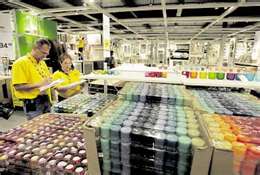
Less than two weeks ago I made my first trip to IKEA. I realize that this puts me far into the minority and now that I have been there truly EVERYONE has been to an IKEA – or so it seems. My wife and I went to IKEA as the one snowstorm this year was waning, as she we figured it might not be as crowded as it usually was (she had been to an IKEA before). She was right and we parked near the entrance.

Prior to making the 40 minute car trip my wife went online and sketched out a couple of ideas she had for a wall unit and printed them out. We were going to try to make our own wall unit and from what I could tell it would be relatively inexpensive. That’s the first reason people go to IKEA right? I mean that the merchandise is for the most part contemporary, modular, fairly well made (to me more sort of an upscale particle board) and there are choices in colors and finishes.

We were able to find someone to help us narrow our choices based upon what we sketched out. Apparently finding someone to help in IKEA is no small accomplishment. He was a very nice septuagenarian (or at least it seemed like that), somewhat computer literate and very earnestly tried to help us. It took quite a while. The computer system was cumbersome and not all that user-friendly (my wife noticed that as well when she was attempting to design something). Once we finally found something we thought we might like it turned out that IKEA had discontinued the line so had we bought the material in stock (which it wasn’t) we would have not been able to replace anything going forward.

We had been in the store for 90 minutes (seemed longer to a guy like me who is a buyer and not a shopper) and like many people came up empty. In fact had we decided on a purchase, the ‘IKEA way’ is for us to go downstairs, pull the material we wanted off the warehouse shelves (like doors and cabinets) and roll it up to a register to pay. After that we would have had to arrange for delivery since we were not going to be able to fit it all in our car. I was assured by my wife that process (had we undertaken it) would have taken another hour. Whatever happened to time is money?

But then it got aggravating – that is, trying to get out of the store. Like Connecticut based Stew Leonard’s, IKEA has you trudge around and around the store through aisles and aisles of products (none of which were of interest), just to get to the exit. No exaggeration – at least ten minutes of going around thinking (hoping?) we were close to getting out only to see yet another turn down another aisle. I kept thinking I sure hope the fire sprinklers work well since if there ever was a fire there was no way you were getting out in time.

I had much higher hopes as the IKEA brand perception I had going in was much different than what I had going out. People seem to love IKEA.

But again I ask – what is it about IKEA?

Posted in Best business practices, Customer Experiences | Tagged , , , , | Leave a comment

Generic brands don’t always mean the lowest price

In the era of stretching a paycheck, generic brands have moved from the fringes to the mainstream. Every day people consider the value of purchasing a ‘non-brand’ when visiting a supermarket, or big box retailer like Costco, Target or Wal-Mart. What people might find surprising (it was to me) is that a generic brand does not necessarily mean the product will be less expensive than the ‘name’ brand.

Wasn’t the whole idea behind generic brands hatched as a way for consumers to pay less while the store could keep a greater share of the profit? An article in Tuesday’s Wall Street Journal http://on.wsj.com/AbOAMK offered some interesting thoughts regarding store brands. It seems at times people actually prefer the store brand to the more established name brand. And they are even willing to pay more for the store brand. What the heck is going on here?

When I shop and consider a store or generic brand versus an established brand I go through the same checklist that I’m sure is the same as many people. If I decide to buy generic or store brand paper towels my expectations are lowered a bit (thinner ply and not as absorbent) but will only buy if the price is considerably lower. Sometimes it is lower, but sometimes the name brand is having a special and the value is better. It rarely (if ever) enters my thinking that I would prefer the ‘private label (fancy name for store or generic) brand.

From the WSJ article:
‘Private-label products still cost an average of 29% less than their nationally branded counterparts. But they are rising faster in price, at a rate of 5.3% last year compared with the industry average of 1.9%, and can sometimes be the most expensive product in a category, according to market-research firm Symphony IRI.
Target’s two-pound jars of Archer Farms roasted almonds, prominently displayed on the end of the nut aisle, recently cost about 16 cents more per pound than Planters’ roasted almonds.’

That Target has been able to create a store brand that costs more than the established brand impressed me a great deal.

The article also noted that Procter & Gamble Chief Executive Bob McDonald said the maker of Pampers and Tide has been balancing its exposure to chains with store brands by expanding distribution in other channels like dollar stores, which don’t sell private labels that compete against P&G products. They are also redoubling efforts to develop new products, particularly at lower prices. “We invest $2 billion a year in research and development, $400 million on consumer knowledge and about 10% of sales on advertising,” Mr. McDonald said in a recent interview. “Store brands don’t have that capability.”

Sounds like someone who is not sure but is hoping he’s right.

Is this a wake-up call for traditional established brands?

Posted in Advertising, Brand Advertising, Customer Experiences, Living in the World Today, Marketing stuff | Tagged , , , , , , | Leave a comment

J.C. Penney sets out on the comeback trail

Newly hired Ron Johnson, recently of Apple, has taken the reins as new CEO at 99 year old retailer J.C. Penney. It was called Golden Rule Store prior to 1913 having been founded in 1902 by James Cash Penney (I guess his parents had a sense of humor). Mr. Johnson was the brainchild behind Apple Stores and Genius Bars and has taken on a fairly monumental challenge to refurbish a true American institutional brand. Prior to his stint at Apple Mr. Johnson was with Target so he has retail big box experience. An article in Daily Finance offers a good background http://aol.it/ifrUoG.

Mr. Johnson unveiled Penney’s new strategy and logo this week (a square signifying a square deal). One of his first moves is to eliminate the seemingly unending promotions and sales. In fact J.C. Penney had 590 such promotions and sales in 2011. He also will be streamlining pricing to be more consistent, around 40 percent off previous prices, all the time. And as reported in Macnn.com – http://bit.ly/A5gC3X when sales happen, they will be month-long events, and the company will strive to offer “great prices” on items every day. It will also price items in whole numbers, meaning a $20 price instead of $19.99.

I have written (unflatteringly) recently about the trials and tribulations at Sears http://wp.me/pJX7l-y6 and while I’ve not set foot in a J.C. Penney store (at least not that I can recall which says something in and of itself) in a year or so, I feel Mr. Johnson has got the right stuff and is saying and doing the right things to refurbish the J.C. Penney brand.

Having a brand stand for something and have that position understood by consumers is the challenge that Mr. Johnson is taking head on. I like that. He’s also avowed to invest $80 million a month in advertising and promotion. I like that too!

What’s your take on J.C. Penney? Is it a tired brand beyond repair?

Posted in Best business practices, Living in the World Today, Marketing stuff | Tagged , , , , , , , | Leave a comment

The U.S. pushing China on trade practices won’t work

It’s an election year here in the United States. 2012 will also mark changes in the Chinese government as well. The backdrop to all of this is a seemingly constant stream of rhetoric from the U.S. that China has unfair trade practices. President Obama made reference to that in his State of the Union message this past Tuesday calling for the creation of a new trade enforcement unit that will be tasked with investigating unfair trade practices in countries, he said, “like China”. Both President Obama and the Chinese government know that any punitive action as a result of this investigation is highly unlikely.

I’ve been to China a handful of times over the past two years and our company is doing business by helping Chinese companies in the U.S. as well as helping U.S. companies enter the Chinese market. I’ve learned a great deal and have much more to learn in the coming years. However I have learned a number of very important things. Here are three to think about:

1) The Chinese will not be pushed around. It’s like when you are being yelled at by someone and you eventually just tune out. Jumping up and down demanding that China accede on trade practices and currency valuations will have little or no impact on how China will act.

2) Win-win does not mean the same thing to the Chinese as it does to Americans. I can hardly count the number of times I’ve had a Chinese businessperson tell me Win-Win right? With a smile and a handshake. Win-win to the Chinese means the company wants you (the U.S. side of the venture) to take all the risk in helping them develop their business in the U.S., and for the most part, non-major Chinese companies are unwilling to invest any money in developing the U.S. market. This should not be all that surprising given that just a little over thirty years ago the notion of marketing and advertising was as foreign as – well, a free society.

3) It is an understatement to say that it takes patience to have your China market strategies bear fruit. When I tell my Chinese associates and U.S. expatriates that we’ve been able to gain client engagements in China in less than two years they are amazed and impressed. For me it feels as if it’s taken a really long time with constant work, some missteps and changes in strategy. I’ve been told repeatedly that having success in anything less than three years is unusual.

I believe most Americans are smart, smart enough to realize that starting a trade war with China will not help the U.S. get its goods and services into the fast-growing market any faster. Yes of course we all desire a level playing field and at the same time it’s frustrating to have to deal with the subsidization of Chinese enterprises by the PRC government. However the U.S. and other western countries will be far more successful if they try to find more collaborative methods to effect policy when it comes to the Chinese.

The Chinese are not focused on helping the west rebound from its financial difficulties. China has its own problems. But the Chinese are aware that they are holding the right cards at the moment. That China will continue to try to exploit its hand should come as no surprise to anyone.

But somehow that doesn’t seem to be the case. Do you think I am being naïve? Practical? Neither? Both?

Posted in Best business practices, Business in China, China, Living in the World Today | Tagged , , , | 2 Comments