No I-Pad for me. Yet.

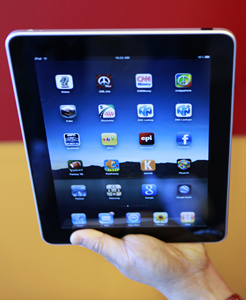
Before I left for China a couple of weeks ago I had intentions of purchasing an Apple iPad possibly ahead of the April 3rd release date here in the United States. The Chinese government had different ideas and delayed the launch in Asia (it still has not launched) where often tech items are released there in advance of the U.S. Since the Apple iPad’s launch last weekend much has been written about the experience. Based upon what I’ve been reading (a lot) I’m less in a hurry to have one than I was before.

One of the early comments I really liked was that the iPad was a ‘lean back not a lean forward device”. New York Times columnist David Pogue http://nyti.ms/bziIpy had several interesting perspectives on the iPad. The Apple iPad has no flash, no USB port, no camera, and touch screen typing that rally needs to be lay-flat to use. Maybe that’s the lean-forward thing but if it is that’s far from ideal. Walter Mossberg in the Wall Street Journal and “All things Digital” http://walt.allthingsd.com was more positive but managed to suppress some of the less attractive features.

Another noted pundit/blogger Jeff Jarvis http://www.buzzmachine.com is not impressed at all. And while he demonstrated much more passion in his dislike he makes some very good points.

Full disclosure I’ve not held an iPad in my hands. But the display is supposedly brilliant although in broad daylight I imagine there will be some difficulties. You won’t be taking you iPad to the beach. Also as a replacement for your laptop it is more portable but far from a content creator. So if you want to read on the road and rid yourself of all the newspaper subscriptions and receive them on the iPad – that may indeed be greener but it won’t be any less expensive once you factor in the cost of the iPad as well as the monthly service ($60 or more depending on if you want both wireless 3G as well as cellular coverage). And then you still have to pay the publisher for the electronically delivered content. Carrying the iPad around may not be a joy however. And there’s no phone so you still need a phone since the iPad is an overgrown iTouch. And what will you carry it in? I see a sub-market for iPad carrying sleeves, cases etc. There will be even more outlay for you buyers way beyond the apps you will buy for the iPad.

I can see that an iPad (or like device since HP has one in development to be released by Christmas 2010) will ultimately be used as your own personal television receiver. And it promises to be a terrific viewer experience with vibrant color and dynamic image reproduction. Complete with the ability to truly be interactive with the viewer (watch an ad – touch the screen and engage with the brand), the ipadTV (and HPTV) will very likely change the way people consume content. I like that idea.

I was a first adopter of the Amazon Kindle and as those of you that follow this blog I have had my issues with it but by and large have enjoyed the experience and am happy with the way Amazon has handled interactions (I still have an original Kindle but am on my 4th Kindle never having paid for anything other than the first one).

But being a first has its benefits and detriments. Being an early adopter of tablet computing appears to be the way I am headed. I am going to stand on the sidelines a little longer. After all this is the tip of the iceberg and tablets will get better and get better quickly. Steve Jobs is a really smart guy. And being first here seems to me to be the primary motivation. Remember all the nasty things that were said about the iPod and how did that work out?

How about you – who’s got an iPad,? What do you think? And if you don’t but are thinking about it why are you waiting?

Posted in Customer Experiences, Living in the World Today, Marketing stuff | Tagged , , , , , , | Leave a comment

A $ 16 million fine on Toyota is not a wakeup call

This morning it was reported that the U.S. Transportation Department is seeking a $ 16.4 million fine against Toyota http://nyti.ms/c6UgOS. This is the largest fine allowed. Toyota has two weeks to contest the fine.

How exactly is a fine such as this going to be anything but window dressing? The accelerator problem is said to likely cost Toyota in excess of U.S. $ 2 billion. A Japanese bank has been asked to lend Toyota more than $ 3 billion. Toyota has held been the most profitable auto maker in the world (well at least up until recently) with sales of more than $ 11 billion worldwide.

While $ 16.4 million is no trifling sum how exactly is this kind of fine going to get Toyota and other automobile makers to pay closer attention to their responsibilities on overall car safety? My sense is that with faulty accelerator caused crashes (and deaths) of Toyota vehicles and a potential loss of sales of more than 10% ($ 1 billion or more) Toyota is standing at rapt attention.

So exactly what does the U.S. Transportation Department feel the issuance of a maximum fine will accomplish? And by the way what would the U.S. Transportation Department do with the money if in fact Toyota decides to not contest or the court rules the fine is allowable?

Toyota has had a marketing slogan since 2004 ‘Moving Forward’. Apparently that is not the problem. They have much bigger problems to with which to contend.

Maybe the Department of Transportation is thinking that they are going to teach Toyota and other automakers a ‘lesson’. I don’t get it. Do you?

BTW – I am just about ready to post on the I-pad but need a couple of days to actually hold one in my hand. The Chinese government held back the release of the I-pad while I was in China. They do that kind of stuff.

Posted in Customer Experiences, Living in the World Today, Marketing stuff | Tagged , , , | 1 Comment

How I turned a holiday into a business trip

Having talked about doing business internationally in previous posts the opportunity to do business in China is too alluring to pass up.  Sure I came to visit my great friend but in the back of my mind I also wanted to figure a way to have our company offer its marketing expertise to Chinese companies looking to market their products and services into the United States.

Before you roll your eyes on why someone would WANT to turn a holiday into a business trip keep in mind that I have been in Asia for a week already and have had an amazing and inspiring trip.  But I woke up yesterday (Monday) morning and had the itch to engage and connect with the business world of Hong Kong and China.   I had already scheduled to attend the Rotary club luncheon in Wanchai at the Grand Hyatt in HK.  I’ve been a Rotarian for nearly ten years now (contrary to the belief of some there is no secret handshake – check it out if you have minute or two – www.rotary.org and our club www.wiltonrotaryclub.org)  Rotary is the only service organization to have a permanent seat at the United Nations and it’s tenets under the ‘Four Way Test’ http://bit.ly/5Wfzse are simple and can be appreciated by anyone regardless of their religious or other affiliation. ‘Is it the truth? Is it fair to all concerned? Will it build goodwill and better friendships?   Will it be beneficial to all concerned?  

I had never attended a Rotary club meeting outside of our club in Wilton.  At yesterday’s lunch I met a remarkable group of professionals – all highly accomplished, all highly motivated to help others and all interested in what I was doing and what was going on at our club.  I received advice on how I might go about setting up our company to do business in Hong Kong and China from several people.  I also met a Rotarian who owns a business that is to market Chinese-made products into the U.S. – and we are going to discuss ways in which we might work together. 

Another suggestion I received was to join the American Chamber of Commerce in Hong Kong – one of the largest American COC’s in the world outside the United States.  I am a member of our local Chamber of Commerce in Wilton but rarely attend any events as the focus is mostly local to Wilton and we do little if any business locally.  So today I am going to attend another lunch (the lunch yesterday at the Grand Hyatt was a full Chinese 7 course deal and was truly excellent) and will aim to meet more people to learn about what they are doing and how we might work together.   My biggest issue – I did not bring enough business cards (very important in Asia)!   After all this was supposed to be a holiday.  But I am way past that now. 

First rule – if you want to do business in Asia (or anyplace else) – you have to go there and look around and put yourself into what some people might consider uncomfortable situations.   I don’t consider meeting new people in new places uncomfortable in any way.  It drives me and makes work seem like play.  I cannot wait to come back to Asia. 

I’ll next post from the other side of the planet.  What a world we live in.

Posted in Living in the World Today, Marketing stuff | Tagged , , , , , | Leave a comment

Hanoi – my 33 hours in the 3rd world

Operating out of Hong Kong offers many places to visit rather easily in Asia.  Since funds were not unlimited we decided upon Hanoi since it was a less than 2 hour flight and were able to work a deal through ‘Last minute travel deals’ out of HK which included airfare and two nights at the Fortuna Hotel in Hanoi.  It was an experience my friend and I will not soon forget.

I’ve some friends back home who have already been to Hanoi with their families.  All told me it was an interesting place and even made some recommendations on what we should do.  However I was not completely prepared for the cacophony and tumult that is Hanoi.  The notion of visiting Hanoi as a tourist destination was unthinkable 35 years ago at the close of the Vietnam War.  Today Hanoi is thought of as an up and coming city.  That is true in a comparative sense but it still has a way to go to be a tourist destination that would appeal to substantial numbers.  Westerners in particular. 

The late night trip (we arrived at 11:30PM a bit late but close on HK Airways) from the airport to the hotel was a serpentine run around a great deal of construction going on, cars stopped in the middle of the road, slow-moving vehicles and boarded up houses.  It was dusty and the ride took almost 45 minutes.  Nearly everything closes down in Hanoi before midnight.  The socialist party must feel it is best this way. 

Our hotel itself was relatively nice in view of the surrounding area.  Catering to a bit of a more well-heeled crowd it contained both a nightclub and a casino (that catered only to foreigners – no Vietnamese allowed was the sign posted outside).  We elected to pass on trying our luck in the casino.

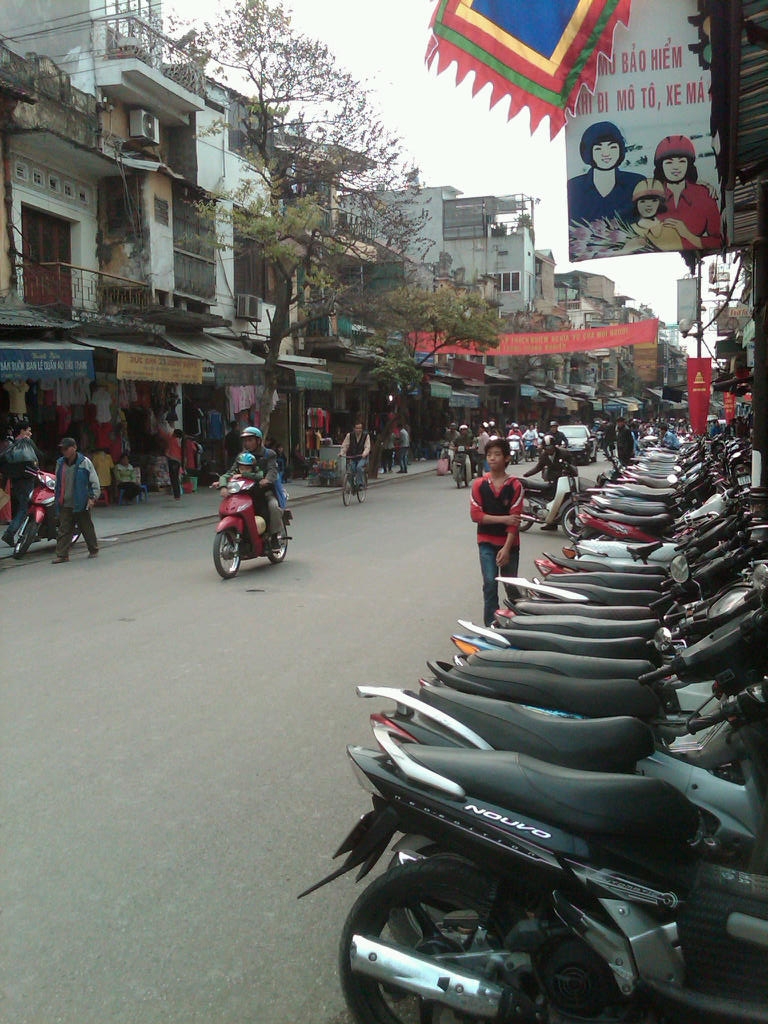
Saturday morning we were up early and we had a nice breakfast (included) in the hotel complete with a pretty good omelet and I had a bowl of Pho (local brothy noodle soup).  I actually did not order it and I think it was destined for another guest but as this was a buffet I decided to eat it and was glad I did.  We took a taxi into the old quarter and the march of the motor scooters was in evidence.  Hanoi has more motor scooters than I have ever seen in my entire life combined.   People travel by scooter often with small children (even infants) either behind or (worse) in front on the handlebars.  Traffic is non-stop and walking across the gauntlet was daunting at first as we felt we had to be hit eventually but somehow the drivers managed to veer around us making us feel like pedestrian scooter matadors.  By the end of the day we paid little mind to the scooter parade.  But it still was a remarkable sight.  

While we were having coffee at a place recommended on ‘Lonely Planet’ we noticed a couple emerging from a car in full bridal gown and suit.  Apparently weddings begin early and we noticed that after a short while the bride (who was pregnant, but we did not see any shotguns) and groom came out and went down the street to another location where the reception was to be held. 

We took in the ‘famous’ Hanoi Water Puppet Show (front row seats for $ 3.00 U.S.) that traced the history of Vietnam and was done with music, singing from the side ‘band’ to complement the puppets.  Maybe it was the beer from lunch but we did manage to snooze for a couple of minutes which actually was quite relaxing. 

At about 19,000 Vietnamese Dong per dollar buying things is cheap in Vietnam.  It does put you off when a meal costs 200,000 dong until you realize that’s about $ 11.  And you get a lot for your money.  Local ‘Legend’ Beer, Fresh spring rolls, and of course more Pho – the food is excellent.  We toured the market outdoor which was interesting but convinced us to shy away from street food.  Goods are also inexpensive and each had a 60 minute full-body massage (get your heads out of the gutter folks this was totally legit). $ 6.00 each plus tip. 

When we decided to return to the hotel that evening we hailed a taxi (also cheap) and were treated to a somewhat harrowing ride from a maniacal taxi driver.   Saturday night in Hanoi is cruising night and the throngs of scooters, cars and taxis was something we will never forget.  At one point the driver bumped a scooter in front of us and cackled ‘motor scooter, motor scooter’, he then stuck his head out the window yelling something in Vietnamese that seemed to scare the scooter rider off. 

I got the feeling that the days of the week do not matter much in Hanoi.  People work to live.  And that was one of the most refreshing things about Hanoi.  Despite their Spartan lifestyle the Vietnamese smile often (in contrast to the Chinese I’ve seen in Hong Kong) and appear willing to help in any way they are able.   We could all learn a few lessons there. 

Two more days to go.

Posted in Customer Experiences, Living in the World Today | Tagged , , , , , | 1 Comment

Hong Kong – ahead and behind all at the same time

Hong Kong is 12 hours ahead of New York.  15 hours ahead of L.A. and San Francisco.  By the time we start our day back in the states it’s evening in Asia (and a bit later than that in Australia).   They say the sun rises first in Asia.  Many things happen first in Asia.  The rampant usage of mobile was one of those things.  People all over Asia can use their mobile phone while on the subways.  Something that is sadly lacking in New York and I’d imagine in many other American cities. 

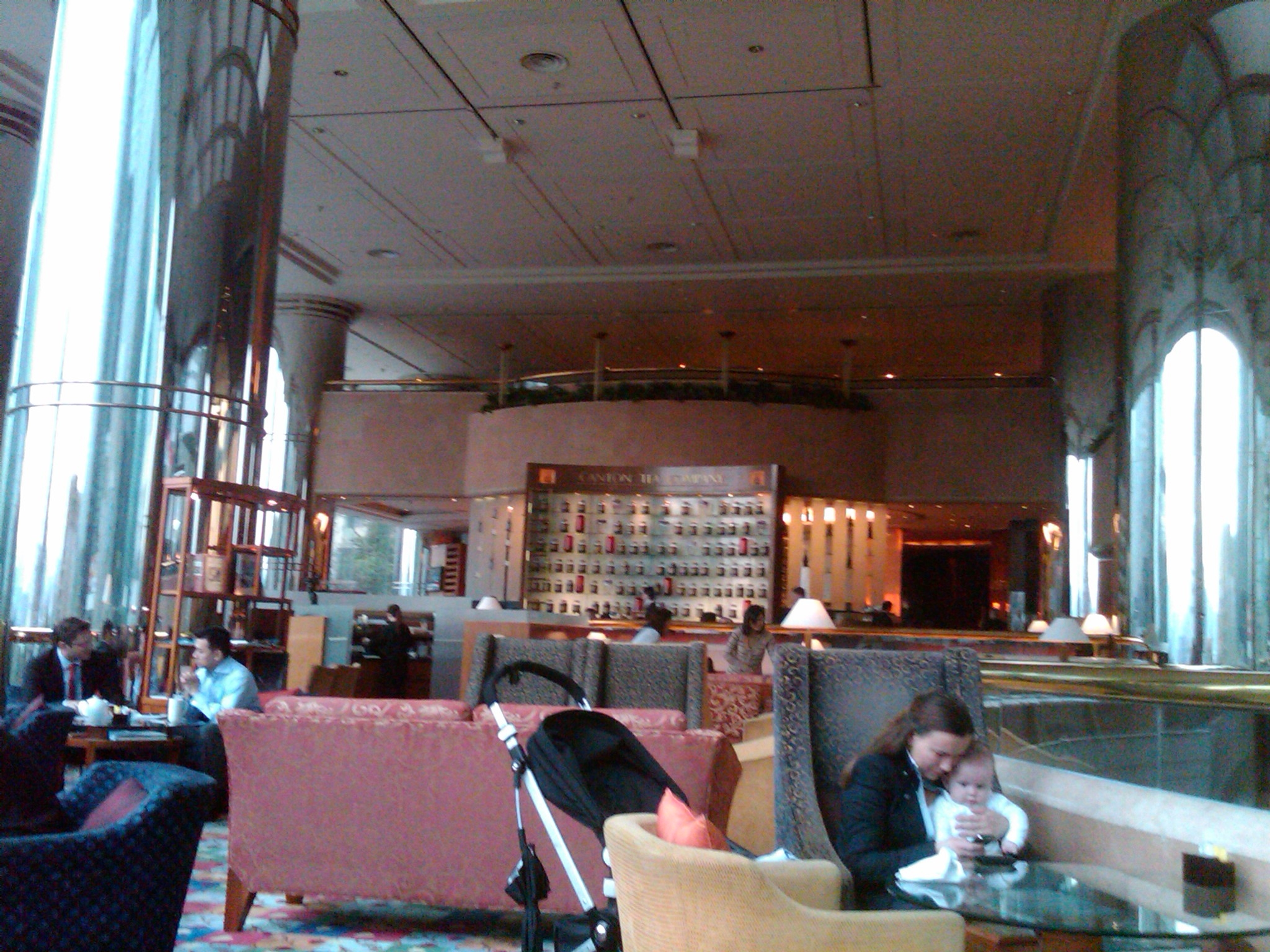
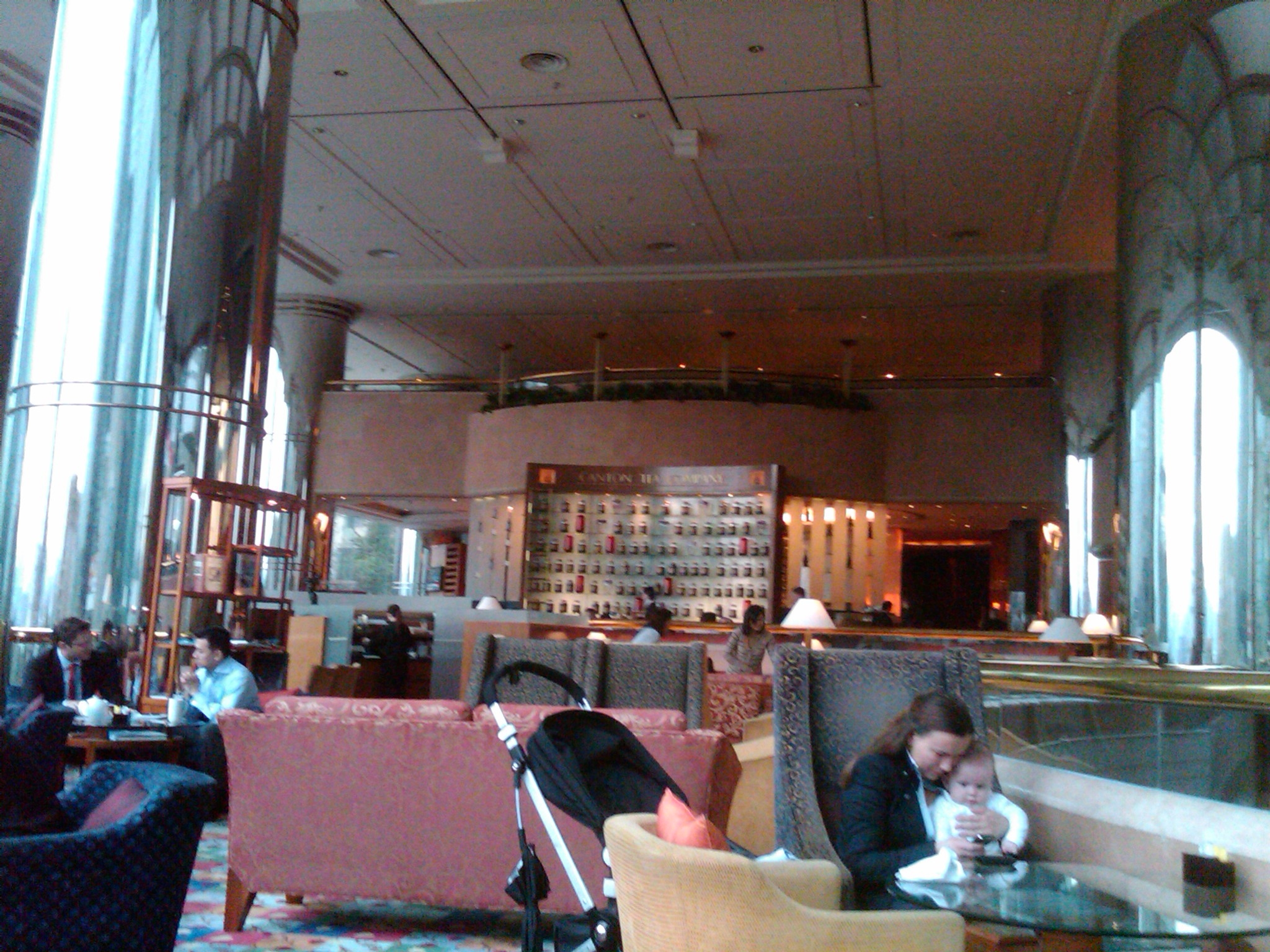
Business is also done differently in Asia.  I sat in the JW Marriott yesterday afternoon having tea looking out over the Kowloon Peninsula and Victoria Bay.  It was about 5PM and there were several business meetings going on all around me and they were conducted in a number of different languages.  There was French, German, Russian, of course Cantonese as well as a bunch of Brits and Aussies.  I overheard snippets of several conversations and all of them seemed to be about making deals, investing in different projects and properties.  Because HK is full of people from all over the globe, business meetings take place in many public locations – hotels, coffee shops (Starbucks and Pacific Coffee Company are particularly popular meeting locales).  This happens to some degree in the United States but Americans are still more married to their offices and desktops. 

But creative innovation is Asia is behind the curve.  Traditions die hard here too and Asian history is so much longer than that of the United States that the ability to break with traditions can be very challenging to say the least.  Attitudes also are difficult to change.  Although people from many different cultures interact on a daily basis, there are outwardly visible prejudices and judgments made not only by the Cantonese but many of the people in Asia.  The U.S. has prejudices that remain as well but in contrast to Asia they are not as deep rooted simply because the U.S. has not been around nearly as long. 

The U.S. continues to have an advantage in bringing new ideas to market and overall how to manage business development.  Hong Kong is an old city with lots of old money.  Shanghai and Beijing represent the future in China.  Do you wonder what will happen to Hong Kong in 37 years?   I do.

Posted in Customer Experiences, Living in the World Today | Tagged , , | Leave a comment

Hong Kong IS China

Even though I’ve been here less than 24 hours my initial impressions of Hong Kong are that it is much more Chinese than I anticipated.   Now that might seem a bit strange but I had the idea that the British influence would be much more pervasive.  There are Brits around (and Aussies, and even a few Americans among the westerners) but English is not spoken nearly as much as I expected.  

After I arrived, my good friend Tom and I (with whom I am staying), raced over to the Vietnam consulate to get a visa for the trip we are taking this weekend.  Of course we did not know we needed photos (why a visa photo is required when I will be carrying a passport is still a mystery).   Then we took a twisty, turny, taxi ride to Stanley Market last night as the sun set and we had a beer along Repulse Bay.   Later we went to Lan Kwai Fong for dinner and then to Soho (South Hollywood but no relation to the California one – it’s about the holly trees as I am told).   Taxis are very in expensive in HK as is the public transportation.  The double decker trams cost the equivalent of just under $ .30 per ride.  They are ancient if not efficient. 

Since I am again staying with Tom I get to see HK from the perspective of someone that lives there and not a tourist or business person that checks into the hotel, goes to meetings, has dinner out and then goes back to the hotel.  We walked through the convenience market last night to pick up a few staples.  Some were expensive, some were not.  Little was in English. 

Hong Kong is all about business.  And China is where things are at these days.  If the 20th century was the American century then the 21st will be the Chinese century.  Hong Kong was turned back over to the Chinese in 1997 after Britain’s 99 year lease expired.  HK was nothing more than a small fishing village prior to the arrival of the Brits in 1842 (the Brits pushed back hard on China after the first opium wars in the 1830’s).   Cantonese and not Mandarin is the primary language spoken in HK.   Even as Mandarin is the primary language of business in China.  Many residents and ex-pats speak both as well as English.  The people here working appear to be highly educated. 

I have much to see and learn here over the next week.  Asia always inspires me.   It makes me remember that the world is not nearly as concerned with what goes on in the United States as we Americans seem to think.  Hong Kong is more than a gateway to China – it is China itself with special privileges.  At least until 2047when the 50 year special exception is set to expire.  It may be renewed however the Chinese government appears to want Shanghai (all new and shiny as opposed to Hong Kong which is – older), to be the centerpiece of the Chinese century.  I’m not going to Shanghai this trip.  But it’s high on my list.  

I’ll be posting a little more frequently as the mood strikes me here.

Posted in Living in the World Today | Tagged , , , , | Leave a comment

Palm Pre – why a rising star fell fast

Palm shares plunged this past Friday March 19th to their lowest level in more than a year.  The Palm Pre Smartphone was to be the ‘killer app’ forecast to bring Palm back to relevancy.  In fact Palm noted in a article last week that the Pre Isn’t an Anything’ Killer.  I think many of us knew that.  Now the talk on the street is that Palm is positioned to be acquired.  What happened? 

When the Palm Pre was released in June of 2009 the buzz was almost universally positive and the subsequent reviews nearly as positive.  The removable battery was a distinct advantage over the iPhone and the interface seemingly easy to use and stable.   The phone was rated more than adequate and email and web access also was notably strong.  The lack of applications for it (as opposed to the iPhone) was and is a drawback but no device can hold a candle to the iPhone when it comes to apps.  Sprint was the exclusive carrier at first but Palm has opened itself up to other carriers like Verizon. 

There were other problems – touch screen and battery life to name two.  Sachin Agarwal commented on his experience in the Silicon Valley Insider last month – http://www.businessinsider.com/why-i-dumped-my-palm-pre-plus-after-a-month-2010-2

While I recognize the problems with Palm Pre, it still is a pretty cool device to use and this was what I heard from a new friend this past Saturday night.  He raved about the performance and ease of operation.  It’s small, slim and the pull-out keyboard is a definitive asset (compared to my BB Storm which seems gigantic next to it). 

Elevation Partners (led by U2’s Bono) is a primary investor in Palm – that likely falls under the umbrella of it seemed like a good idea at the time – but interesting that they had the same optimism as did I, (and many others) before the release.  There was a LOT of buzz prior to the release. And then very little noise, at least from the standpoint of marketing and advertising messages.   In fact the pre-launch campaign from Modernista was slammed, (the comment that they thought that Pre was a new brand of feminine deodorant speaks volumes) – http://www.engadget.com/2009/06/04/video-latest-palm-pre-ad-makes-poppies-seem-brutish/.  

Since then I cannot recall a Palm Pre offer being mailed, emailed, or promoted on Facebook or anywhere else for that matter.   Verizon ran a few television ads http://bit.ly/c9g6bP touting the simplicity of the operating system while at the same time alienating women by implying mom is too dumb to use a smart phone.  This would suggest that having the carrier distribute Palm’s advertising message might not have been the best idea ever either. 

It is important to keep in mind that Palm Inc. had fallen so far from public perception that an entire re-brand of Palm (much less the Pre itself) was necessary.  All of their problems can hardly be attributed to recent Palm Pre advertising campaigns.  What surprises me most is how an exciting and positive pre-launch buzz has unraveled into what appears to be an unmitigated disaster on all fronts. 

Does anybody out there love or hate their Palm Pre?  Anyone?   Hello?

Posted in Customer Experiences, Marketing stuff | Tagged , , , , , , , , | Leave a comment

Foursquare still needs a little more refinement

If the darling of 2010 applications is to truly take hold Foursquare still has some work to do.  A location based mobile application; the mobile marketing community is watching Foursquare’s adoption and usage with great interest.  

It’s pretty simple.  You put the app on your Smartphone and it links with GPS (and even Facebook if you want it to) and wherever you are you can ‘Check-in’ to let fellow Foursquarer’s (my term not theirs) know where you are and even invite them to ‘Swing-by’ (their term).   These ‘updates’ can also be posted on Facebook automatically. 

So say you are in Manhattan at your favorite watering hole.  You check in to let your friends and followers know where you are so they can stop by if they are nearby.  You can also make comments on whatever establishment you are in – good or bad.  If you are the person to visit a particular establishment more than anyone in the network you are then deemed ‘Mayor’ of that establishment. 

You gain ‘badges’ for checking in the first time and when you check in more than 3 times per week at a location you then get a ‘local’ badge.   I cannot resist the temptation to think ‘we don’t need no stinkin’ badges’..but that’s not apparently how the folks at Foursquare feel. 

The marketing implications?  I’m not sure just yet.  A few of my marketing associate friends are using it probably out of the same curiosity that I have – to learn more and see how people use it.  But the whole check in thing while ok can be a bit much.  There’s no way to not invite someone to ‘swing-by’ so wherever you check-in you invite people to swing by.  This may not always be the way you’d want to go.  If you check in when going home do you really want people to swing by?  

One way Foursquare could be used is by companies that have sales and other employees on the road visiting clients and prospects.  If integrated with a platform like Salesforce.com Foursquare would be able to show that the agent was at the location on the sales report.  GPS is a wonderful thing – and big brother like at times as well. 

At present it seems to me that Foursquare is primarily an urban-oriented tool.  So that people could actually ‘swing by’ if they are in the neighborhood.  Suburbanites and those in even more remote locations won’t immediately have as much use for it.  But for some reason I think Foursquare is going to take hold and be a big-time force in the future.  I’ll let you know if I figure that out and if you have any ideas on that I’d love to hear them.

Posted in Living in the World Today, Marketing stuff, Social Media | Tagged , , , , | Leave a comment

Local newspapers need to change to be relevant

For those of you that do not live in the Northeastern United States you may be unaware of the aftermath of the ‘unnamed’ hurricane that occurred over this past mid-March weekend.  Hurricanes by definition have sustained winds over 75 MPH and there were several reports of winds in excess of that.  Whether they were sustained or not is not the point.  What is important is that millions of people were impacted – some tragically and 2 ½ days after the storm thousands of people remain underwater and without power. 

It’s obvious that national newspapers would not cover local events, (to any specific or significant degree) like the impact of a storm in the suburbs of New York City.   But our local paper (the Norwalk Hour) is there precisely for that reason.  When I opened my paper on Monday to read articles about the impact of the storm locally there was exactly one article on the storm.  No data.  No rainfall or wind amounts.  The website had little more to offer and did nothing to help people without power who could not access the internet anyway.    Although I did not intend to pick on the Hour, I’ve been monitoring both their printed and web coverage of local events for several years.   

Why do we even get a local paper?  For me (and many people) it’s to cover local events.  News, weather, sports, local politics and issues related to schools and services in our immediate communities.    I realize that some people may only get one newspaper and the local paper may be it.  But many people receive either national newspapers like the New York Times, USA Today and Wall Street Journal or read them online.   But those papers will not cover local events such as high school and youth sports.  Nor would they offer detailed local weather records or stories from people in the community.   I suspect that most people are not looking for in depth reporting of national and international events in the local paper.  

Their website can take on much of those added functionalities and offering full website access to subscribers would be added value.  Contextual advertising could be created to serve up ads during weather events that would offer services such as snowplowing, services for helping after a flood, tree removal and generators.   You get the idea. 

There are some local newspapers that are marrying web and local content very well even now.  But far too many are miles behind the curve.  If they don’t change their approach I fear that they will be extinct sooner than later.  That would be not only a loss of employment for those that work on the staff of local newspapers; it will be a huge loss for the local communities.   

I’m not naïve.  It’s terribly difficult these days in the newspaper business.  People want access to information for little or nothing.  But if local papers are not going to cover local events in a timely fashion their audience will disappear completely.  It’s happening every day.  By the way today’s paper did have three articles on the aftermath of the storm.  A day late.  

Agree or disagree?

Posted in Customer Experiences, Marketing stuff | Tagged , , , , , | Leave a comment

The New York Mets need marketing

My creative director Nader Ashway and I not only work together but we share a passion for the New York Mets.   This is a collaborative post.  

As a season-ticket holder, I get to see all the colorful communications the Mets have to offer. In the yearly package the Mets send out, there’s a media guide, your tickets, usually some cheesy tchotchke, and a letter or two from the owners.  They usually talk about how “this is the year,” and how they’re gearing up for another great season.  But if you look at the non-verbal cues of the Mets, and dissect some of the verbal ones, they’re kind of saying “okay, we might fail again.”   This team needs marketing help.

First and foremost the product on the field has to be improved – that goes without saying.   Second, the communications agenda is sorely lacking.  From Omar Minaya’s almost-incoherent press statements to Jay Horowitz’ message gatekeeping, there’s very little to latch onto from a fan’s standpoint.  Thankfully, the Mets continue to have the best radio and television announcers in NY or anywhere else.  It may indeed be the strongest part of their brand. However, communications with Met fans and marketing of Met products in general are incredibly lacking. 

As noted Nader and I share a big-time passion for the Mets.  What would we do differently if we were in charge of marketing for the Mets?  

1)     Be honest and more transparent with your fans.  Stop the double speak and try plain language.  Beltran’s knee treatment fiasco was mishandled, only to be outdone by Reyes’ thyroid condition.  Did anyone hear about K-Rod’s pinkeye?  Exactly.  The Mets surely have good doctors but somehow have turned the term ‘Met medical staff’ into an oxymoron. 

2)     Reward your loyal fans. If people are going to shell out $ 7,000 – $ 15,000 for 81 games per seat at CitiField, they should offer more than ‘access’ to clubs on different levels where you have to pay for everything anyway.   How about free parking once in a while?   Or a hot dog and soda?   It would not kill concession revenue and would create an even closer bond between fans and the team – which has not made the playoffs since 2006 in case management has forgotten.  [Oh they did “allow” us to purchase tickets first for the first game at CitiField– an exhibition game vs. the Red Sox in 2009.   It snowed and rained.  What value.]   

3)     Listen & Engage. The best marketers listen to their customers, and develop products and programs to serve them.  In some categories, the consumer feedback can be instrumental in product development.  The Mets could use a series of focus groups with fans to understand their frustrations, their hopes, their desires.  Not only would it help make the team better from the inside out, it would likely put more asses in the seats – you’d go if you were invested on that level.

4)     Learn from past mistakes. If you were a product manufacturer, and your 2009 product wasn’t working so well, and your customers were grumbling and revenues weren’t promising you’d probably FIX the product, and FAST.  (Um, Toyota?) Although 2009 was a strange injury-plagued year, the Mets did only a cursory once-over in improving their product by adding Jason Bay to the roster.  If the Mets could learn from history, they would know that pitching is the key to winning – and right now, they haven’t done anything to shore up the starting rotation for 2010. 

5)     Give us a message to hold on to.  We know it’s marketing fluff, but the fans want it anyway.  Remember “ya gotta believe” from the late great Tug McGraw?  It was (and still is) a rallying cry for a generation who actually believed we could win.  How about “The Magic is Back?” (Thanks to Jerry Della Femina.)  This year, the internal message the team is receiving is “Prevention & Recovery.”  I’m not kidding – look it up.  Seriously, these guys need a more spirited rallying cry than “don’t get hurt.”  These guys need a marketing company!   Oh and Let’s go Mets!

Posted in Customer Experiences, Marketing stuff | Tagged , , , , , | 2 Comments