Colleges and Universities are all about marketing their brands

With our daughter a rising high school senior (when exactly did that expression become so popular?), our family is deep into college consideration. Having been through this with our son four years ago we have a little experience. But like everything else this is going to be different.

We took a trip this week to visit two more universities – two large public institutions – our daughter wants the whole college experience complete with big time athletics (to attend not to play), academic programs and diversity in the student body, and of course a vibrant social life.

The seemingly endless amount of college rating books offer a fun and interesting read. But I came to realize that the marketing of those colleges only begins with those books. Should a student show interest (and even if they don’t) the never-ending parade of literature sent via the USPS (it may be keeping the USPS in business – at least for now) is truly impressive.

Colleges and universities have definitive brand identities. And yet the marketing of these institutions displays the very essence of direct marketing. What could be a more personal and one-to-one decision than deciding where to spend 4 years (or 5 or 6 as it is these days) of one’s life. Not to mention as much as $ 200,000 at the top end for those that can afford it!

Statistics offered by colleges and universities play a big role. SAT/ACT scores, GPA, % of incoming freshman accepted vs. total applications, – this creates cachet and excitement, as well as angst and heartache. Our daughter now has her heart set on a school that might be considered a reach – she claims she will be mortified if she does not get in. The performance of athletic teams, as well as top line artists coming to perform at the school creates buzz and excitement – all adding to its brand identity.

The experience of visiting the school, taking the tour and experiencing the campus is invigorating and always makes me (and my wife) wish we could go back to those carefree days of college (which somehow did not seem so carefree when we were there). Like my Dad still says – ‘education is often wasted on the young’.

Years after graduation the alumni are encouraged to remain a part of the family (and donate a building if you can please – or whatever you can) and thus the brand relationship continues. Word of mouth marketing comes into play aiding the brand positioning with alumni waxing poetically about their days on campus and all the great things that were experienced.

How often do you reminisce about those college days? Are you helping advance your alma mater’s brand?


Posted in Customer Experiences, Living in the World Today, Marketing stuff | Tagged , , , , , | Leave a comment

Holiday layaway plans are a bad deal – or are they?

Do you remember Christmas Clubs? During the Great Depression bank customers would put money aside each week into a special savings account and get it back at the end of the year for Christmas shopping. Sears has brought back this concept just this year – http://bit.ly/ceRJBG

Back in the 1950’s before the credit card era, layaway or installment plans became popular. It enabled consumers to assure they could purchase that special gift for someone they cared about – or even for themselves.

The 2008-2010 (yes isn’t it almost three years now?) recession has brought back layaway plans as consumer credit has tightened and consumers take pains to manage their finances to a greater degree. Traditionally from the banking sector these plans have common themes – low interest and often many restrictions. Store layaways were a little more flexible although they too offer little or no interest and of course they are far from portable.

I’ve never thought much of layaway or Christmas club plans due to the drawbacks and limitations noted above. They may seem like a good idea but I liken them to getting money back on your taxes which makes you happy until you realize that you’ve given the government a tax-free loan. The best tax return is a net zero as far as I am concerned.

Yet at the same time I a champion for responsible consumer spending and the recent past has shown that Americans in particular liked to spend money they did not have. Layaway plans at least address this concern and with the economy still in need of a shot in the arm of consumer spending, the idea of setting aside funds for the holidays could be a way for this coming holiday season to be just a bit brighter for retailers – and consumers alike.

Each year I go off with a bunch of guys on an annual trip for a few days to Myrtle Beach, SC to play golf and have fun. For the past few years we’ve arranged for our credit cards to be debited a set amount each month over 9 months such that when the always eagerly anticipated trip comes about – it’s already paid for. It’s worked well for all of us and while I am not suggesting I am going to do this for this coming holiday season I do understand the value of taking time to pay something down BEFORE the event. There’s something great about heading to the airport for our annual trip knowing that all is paid for except dinner. Yes there’s a refund policy and cancellation date (pretty close to the event date) so if something were to happen I could get out with all of my ‘investment’ – not true of some layaway plans.

How about you – would you consider a layaway or installment plan for the holidays or anything else?

Posted in Customer Experiences, Living in the World Today, Marketing stuff | Tagged , , , | Leave a comment

Internet access at 35,000 feet – GoGo is just so so

I’ve been on a flight or maybe two that offered internet access this year but they were short flights – under 3 hours so it did not seem necessary. This past week I flew from the East Coast to the West Coast on Virgin America and although the gogo (www.goginflight.com) service was not offered on the flight west we were offered internet access on the trip from LAX to JFK.

It seemed like a good way for me to keep up with the email onslaught so I slid my credit card in the slot and pretty easily went through the procedure. I was a bit surprised the find out that the cost was $ 12.95 for the entire flight. In checking the prices after the fact it seems they are somewhat inconsistent in that some airlines are as much as $ 15 and others just under $ 10.

In looking around I appeared to be the only one who was availing himself of the service. Once I logged on I found that gogo offers spotty service – sometimes the speed was reminiscent of dial-up modem service. Without a doubt it was never as fast as cable or DSL service but there’s no mention of that on the sign-up page.

Despite the sometimes glacial pace of the service, gogo in flight internet was useful as I was able to get a good amount of work accomplished in what normally would have been time spent reading (I did a lot of that as well given this was a 5 hour flight) or watching in flight television. Given that I spent about 2 hours working $ 6.50/hour seemed more than a little steep to me.

On the gogo site I now come to find out that I could have pre-bought (what is it about airlines with the paying before thing?) the flight for $ 11.00. Of course that was not offered to me during sign-up ON the flight itself. I can also buy a gogo 30 day pass for $ 29.95. I would have been extremely agitated had I chosen that option only to find out that the service is not offered on all Virgin America flights.

I now also know that I can buy a gogo 6 pack for $ 49.95 which is better deal but this is a limited time offer. Why I have no idea. Gogo also offers flights up to 1.5 hours for $ 4.95. Given that it takes about 20 minutes before you can turn your laptop on after takeoff and you have to turn off electronics 10 minutes before the plane lands that leaves about an hour for $ 4.95. A deal for 1.5-3 hours for $ 9.95 is hardly a much better deal.

Anytime a new technology emerges there are bugs that need to be worked out and early adopters often get treated the worst (I can speak from experience with my original Kindle and Blackberry Storm).

I will use the service again on a future flight and hope to find improvements in the gogo service (or whatever service is offered). Having internet access on flights is a great thing overall although I did not try (but thought about it) Skype to see if I could make a call while flying at 35,000 feet.

How about you – would you use in flight internet service? Or is the air your respite from constant communication?

Posted in Customer Experiences, Living in the World Today, Marketing stuff | Tagged , , , | 3 Comments

Former Jet Blue flight attendant Steven Slater is no kind of hero

Jet Blue got unlucky in having a long time employee snap on a flight earlier this week. Compelling story? Well it is an unusual that’s for sure. In fact Mr. Slater is ‘overwhelmed’ by the attention – http://nyti.ms/c1XE8M. In the words of the sage Bugs Bunny – ‘What a maroon’.

In claiming that he had been thinking about doing something like this for 20 years Mr. Slater did not do anything that many people think about from time to time. The difference is most people (thank fully) don’t act on it. Jet Blue’s brand has to take a bit of a hit here and they’ve worked hard to repair the damage done several years ago when a Jet Blue plane sat on a tarmac for umpteen hours leading to regulations being put in place in the form of a passenger bill of rights. I guess that did not cover crazy flight attendants (they took a hit here too by association).

I’ve been reading about people that are applauding Mr. Slater’s actions as representative of how they feel deep down inside. The ‘I’m mad as hell and not going to take it anymore’ angle. C’mon people – really? Mr. Slater is nothing more than the idiot that runs onto the baseball field during a game and is tackled by security guards and taken off to jail. For more than 20 years television coverage will not show an idiot running onto the field so as to not encourage this kind of behavior.

So the T.V. movie is no doubt being put into creative production and the scene in which Mr. Slater grabs a couple of beers and heads down the slide, (deployment of the emergency slide that thankfully did not hurt anyone on the ground when launched unexpectedly) will I assume be the highlight.

Maybe Mr. Slater will get a shot on a reality show. And appearances on Letterman, Leno and wherever else would seemingly be in the cards. But I truly hope this guy gets ignored and goes back into the hole from which he came. Will other flight attendants or disgruntled workers try to outdo this kind of stunt in some way? Count on it.

Steve Slater is no working man or woman’s hero. He’s just a moron that had a bad day and made a big scene. He should have 15 seconds not 15 minutes.

Maybe you don’t feel that way?

Posted in Customer Experiences, Living in the World Today | Tagged , , , | 1 Comment

In Mark Hurd’s case the affair was not the thing

The news came blaring across this past Friday afternoon. Hewlett-Packard CEO Mark Hurd had abruptly resigned (or had been asked to resign more properly). This occurred after it was revealed that Mr. Hurd had not disclosed a ‘close personal relationship’ with an H-P contractor Jodie Fisher.

Both Mr. Hurd and Ms. Fisher have denied that they had any kind of sexual relationship. As in the case with Tiger Woods and his wife, I say – who cares? What Mr. Hurd (or Mr. Woods) does with regard to his private life should not be any of our concern – but too often that is not the case. The real problem is that Mr. Hurd used $ 20,000 of H-P funds to pay some of Ms. Fisher’s expenses. And that Ms. Fisher was at times paid when there was no legitimate business purpose.

OK, wipe the smirk off your faces now.

Mr. Hurd offered to repay the money. But it was far too late. Just a note for the record – Mr. Hurd made $ 42.5 million in fiscal 2008 http://bit.ly/98dM2P. In 2009 the number was over $ 24 million. I think the real reason Mr. Hurd had to resign is that the directors at Hewlett-Packard were shocked to find out that they man had been anointed a corporate genius in rallying H-P back to prominence was actually not that bright after all.

Is there any reason you can think of to corporate expense $ 20,000 to a still attractive former B-movie actress who was hired as a ‘consultant’ when you made more than $ 60 million over the past two years?
That’s about the worst kind of judgment and were I an H-P shareholder I would have been frightened not to mention furious.

Another shooting star has fallen fast. Is it just me folks or are you also shocked at how smart people can be so dumb?

Posted in Living in the World Today | Tagged , , , , | 2 Comments

American consumers cutting spending and increasing saving – and this is a bad thing?

It’s a bad thing for retailers. We’re also being told that it is a bad thing for job creation. More than half of all jobs are created by small businesses and many small businesses have used worldwide recession to teach the lesson of doing more with less.

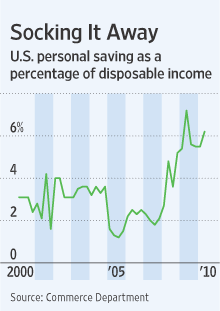
Yet at its core, the prospect of people cutting spending on things like apparel and inessential big purchases – like automobiles and giant flat screen televisions, should not be seen as a bad thing. Weren’t we told that Americans HAD to increase their savings rate? That rate is now up to 6.4% from the latest report about three times greater than 2 years ago. An article in today’s NY Times highlights the challenges of retailers and the economy in general – http://nyti.ms/9ylhPl

Economists never agree but there does seem to be consensus that consumer spending which represents 70% of the American economy has to move forward in order to enable a real recovery to take place. Since retail sales were so bad a year ago, John Long, a retail strategist at Kurt Salmon Associates noted “that should have made this July’s comp a layup”.

An article in the Wall Street Journal earlier this week http://bit.ly/ayAGVe noted that sales of technology and electronics are bright spots but those sales appear to be coming at the expense of items like clothing and appliances.

I cannot for a moment imagine that returning to the ways of the recent past – profligate spending and people spending money they did not have in the first place – will result in economic salvation.

We run a marketing agency and our primary focus is helping our clients gain and retain customers. Consequently consumer (and business for that matter) spending is critical to our mutual success. However I am not disappointed that Americans are being more careful about how much they are spending while at the same time increasing their savings.

The big problem for businesses like ours is getting banks to loosen up their purse strings and actually lend money for expansion and growth for small businesses. But if a return to spending money one does not really have is the answer we are in a lot more trouble than I ever could have imagined.

Agree? Disagree?

Posted in Customer Experiences, Living in the World Today, Marketing stuff | Tagged , , , | 1 Comment

Do you have a bottle of Tabasco in your home?

I just had breakfast at the local diner and as usual I asked for Tabasco for my eggs. (Ok egg white omelet on the off chance my doctor might read this). Tabasco has been made by the McIlhenny Company out of Avery Island, La., since 1868. The company is still family-run and privately held and doesn’t disclose its financials, but estimates are that Tabasco found just about everywhere I go, owns about 20%-25% of the market.

McIlhenny, which grows its peppers all over the western hemisphere (apparently they are all handpicked); sells six flavors of Tabasco, but none come close the numbers of its bestseller, the original red. International business comprises 40% of the company’s overall sales. I can’t think of another brand that would be found in so many homes around the United States – and perhaps outside the U.S. as well – can you?

Everyone seems to have a bottle of Tabasco somewhere in the spice cabinet or refrigerator. Many of us have no idea as to the actual age of that bottle. (Can Tabasco go bad? Has that ever happened to anyone?) I have a number of women friends that carry a small bottle of Tabasco around in their purse.
Tabasco even has a relationship with a franchise style marketing (but not a franchise business yet it has a buy in of slightly under $ 15K) company http://specmarksystems.com/ that allows you to re-sell Tabasco brand product. By the way they claim it’s not a get rich quickly program.

Sold in more than 160 countries and packaged in 22 languages and dialects (at least according to Wikipedia), as many as 720,000 two-ounce (57 ml) bottles of Tabasco are produced daily in Louisiana. The U.S. military has included Tabasco sauce in MRE’s since the 1980’s. I had first-hand evidence of this last summer when I did a two day USMC executive session which included lunching on MRE’s (in case you are interested http://bit.ly/dr7UdL.)

What strikes me more than anything else is that Tabasco only owns about 20%-25% of the market. Is that the market for hot sauces? Quick can you name #2? I am at a loss to come up with any brand that even comes close in this – or for that matter just about any other space.

Got any ideas on other brands that are as ubiquitous as Tabasco?

Posted in Customer Experiences, Living in the World Today, Marketing stuff | Tagged , , , , , , | 2 Comments

Why would Tumblr like to be Twitter’s rival?

Even before I read the article in today’s New York Times (http://nyti.ms/aQ9oKV) I had some knowledge of Tumblr – http://www.tumblr.com. Yes I signed up. No I’m not exactly sure why.

A blogging service based in NYC, Tumblr claims to want to (in the words of journalist Mark Coatney) occupy ‘a space in between Twitter and Facebook’.

Personally I have difficulty seeing how big that space might be. The 24 year old founder David Karp notes that Tumblr is not all about followers (well that’s a relief). What I like about Tumblr is that it offers a like for publications to truly interact with their readers in a way that Facebook and Twitter do not. Tumblr requires publishers to add commentary in order to gain favor with its ‘community’.

Here’s what is even more interesting. Somehow Tumblr – which still does not have a business model, recently raised $ 5 million from Spark Capital and Union Square Ventures. This apparently (according to President John Maloney) offers some validation. Ya think?

As the American and world business climate today remains choppy and challenging it’s more than difficult for companies, even like ours, to obtain adequate financing for expansion, hiring and working capital. That VC firms would throw up a combined $ 5 million to a firm without a business revenue is evidence that despite all the talk of fiscal prudence, as long as there is the chance to make a fast buck, caution can and will be thrown to the wind and the speculators will continue to do what they have always done.

I am all for on the edge new ideas and new businesses. But Twitter still has not shown the ability to make any money (in contrast to Facebook) and much more money has gone into Twitter than $ 5 million. Maybe Twitter will get there but the jury is still way out as far as I am concerned.

Do you think you would get financing for coming up with an idea that had no decided revenue model?

Posted in Marketing stuff, Social Media | Tagged , , , , , , | Leave a comment

Seven Ways to Make Sure You and Your Marketing Agency Are On the Same Page

In case you want to read it on the site… http://bit.ly/bTpGtT

Are you getting what you pay for when it comes to marketing?
As U.S. and world economies bump along the bottom, customers repeatedly ask their marketing agencies (among other vendors) to do more with less. Our agency is no different.

Many clients have the perception that e-mail marketing, social media marketing and ‘guerilla’ marketing tactics are great ways to save money. And those channels should be considered a part of the marketing mix – but not solely on the basis of cost savings. For some clients a social media campaign may bear little fruit. You should view your marketing agency as your partner in achieving your sales goals. That’s how we have always worked with our clients. How can you be sure you are getting what you pay for? Here are 7 things to think about:

1) Be sure you can measure it. Aside from broadcast television/radio and magazine advertising most marketing channels today offer at least some ability to measure performance. Satellite radio and cable television offer better tracking capabilities than broadcast and these capabilities will only improve over time.

2) Set a realistic marketing budget. Your budget should be aligned with your sales goals, with a clear depiction of how a successful marketing campaign will be evaluated. Low/medium and out of the park scenarios should be included. I’ve seen far too many ‘budgets’ that are very small and totally out of line with their objectives; i.e. ”We want to sell $20 million worth of our product/service and we have a marketing budget of $100,000.“ How exactly is that supposed to work? Is 200 times your investment an achievable goal?

3) Be prepared that some tactics may not work. If you eschew all or most traditional marketing channels in favor of new media marketing, be prepared that they may not work. Sure it’s possible you will extend your marketing budget but also be sure that in ignoring traditional channels you have not ignored many current or potential customers who simply do not use social media.

4) Allow your expert partners to do their jobs. It sometimes seems that everyone wants to play art director or copywriter. Client-side ideas are very valuable (since who knows the product or service better than you?); but would you make tweaking suggestions to your doctor or attorney? Not likely. Marketing agencies are staffed with professionals, just like your doctor’s or lawyer’s offices. Years of training and experience have gone into their decision making processes.

5) Incentive based deals are acceptable for marketing agencies. For certain products – this may not be true. And an agency willing to take some of its final compensation on the back end still needs to be compensated along the way. But if you enter into a speculative deal it should be a deal you would want for yourself if the product truly excited you. “You win, they lose” is not a basis for a successful long term partnership.

6) Ask your marketing agency to provide prices for creation of different channel efforts. Remember you are the client. It’s not taboo to ask questions like: How much is a print ad? An email or survey? A direct mail package? An outdoor ad? A PURL campaign? Writing a broadcast or cable spot? Even knowing what setting a Facebook fan page or handling a twitter feed will cost is not out of bounds. If your agency is not willing to give you information like this you may want to look around.

7) Allow your marketing agency at least a year to leverage their understanding your business. Yes there are times when you will know relatively quickly that the fit is wrong. But all the time invested in bringing your agency up to speed will be lost if you change agencies like you change socks.

Don’t be hesitant in discussing your marketing budget with you marketing agency. Let them tell you what they feel can and cannot be done. Both parties will come out of that discussion with a much better idea of the expectations and deliverables.

Posted in Marketing stuff | Tagged , , , | 1 Comment

Why haven’t you ditched your home telephone line yet?

The better question might be why haven’t I? The cable company that delivers our cable TV and internet service has been advertising a triple option to include cable phone service. You get to keep your telephone number (thanks to a government statute enacted several years ago) and the premise is that overall you will spend less by combining services. And this is certainly true in year one but subsequently it the gap closes a bit but overall it is still less expensive to have cable phone service than a traditional land line.

For years the argument against cable telephone service was that if the cable service went out – so would your phone service. And while all of us at my house had mobile service (spotty service due to where we live), emergency calls might be a problem from a mobile phone (turns out that’s not true).

Last week like many areas in the United States the Northeast was hit by severe thunderstorms and our area on Wednesday in Connecticut in particular. We lost power for nearly 24 hours and many people lost power for much longer than that. But we also lost our home landline phone service at the same time.

Fortunately mobile phones work well enough at our house to be a reliable back up. We have a small generator so we had limited power (no air-conditioning!), and still the phone was out and when we called AT & T told us we would have phone service back after the weekend on Tuesday (tomorrow).

That’s a week without home phone service folks. Since I rarely use the phone at home it was no real hardship for me (come to think of it only my wife really uses the phone at home) or our daughter. Tue result is we are going to dump our AT & T home phone service since the whole reason for keeping it turns out to not be valid.

It’s in keeping with the way telecommunication companies view phone service now with the majority of their focus being (and rightly so) on mobile service. Yet it still amazes me that AT & T could consider a residence without phone service for a week to be acceptable. It’s exceedingly obvious that they’ve given up that ship by their action – or inaction.

Our son has no landline where he lives in Florida – and I doubt he ever will nor will our daughter. People under 30 roll their eyes at the notion of a landline saying – ‘what for?’

So how about you? Do you still have landline phone service at home? Why?

Posted in Customer Experiences, Living in the World Today, Marketing stuff | Tagged , , , | Leave a comment