Is Jeff Hayzlett leaving Kodak at just the right time?

On May 28th Kodak CMO Jeff Hayzlett will leave Kodak to pursue a television career. He has recently published a book, The Mirror Test: Is Your Business Really Breathing? His new television show is likely to be centered on offering business advice. Mr. Hayzlett has done a remarkable job in keeping Kodak relevant. The fact that he is leaving may be a signal that Kodak is again headed for troubled times. In yesterday’s Wall Street Journal http://bit.ly/bmu4DP it was noted that Kodak relies heavily on payments from intellectual property lawsuits to bolster revenue as it waits for the new initiatives to take hold. That does not strike me as an ideal business model.

Under Mr. Hayzlett, the company created the roles of Chief Listener and Chief Blogger and launched a social media team. Kodak also landed a central spot on NBC’s Celebrity Apprentice, where viewers vote for their favorite Kodak Moment of each episode. Kodak also recently launched a new advertising campaign, emphasizing the “share” capability on its cameras, which allows users to post pictures directly to Facebook and other websites.

Having joined Kodak in April of 2006 as SMO and VP of Graphic Communications, Hayzlett was instrumental in helping Kodak gain a foothold in the digital printing marketplace. Competing with HP’s Indigo and Xerox iGen, Kodak’s NexPress is a very solid performer both for print resellers as well as Kodak.

I visited both Xerox and Kodak back in 2006 and toured their facilities when an associate asked me to help him decide which machine to purchase (the NexPress was $ 3.2 million at the time). I was more enamored with the Kodak technology than the Xerox but both platforms were impressive in their own right. And Rochester, NY is lovely in mid-March after all.

Moving into the digital printing arena was a smart move by Kodak. After all, Instamatic cameras were long gone, film cameras a novelty, and digital cameras were being relegated to special occasions as consumers increasingly used their phone or PDA cameras to take photos. So what’s the next play for Kodak? I would not consider the digital print marketplace to be rife with new opportunity.

Kodak CEO Antony Perez will not replace Mr. Hayzlett, who noted that in staying four years at Kodak it was the longest he had ever stayed in one spot. His resume while at Kodak will read well and I suspect he got out while the getting was good.

What kind of future do you think Kodak has?

Posted in Customer Experiences, Marketing stuff | Tagged , , , , , , , , , | 4 Comments

Conde-Nast and the New World Trade Center – a match made in heaven?

The rebuilding of the World Trade Center (WTC) is an ongoing saga. It’s hard for me to believe that nearly nine years after the event of 9/11 construction is only now starting to get into gear. To call it a fiasco might be an understatement and I am overly thrilled with the final design. In addition, a lack of prime tenants (I would not consider the Port Authority of NY/NJ to be a prime tenant) had been of great concern to Larry Silverstein and his development team.

It’s no secret the publishing industry is in the midst of severe changes and employee downsizing. The future of publishing is fast evolving. So let’s say that one the largest and most successful publishers in the world (Conde-Nast – think Vanity Fair, Vogue, etc.) might be uncertain about their future in terms of how many people and they will employ (staff vs. freelance for example). What might they do?

Reading the article in today’s New York Times http://nyti.ms/cHwJyA gave me the idea that Conde-Nast moving out of Times-Square and down to the WTC is a nearly perfect arrangement. It gives the WTC a flagship tenant that very well could attract other possible prime tenants to head back downtown. Conde-Nast currently occupies 800,000 square feet at 4 Times Square as well as five other buildings in Manhattan. One million square feet out of 2.9 million total square feet will be a huge boost to Mr. Silverstein and his partners.

And what does Conde-Nast get? A back door perhaps? If for some reason Conde-Nast were to be smaller than they forecast, (I strongly suspect the brass at Conde-Nast have no idea what their personnel needs will truly be five years from now) they can simply renegotiate lease terms – less space, lower cost per square foot etc. In the meantime both parties can crow about a match made in heaven or at least the 110th floor of this 1,776 foot tower, (to be known as 1 World Trade Center after the term Freedom Tower was scrapped) which is to be the tallest building in the United States.

It’s a risk both parties have a good reason to strongly consider.

Agree? Disagree?

Posted in Living in the World Today, Marketing stuff | Tagged , , , , , , , | 2 Comments

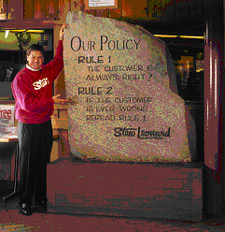
Stew Leonard’s gets it right

I’ve lived in Connecticut for more than 18 years. Even before my wife and I moved here we visited frequently. On more than one occasion we stopped and shopped at Stew Leonard’s http://www.stewleonards.com – self proclaimed ‘World’s largest dairy store’. With roots back all the way to 1921 Stew Leonard’s is a Connecticut and now New York State institution. In 1969 Stew Leonard’s opened its first retail dairy store with 7 employees. Stew Leonard Sr. (the stores today are run by Stew Leonard Jr.) wanted retail dairy store where children could watch milk being bottled, while mothers did their shopping in a farmer’s market atmosphere.

Stew Leonard’s practices the ideal – ‘the customer is always right’. Each store carries only 2,000 items. All have a prime butcher, fresh baked goods, as well as fresh fish and produce. Most people do not do their regular grocery shopping at Stew’s. But people do go there if they want a high quality and yes – fun experience. The stores are designed such that you push your cart around in a circuitous manner in and around people who are constantly stopping to get free food and drink samples which are offered throughout the store. That’s fun and an experience. It’s just one reason Stew Leonard’s is a destination place.

For kids it is a fun place too. Outside the Norwalk store is a petting zoo – my children loved it and always wanted to stop there when we first moved to the area. Inside there are motorized displays with animals singing and dancing, and ‘interactive’ displays like pushing the button and hearing the cow moo. So kids love going to Stew’s as well.

It takes a while to navigate the store – not a fast in and out, and anyone that goes there regularly will tell you it is a commitment of sorts. It’s not a bargain store necessarily but not overpriced either and even at the end of the ride Stew Leonard’s shows that they get it. They have a large number of cashiers – all pleasant and fast with baggers helping get you out fast. Spend more than $ 100 and you get a coupon for a free ice cream on your way out.

Consistently Stew Leonard’s is ranked among the 100 best companies to work for in America. http://www.stewleonards.com/press/07Fortune.cfm.

Let’s see, a fun place for the whole family to shop for quality food, where employees are happy and valued. Something every company should aspire to be. How does your company measure up?

Posted in Customer Experiences, Marketing stuff | Tagged , , , , , | Leave a comment

Oh Canada -2010 is Canada’s year to shine

Our company owns shares of a technology partner in Canada so we have interaction with Canadians just about every day. And I also seem to have a good number of Canadians in and around my life. Some are French-Canadian and other English speaking Canadians. Those two groups have difficulty agreeing on many things. But they sure were in agreement when both the Canadian women and Canadian vanquished the United States in the gold medal games in the Olympic games of this past February.

Canada has a little less than 34 million people. That places the entire population of Canada below the entire population of California. 90% of the Canadian population is located within 100 miles of the United States Border. The Vancouver Olympics were a pretty big success and during the Olympics the B.C. province as well as others ran a good number of television spots featuring well known Canadian people promoting tourism.

The perception of Canadians by Americans has evolved over the past 30 years (think of Doug and Bob McKenzie from SNL) and it is for the better. I’ve found Canadians to be fiercely proud and nearly universally not desirous of being affiliated as northern U.S people. There are Americans who feel Canada should just be annexed or could be easily absorbed into the U.S.A. for its natural resources. Oh and Canada is the world’s 4th largest country by landmass right behind the United States. It’s a large country with just a few people – lots of open space. Canada has the 10th largest economy in the world which came as a surprise to me.

With all the debate about health care in the United States, Canada has had a nationalized publicly funded health care system for quite some time (first advanced in 1946). The government plays about 70% of Canadian’s health care and Canadians have become accustomed to waiting sometimes months for various procedures. They seem to take it all in stride as part of the greater good since everyone is covered. I have talked with a number of Canadians who simply cannot understand why the United States has such difficulty with universal coverage.

I’ve had Canadians tell me that a primary difference between Americans and Canadians is the American notion of climbing up the ladder to get higher than your neighbor. A gross generalization to be sure but the idea being that Canadians are more interested in helping their own neighbors than climbing over them was an interesting concept to me.

Canadians are for the most part favorably inclined towards Americans and for good reason – the United States in general as the United States is its largest trading partner. There is much we Americans can learn from our neighbor to the north and it’s time for Americans to stop being so ignorant of this rising nation.

You’d expect the people of Canada (and Mexico for that matter) to know the President of the United States. But quick – can you name the Prime Minister of Canada without looking it up? How about the President of Mexico? We Americans might want to play closer attention to our neighbors. And not just by trying to keep them out.

Posted in Living in the World Today, Marketing stuff | Tagged , , , , | 2 Comments

The laws of marketing attraction

According to the “State of Inbound Marketing Report” from Hubspot, as reported by Marketing Charts, inbound marketing is continuing to grow in importance at the expense of outbound marketing. This is good news and further validation that paid search, SEO, social media, blogging really resonate with consumer as well as marketers. For a copy of the pdf – http://bit.ly/aewfHr

With so many marketers looking to employ social media and other non-traditional outlets the report should serve notice that attracting interest in products and services will become the dominant method of marketing. And I could not be happier.

I posted last October that my hope was with the passing of pitchman Billy Mays http://bit.ly/anfWYD the shouting might finally stop. In an article by Stuart Elliott in today’s New York Times http://nyti.ms/9CQlR9 companies like Proactiv are also getting the message that fast and loud is no longer the way to promote products. When the giant infomercial and marketing firm Guthy-Renker tests a less ‘noisy’ approach, that’s big marketing news indeed.

Eliminating in your face direct marketing come-ons still will take time. And don’t think for a second that there aren’t consumers out there that don’t respond to FREE, and ACT NOW. There are many of them out there and the older you are the more accustomed (ok inured) to the blast and hope approach. They continue to be effective but if you look closely you can see the tide is changing.

Why do I think it’s better to attract? Mainly because it offers the prospect/consumer to choose to pay attention what interests them and to disregard messages that they individual feels are irrelevant. The result should be a deeper level of customer engagement since it’s THEIR choice to engage. It does present a major challenge and shift in thinking for marketing agencies. That shift has already begun and there is now a mad scramble in the agency world to show understanding, performance and measurement for social media campaigns in particular.

I’m both intrigued and excited at the direction things are heading with regard to attracting more interest as opposed to promoting it. To give you an example we have a client that wanted to send out text SMS messages to ‘opted-in’ teens promoting music in mall stores. While that can work (and we are planning to test) we suggested signage in the malls noting the number to text to in order to receive free music at the store. We are in development of the campaign right now.

Which do you think will work better?

Posted in Living in the World Today, Marketing stuff, Social Media | Tagged , , , , , , , , | Leave a comment

Guerrilla Marketing doesn’t mean clients don’t have to spend any money


Our agency being on the smaller side has the ability to be nimble while at the same time employing new marketing tools in real time for our own http://www.YourCover.com product as well as for our clients.
Because budgets can be tight we’ve learned a great deal on how to maximize efficiencies and take a guerrilla marketing approach to particular projects. But what exactly does the term ‘guerrilla’ marketing mean? It seems to mean different things to different people.

Thanks to Wikipedia the definition of guerrilla marketing is: ‘an unconventional system of promotions that relies on time, energy and imagination rather than a big marketing budget. Typically, guerrilla marketing campaigns are unexpected and unconventional; potentially interactive; and consumers are targeted in unexpected places. The objective of guerrilla marketing is to create a unique, engaging and thought-provoking concept to generate buzz, and consequently turn viral. The term was coined and defined by Jay Conrad Levinson in his book Guerrilla Marketing.

That sounds all fine and good, but too many people equate guerrilla marketing with – you don’t have to spend any money. I don’t believe Jay Conrad Levinson had that thought in mind. Then there’s also the notion that somehow when guerrilla marketing strategies and tactics are employed we agency types will be smarter and more cost-conscious. My point is that ALL marketers should always be trying to do things smarter and more cost-consciously on every project.

For example, building a Facebook ‘website’ type page within Facebook is something different that might fall into the guerrilla marketing category – it’s unconventional (at least for now), has a potential reach of 500 million Facebook users and is decidedly a less expensive proposition than a conventional website. But even with that less expensive approach than that of a conventional website, it’s far from free or even a nominal expenditure. Strategy, concept, and execution on the part of the agency are what we get paid to do.

We like and ascribe to the idea of unconventional approaches but there also are times when we know a big fat branding and marketing campaign will be the best way for a client to achieve their marketing objectives. We feel that way about YourCover all the time but lack the resources to blow out a big time brand message so we continue to grow the company using a myriad of what we consider to be affordable tactics and channels. So yes we are employing guerrilla marketing when we know we’d be better off if we could employ gorilla marketing!

I’d love to hear about some of the unconventional approaches you’ve encountered out there. Please share your stories and we can all learn a little more.

Posted in Marketing stuff, Social Media | Tagged , , , , | Leave a comment

I’m ready for an EZ-Pass smartphone application

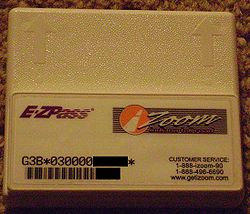
I was driving across the Whitestone Bridge headed to Queens, NYC last night, and as I reached for my EZ Pass, (I don’t have it mounted on the windshield so as to not attract attention to it when parking in various places) the thought crossed my mind that it would have been great to just wave my BB Storm at the reader and travel on through.

I checked and the I-Phone does not have an app for tolls (like EZ Pass or Sun Pass) either. If Apple does not have an app then there’s no way Blackberry would have one. It would be a great thing to have however, and I can come up with many uses for a smartphone application to be used a toll booth throughout the United States. A few ideas:

#1 – You would be never to have to wait in the cash lane wherever you are driving in the United States. The different systems would be easy to integrate and funnel credit back to individual states and toll systems.

#2 – There would be no need to have the ugly EZ Pass or other box adhered to the windshield (another reason I don’t mount mine).

#3 – It would be easy to see how much is in your account without logging on (who does this anyway?). And can you possibly remember the tolls you are being charged for a month plus after it occurred when you read your statement – if you read your statement in the first place? You also would have an easy way to see how much you are spending in tolls. Expense reports including tolls would be infinitely easier to update for business people as well.

#4 – The need for toll takers would be even further reduced. At some point in the not too distant future nearly everyone will have a smartphone whereas not everyone has an EZ Pass or other electronic toll pass device (although I can never understand why as there are incentives for using the EZ Pass in the form of lower toll rates.

#5 – The amount of waste created by physical EZ Pass et al boxes would be eliminated.

Of course there are a few potential drawbacks in my scheme mainly in the form of loss of privacy. GPS would identify where you are at any time and it would be hooked into your profile (as opposed to a Magellan or Garmin or auto based GPS system). But it seems to me that people are already trackable already to a large degree – much more than they realize.

I’ve also been thinking about the ability for a speeding ticket to be sent to people who average more than the posted speed limit (this has been known to happen even to me unknowingly of course), by a certain percentage. That could happen now with EZ Pass but it might be considered circumstantial evidence. With an integrated smartphone toll application I think that excuse might be less available.

But I will raise my hand and say I’m ready to be first in line if someone creates a smartphone toll application. Even if it starts with EZ Pass and is not compatible with other systems initially eventually that would change as well.

Would you use an app like this if it existed?

Posted in Customer Experiences, Living in the World Today | Tagged , , , , | 25 Comments

Travel by rail in the U.S. – getting our ashes kicked

I received an email from a good friend of mine today relating his trials in traveling on business in Europe the past week. Unless you’ve been living under a rock the big story for days and days is the horrific impact of the Icelandic volcano that erupted last week. What we have heard in the United States is all about how travel has been disrupted, people sleeping in airports (I was this firsthand at Newark this past Sunday morning when we I was catching a flight).and travelers being stranded all over the globe.

But my friend had a different problem. He does a great deal of consulting in Europe and had multiple engagements over a 3 week period all over the European continent. Since he has over 1 million American airline miles he flies everywhere and it works. Not this time. Being a very smart fellow he anticipated the problems and worked out train travel for several destinations (he did mention that Paris to Barcelona was 12 hours by train as opposed to under 2 by air and was hoping to not have to go by rail).

The key thing here is that in Europe, as in much of Asia train travel is fast, efficient and truly an alternative to air travel. Not necessarily less or more expensive (prices for rail travel and air travel are not all that different in Europe and Asia for many routes); Americans would expect rail travel to be less expensive, mainly because we’ve been anesthetized by Amtrak.

I read recently that maybe by 2025 there will be a train from Shanghai to London that will make it in 2 days. Considering a flight is already 12 hours that’s not too bad and the ability to avoid jet lag (never have heard anything about train lag) makes that an amazing proposition.

Amtrak has made some striders and is becoming more of an alternative to flying than it used to be. But it still pales in comparison to travel by rail in Europe and Asia. Americans remain in love with the automobile. Could you imagine a college student coming to America to travel around by train?

The Northeast corridor of the U.S. is the area most primed for high speed rail travel. However the existing train rails are so outdated (curved and shared with other rail travel) that although Amtrak Acela trains can reach speeds of 150 M.P.H. they rarely exceed 90 M.P.H. since they are more prone to derailing the faster they travel. Perhaps you’ve heard of Amtrak trains derailing?

It seems today that everyone talks about the green revolution and getting people out of their cars and onto trains would be a great place to start. Recent news has a high-speed rail system being built from Tampa to Orlando Florida that will be ready in several years time. I guess progress has to start somewhere but it’s difficult to understand how Florida became the test case. People are out of work and there is a huge opportunity here to really get going on something that is a win-win project for a long time to come.
Of course maybe my head is just in the clouds. Or the ash. What do you think?

Posted in Customer Experiences, Living in the World Today | Tagged , , , , | Leave a comment

Making your business a destination place

I live in a small town in Connecticut. When I moved here there was an old diner called Orem’s that hailed its beginnings from 1921. You can visit the website – http://www.oremsdiner.com. And inside the place it looked like it. The food was kind of greasy. The place was dingy and there was not much parking. Still it was prominently located on a busy (and getting busier) stretch of a two line ‘highway’ that goes starts near the Connecticut coast and goes all the way up to Canada. Even then Orem’s was a meeting place or destination.

But it got better. In and around 2005 the state decided to widen the highway which necessitated that the Orem’s original location was in the right of way for the new highway. So the Papanikalou family took a big leap and decided to build a new Orem’s south on Route 7 of the old location. The ‘new’ Orem’s Diner is seemingly 3 times the size of the old one with 6 times the parking. The family was nervous that they would not be able to fill the new venue. They had no reason to worry.

Today Orem’s is even more of a destination than ever before. People from out of state know Orem’s and many meetings take place at this now new landmark. The place is clean, the food is better, the wait staff seems happy to be there and the service is attentive. Kids from 5 – 90 are in Orem’s all day and all night and frequently there are lines of people waiting to sit down. At a diner. And Orem’s is open later (for a town that rolls up many eateries at 9PM) than just about any place around town.

There are other places to eat in our town. But Orem’s remains a go-to location for so many people that it has no doubt impacted other quick service type restaurants. And not for the better.

So when we work with our clients our aim is to help make their business a destination place. Whether it is retail, direct response, or internet based business. Or even a business to business company.

It’s hard not to like a business that understands what customers want, continually makes efforts to maintain product quality and service, while listening to their customers.

Orem’s for breakfast, lunch or dinner. It’s a destination place. Is your business?

Posted in Customer Experiences, Living in the World Today, Marketing stuff | Tagged , , , , | Leave a comment

Social media and Internet censorship in the office will not make things better

I heard a radio spot yesterday from Barracuda Networks. Their offer is to help companies make their workers more productive by blocking/firewalling them from websites and social networks that (as the ad infers) detract from employee productivity and company profits. Their ‘solution’ is to have companies employ their product as a step on the road to productivity. It’s a blatant scare tactic and the barracuda is a pretty scary looking fish after all.

It’s nearly a certainty that there are some business owners and/or managers that will consider this approach as a salve for some of their business problems. I’m not one of them in any way. Walling off employee access to certain websites and social networking is simply a terrible idea.

The idea of restricting access during the workday in order to ‘get people back to work’ will quite possibly have the opposite effect. Pretty soon companies that take that tack will ask employees to leave their mobile devices at the door when they come to work. After all many people now can adroitly access the web and social networks from their iPhone or other smart phone. Take away the websites and social media check-ins and employees will spend more time trying to find a way around it. So exactly how will that approach make things better?

Companies that restrict internet access are telling their employees – ‘We don’t trust you’. “We don’t respect your ability to make appropriate choices on how you spend your time during the work day.” And what kind of bright young minds would be interested in joining a company that approaches its business in that manner?

I’m not so naïve that I think employees always act in the most productive manner every minute of the work day. But is that really the goal of an employer? No I don’t wish that members of our team spend 3 hours a day on Facebook, LinkedIn or looking for a job on Monster or Career Builder, (apparently we had one that did that while here). But I ask those companies that think restricted access is a good idea – do your employees receive and respond to emails before and after the workday? On weekends? For many companies including ours the answer is an unequivocal yes. Granted our company is a smaller one with less than 25 people. But even if we were the size of, oh say Microsoft or Wal-mart, would the restriction of access to the web create a better and more productive working environment?

My take is if you cannot count on having smart, motivated people on your team who know the difference between what is appropriate and what is not, then you have the wrong team in place. It can sometimes be the job of managers to teach employees the difference if they don’t know it already. But forbidding access and censoring sites sounds a bit China like to me.

I wouldn’t want to be a part of a company like that – would you?

Posted in Living in the World Today, Marketing stuff, Social Media | Tagged , , , , , , , , | Leave a comment