How often do you have thinking day at work?

Like many of us I find that there hardly is enough time in a ten (ok 13 sometimes) hour work day to get all the things done I need to get done. Fortunately I thrive on being busy and actually enjoy it. Yet the day to day pace can wear down even the strongest of resolves. Most days I have a list of several must do’s, while the remainder of the day is spent helping others around me both on the client side as well as team members.

Whether they are tasks or support type meetings most work days are filled with things that have to get done. Not enough time is spent thinking about what the most productive or important thing you could do next would be. The ‘Just do it’ mentality is pervasive and I think at times counter-productive.

In my case, this can go on for weeks at a time, particularly when I am traveling and out of the office more often than I am in the office. The weekend does offer time to catch up although this summer I have tried very hard to not be in the office much at all on the weekend. Every once in a while appointments move around or even drop out and I end up with a day in the office that is not overscheduled. I had one of those yesterday. It just sort of happened. I had planned to be around the office most of the day with just a couple of meetings but things broke differently than I planned and I actually found myself with some time to think about things that I wanted to do as opposed to things I had and needed to do.

One day can mean a lot in changing my outlook. Getting to the point where I don’t have things hanging over my head is a great place to be. Even if it only lasts for one day! It’s refreshing and even re-energizing. I’m also aware that it may not happen again for a long time (in my case I am guessing it might be a few months). But you never know and when that opportunity presents itself for a ‘day’ I will leap at and relish it. And I know I need to do it more often.

How about you? Do you ever get one of those thinking days? Would you like to? Do you think it is important and worthwhile?


Posted in Living in the World Today | Tagged , | 3 Comments

Restaurant reservation systems and restaurants need to do a better job of working together

If you live in a major city, (or even smaller town with a really hot restaurant) the process of making a reservation can be onerous, to say the least. As many of you know, in the top rooms, the experience can include having to call exactly 30 days in advance to secure a desired reservation date and time, (of course even doing this sometimes results in getting a 5:45 or 9:30 option for dining!) and then if you are lucky enough to reach a ‘reservationist’ (who comes up with these terms??) leave your credit card number to ‘secure’ the hallowed reservation.

But wait, there’s more. The day before or the day of someone from the restaurant (ok the reservationist – could you imagine telling your parents that’s your job?) calls you at the number you left and asks you to ‘please’ confirm. In fact if they leave you a voice mail you are then asked to call them back to confirm.
Understanding that there are people out there who are no-shows and that can really screw-up a restaurant, I get the idea that restaurants have a need to know who’s showing up and who’s not. But the system still used by most restaurants today is archaic and just bad. It does not serve the customer it serves the restaurant. Making the customer jump through hoops to obtain a reservation does not serve the customer at all and that’s ironic since restaurants are in the business of service right?

In recent years online reservation systems like OpenTable, Tablefinder, Blueskies, Rodeco ICT and Magellan (to name a few) have grown with OpenTable being the most well-known. It’s a good idea. You sign up for an ‘account’ that costs nothing. You log-in with your email and get points for making reservations at participating restaurants (yes multiple platforms means different restaurants are part of different systems).

You pick the day and time, number of people in your party and the restaurant let’s you know what’s ‘available’. Sometimes what’s available is 5:45PM and 9:30PM. I wish I were hungry at these times since obviously I would always get what I wanted but alas my stomach, family and friends are not aligned with this concept. But many times you can get your exact time or something within 15 minutes of your time and that’s fine. Then you hit send and you are all set. A confirming email is sent to you and you are good to go. You are not automatically opted in to receive the restaurant’s emails (another good thing) but you may get a follow up email from the platform asking you about your dining experience which you can ignore which is what I do. The best thing is YOU DON’T HAVE TO MAKE A PHONE CALL TO REACH THE ‘RESERVATIONIST’ or anyone for that matter.

I have a good friend in the restaurant business who understands the need to have the platform but notes that it can backfire for the restaurant since if the user does not see the time they want they often will just move on to another restaurant without calling at all. If you called the restaurant it would go out of its way to try to accommodate you. Online reservations offer no chance of that.

The other day I made a reservation on OpenTable – got the time I wanted, the confirming email. And I could even invite my guests by sending them an email giving them the details – location, time etc. Cool!
But then something happened I did not like. The restaurant called the number I left to reconfirm and left me a voice mail. Considering I made the reservation 3 days prior WITHOUT CALLING, I now had to call them back to ‘confirm’. I was out of the office and did not have time to call so I tried to text them. That did not work as it was a land line. This is ridiculous! Why don’t the restaurants confirm (if they have to) either by email or leave a number that you could SMS text to? Hasn’t anyone thought of this?

Who wants to call a restaurant to reconfirm a reservation anyway? Anyone?

Posted in Customer Experiences, Living in the World Today, Marketing stuff | Tagged , , , , , , | 5 Comments

My strange but positive customer experience

The worldwide recession appears to be stubbornly holding on and impacting so many people, Here in the United States the talk is all about job creation or lack of jobs in general. Companies that have reduced staff have been running lean for quite some time now. The results often are found in less than exemplary customer service.

I had a taste of that at Stop and Shop this past weekend. Walking in there on a Friday evening after 6PM the store was relatively empty. Having promised my daughter a lobster for dinner I had to pick up a couple of things as well as a couple of crustaceans. These days lobster is pretty inexpensive in the Northeastern U.S. with prices as low as $ 4 U.S/pound. Since a 1.25 lobster is a pretty decent size it hardly seemed like a luxury. At Stop & Shop the lobsters were actually $ 7.00/lb. At least that’s what the chalkboard read in the seafood area in the store.

However when I arrived in the seafood area there was nobody attending the area. And nobody was working anywhere nearby. I waited about five or ten minutes (seemed like 15), finally gave up and walked to the front of the store to ask if anyone could help me. I was first told nobody was working back there. Big news indeed. They offered to page someone which they did and I walked back to the seafood area. Another five minutes ensued but no sign of anyone.

I again walked to the front of the store and was again told that they would page someone. I pointed out that I had already seen that movie and did they want to sell me a lobster or not? They paged again and I again walked back to the seafood area. Finally I saw what appeared to be a manager type and I told him I had been waiting fifteen minutes to purchase a lobster. He again noted there was nobody back there. I am not making this up.

Pete, the manager offered to help me (ok maybe I was finally getting somewhere). After he scanned the area to be sure nobody was there but him he went behind the counter to the tank to (I hoped) fish out a couple of lobsters. But I could tell right away that this 6 foot 4 guy was not at all comfortable around the lobsters. So I offered to go back there myself to fish them out and put them in the bag. Looking incredibly relieved he quickly agreed and back I went. He stood pretty far away from me as I selected two of the 6 or 7 lobsters in the tank. I put them in the bags and then Pete did exactly the right thing. He told me he had no idea how to ring them up and for my trouble he was not going to charge me for the lobsters. I was both surprised and pleased.

The cash register attendant was a bit skeptical but when there wasn’t any tag on the bags he shrugged and checked me out.

So a big negative experience was turned into a positive experience and a story. Pete got it right and by extension Stop & Shop had a happy customer.

Good customer experiences come in many different forms.

How about you? Got any strange but true stories like that?

Posted in Customer Experiences, Living in the World Today, Marketing stuff | Tagged , , | Leave a comment

How George Steinbrenner was a marketing genius

Full disclosure – first and foremost, I am die-hard Met fan. It is not really possible for me to ever root for the Yankees although as a New Yorker it is tough to root against New York at times.

George Steinbrenner was a complicated man. He was bombastic, tyrannical, profligate, seemingly at times unstable, and yet at times generous. In the early years (he bought the Yankees for $ 10 million in 1973), the franchise today is valued at over $ 1 billion. In 37 years of ownership there are few if any owners that can claim that kind of track record.

Steinbrenner often appeared to be a blowhard and buffoon. But he always exhibited characteristics that are instrumental in the stewardship of a successful brand.

1) Mr. Steinbrenner loved and adored his product and was a fierce protector of the brand. His methods were not always successful but there was never any doubt of his commitment to success.

2) The ‘Boss’ learned on the job and improved his own (and the team’s) performance over time. When Mr. Steinbrenner took over the Yankees they were at a low point and he brought them to back to back World Series victories within 5 years.

3) Harvey Schiller who worked with Mr. Steinbrenner for more than 30 years was quoted saying “Knowing George, most everything he did that appeared to be emotional was actually planned,” “His contributions to the marketing side of baseball are untold. He once said ‘I didn’t buy Seattle. I bought New York.’ He felt he had a responsibility to the market.

4) Once the Yankees became successful Mr. Steinbrenner leveraged that success into making the Yankees one of the most valuable sports franchises on the planet. Creating the YES network in 2001 was a brilliant idea and the Yankees ability to attract advertisers and sponsorships is nearly unparalleled in all of sports.

5) The Yankees had won 20 World Series championships prior to Mr. Steinbrenner’s arrival. But through his hard work and dedication to making the Yankees the best team and best franchise in sports, he created a legion of fervent and loyal fans that wear their Yankee colors with great pride.

6) Mr. Steinbrenner embodied word-of-mouth and viral marketing before those terms became part of the lexicon. The Yankees owned the back pages of the tabloids, and ESPN leveraged Mr. Steinbrenner’s famous tirades and sometimes bizarre behavior into must-see TV. – ESPN owes Mr. Steinbrenner a huge thank you for helping make that network more relevant.

As a Met fan I don’t ever wish that Mr. Steinbrenner had decided to buy the Mets instead of the Yankees. I prefer to live and suffer with my two Met championships in 47 years being the second team in New York. Yet as a marketing aficionado I am still able to recognize a marketing genius and brand champion when I’ve see one. And he never, ever, was boring. That’s more than can be said regarding the ownership of the Mets over the years.

The Yankees may continue to excel on the field but Mr. Steinbrenner will be missed for his commitment to winning and his brand. There will never be another major sports team owner like him.

Posted in Customer Experiences, Marketing stuff | Tagged , , , , , | Leave a comment

I wish it were the case only at LaGuardia

Last night we picked up our teenage daughter from LaGuardia airport. She came in from Central America through Miami to LaGuardia (LGA). Originating as an international flight but they went through customs in Miami so the leg to LGA was domestic.

It was a bad weather night in the New York metropolitan area with thundershowers all day and heavy downpours. We knew the flight would be delayed and American Airlines updated the flight status dutifully all afternoon on their site as well as through opted-in reminders we subscribed to. It was frustrating for all of us that the flight was delayed more than two hours but pretty good use of communication overall by American Airlines.

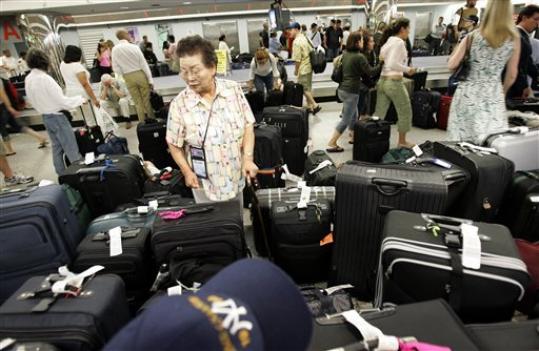
The same cannot be said of the baggage handling at LGA. The baggage claim at LGA is not run by American Airlines or any other airline as it is unionized and the handlers are employed independently. Moreover we got into baggage claim and there were hundreds of people milling about with no signage indicating where the baggage was to be claimed. However there were a number of ancient but blank video screens.

We stood at one baggage carousel talking for ten minutes with another family whose son was on the same flight. Finally my wife (she’s the proactive one here) suspected something was not right and found out that in fact baggage from our flight was at a carousel at the other end of baggage claim. Still without any indication but she found someone who seemed to have an idea.

Then we learned that the baggage was being off-loaded to two carousels. So we had to split and have one of us at one, one of us at the other and the third standing on long line for reporting lost baggage as after 45 minutes we had begun to lose hope.

Finally my wife spotted our daughter’s bag and we were able to leave just as I was about to enter the office to report the bag lost.

Aside from this situation proving that carry-on is the only way to go (not an option when you are backpacking for three weeks), I was shocked, disgusted and disturbed that in one of the world’s busiest airports, the baggage handling was among the worst I’ve ever seen. Believe me when I tell you that Hanoi, Vietnam was cleaner and with better signage than La Guardia.

People that travel into NYC hate LaGuardia. Is it any wonder why? How does this show off my hometown to visitors from other countries? Or those that live in the United States?

Posted in Customer Experiences, Living in the World Today | Tagged , , , | 1 Comment

The World Cup process it’s great when the world gets together – my top 5

Now that the World Cup is over and Spain has been crowned champion for the first time the time is right for a little reflection on the event that has spanned the past 4 weeks. My soccer experience consists of playing junior varsity soccer (not all that well) and coaching my children’s soccer teams until they became good enough to exceed anything I could teach them. However, I have a number of observations regarding this year’s World Cup so here goes:

1) Watching it together. There are few events in which people from across the planet watch the same thing at the same time. The Olympics come to mind and Americans might think the Super Bowl is up there but in my view there is nothing that comes close to the World Cup in terms of exhibiting a country’s passion. Is there any other sporting event that has fans of one country rooting hard for or against a country other than their own?

2) Kudos to South Africa. South Africa achieved nearly everything it hoped for short of winning a game or two. Hosting the World Cup is a monumental task and all indications are that the South Africans set the bar extremely high. Keep that in mind Brazil (where the next World Cup is in 2016)

3) Soccer comes of age in the U.S. My guess is that many more Americans watched (and talked about) the World Cup this year than ever before. Landon Donovan’s goal in extra time to push the U.S. past Algeria may be seen as a watershed occurrence for American soccer (or football as the rest of the world calls it).

4) Timing means a lot. Having games televised at 10:30 in the morning and 2:30 in the afternoon on the east coast of the U.S. (not so bad in California at 7:30AM and 11:30AM) created a positive buzz around the office – at times it almost felt as if people were having fun at work – that’s a good thing folks! As the 2016 cup is to be held in Rio (one hour ahead of east Coast time), North America will get games in both the afternoon and prime time while Europe will stay up a later and Asia – well they will be the bleary eyed ones. People will watch, oh yes people will most definitely watch.

5) Advertising: The running time of a World Cup game makes it more eminently watchable than most other sporting events. No television (or radio for that matter) ads for 45+ minutes. The changing ads behind and around the field were not at all intrusive and I think very food for the brands that chose to participate.

Sure the officiating was at times deplorable, (ok much of the time) and Uruguay’s Luis Sanchez match-saving handball will live infamy, but the thing the strikes me the most is the collective excitement and pleasure and goodwill created by the World Cup event. I eagerly await the 2016 World Cup.

Did you get into the World Cup this year?

Posted in Customer Experiences, Living in the World Today, Marketing stuff | Tagged , , , | 1 Comment

Why does Activision/Blizzard want to pull the pants down of its members?

Starcraft II

Activision/Blizzard’s online role playing game World of Warcraft (WOW) continues to amaze me. With more than 11.5 million monthly subscribers it is one of the most successful online gaming models ever created. This past Tuesday Blizzard announced a new feature called ‘Real ID’ to be used on its official bulletin boards. This feature would require a person to submit his real first and last names in order to submit comments. It appears to be first tested on a new game release called StarCraft II but it appears the ultimate plan is for the new policy to apply to all forums.

They have put it under the banner of helping improve the quality of conversations and make the forums better places for players to visit. Blizzard said in a blog post that the change was intended to “help improve the quality of conversations and make the forums an even more enjoyable place for players to visit.”

“The official forums have always been a great place to discuss the latest info on our games, offer ideas and suggestions, and share experiences with other players,” and it went on to offer, “However, the forums have also earned a reputation as a place where ‘flame wars’ (vitriolic commenting), trolling, and other unpleasantness run wild,” Blizzard said.

“Removing the veil of anonymity typical to online dialogue will contribute to a more positive forum environment, promote constructive conversations, and connect the Blizzard community in ways they haven’t been connected before.”

The gamers are almost unilaterally opposed. And furious, if not possible vindictive (many have posted they will quit the game, never post again etc.)

Anonymity, for better or worse, has been used in online gaming since it began. Apparently after receiving a backlash, one community manager, under his former alias Bashiok, decided to test the system with his real name. The results were not so kind. Within minutes of internet sleuthing, everything from his personal life to the names of his wife and children were put on public display. None of this is surprising at all, given how much information is published on the internet.

Is it any wonder why the gamers are apoplectic?

Many people rely on anonymity as they move around the internet. The cartoon shown as a part of this post is a prime example of people’s desire to be anonymous.

Companies understand that that there are problems with spamming, griefing, threats, etc. but a large amount of Blizzard’s customers think that showing their real names is infinitely worse. The gamers feel if Blizzard continues on this track, the practice could spread to other networks like the PSN. Perhaps now, the outcry will have them think again.

But for me the real questions are – 1) How is this serving the membership and community? 2) Why now? 3) What will be done with the data?

What do you think – good idea? Bad idea?

Posted in Customer Experiences, Marketing stuff, Social Media | Tagged , , , , | Leave a comment

Rolling Stone Magazine – a study in the continued relevancy of a great magazine

Founded in 1967 by Jann Wenner (still at the helm), Rolling Stone Magazine has managed to stay on the leading edge of journalism for more than 40 years. With articles from some of the most topical writers over the years Rolling Stone is much more than a counterculture publication and has been for many years.

Just in the last two weeks Michael Hastings excellent and fascinating article The Runaway General http://bit.ly/cepMPs was singlehandedly responsible for President Obama’s sacking of top General Stanley A. McChrystal. I personally was impressed at how Mr. Hastings was able to get such a level of information and candor from General McChrystal, such that there were no denials – highly unusual in today’s media.

Last July Matt Taibbi’s piece on Goldman Sachs – ‘The Great American Bubble Machine’ http://bit.ly/d3odRB was a smoking gun and a great read if not a slanted position statement.

What is also interesting is that I am not a subscriber to Rolling Stone and never have been. But I am able to read the articles that interest me in some form or another. The pieces are often long reads (evidence to the contrary that people won’t read a long article anymore?) but to me they seem unshackled by the heavy hand of a timid editor.

One of my favorite all-time movies is Almost Famous. It tells the story of a fifteen year old would-be Rolling Stone writer who sets out to do an expose on a fictional 1970’s rock group. As a period piece it is one of the best I’ve ever seen in capturing the feel of the mid 1970’s. It also does a great job of portraying Rolling Stone Magazine in its early days and you can clearly see the development of its journalistic culture.

There’s an ongoing debate on the future of magazines between Samir Husni http://www.mrmagazine.com/ and Bob Sacks http://www.bosacks.com. The debates are lively and the encounters often provocative. Recently the description of ‘what is a magazine’ is at the forefront.

Rolling Stone has been and remains a very good magazine. Whether it is read in print, online, an I-Pad, Kindle, or any other device you can think of. Why? Because it has compelling content that engages readers. Simple enough concept not executed nearly enough.

Guess it’s time I subscribe finally. The question is will I? Do you? Will you?

Posted in Living in the World Today, Marketing stuff | Tagged , , , , , | 2 Comments

Will Dell Computer’s breaking of its promise be its downfall?

If you read the article in the NY Times this past Monday http://nyti.ms/cLeFl6 you saw that Dell Computer had a series of problems with its computers failing at the University of Texas (among others like Wal-Mart, Wells Fargo and the Mayo Clinic to name a few). It’s a sad, sad story of a once high-flying company that had it all (brand reputation and market share) whose star has come crashing down to earth.

It was such a great story. College student Michael Dell has an idea and creates the model of selling personal computers directly to customers while a student at the University of Texas. Being a direct response guy Dell Computer was the paragon of how direct to consumer sales can be a rousing success. The Dell name was synonymous with quality, reliability and service. It also was the harbinger of corporate outsourcing that became a regular business model for other companies. The early 2,000’s television campaign ‘Dude, you’re gettin’ a Dell!” was a winner all around and was fun at the same time as it demonstrated the brand promise.

As time went on consumers began to accept that one might pay more for a Dell than other brands but the positives far outweighed the negatives. My company was one of those companies as our entire team has had Dell’s for years. And they have performed very well.

Dell employs somewhere just under 100,000 people. Most of them are no doubt hard working and principled employees. But there reportedly also employees that went out of their way to hide the problems. Now Dell is being sued by the University of Texas and can expect other companies to follow that lead as the news has come to light.

Dell compromised on the promise and brand reputation it had painstakingly built over 25 years. Now Dell will be in full damage control but the damage as far as I can see may already be the beginning of the end. I know I will personally never feel the same way about a Dell Computer again. Chances are I will have a great deal of company there. They’ve besmirched their own brand name, while at the same time tearing down a direct marketing made turned mass-retail feel-good story.

I could not be more disappointed and in addition I am worried that people in my own company possibly have bad machines that could go at any moment or worse pop and leak fluid (read the article).

Do you feel the same about Dell Computer?

Posted in Customer Experiences, Marketing stuff | Tagged , , , , | 4 Comments

Ze French just don’t get it – will the United States?

It’s not been a great week for La Belle France. First their World Cup Soccer team – champions in 1998, (or Futbol as it is there) was unceremoniously dispatched from the tournament in the preliminary round. It was a major slap in the face to the loyal fans of Les Bleus.

Then American ‘Marathon Man’ John Isner outlasted French hope Nicolas Mahut 70-68 in the fifth set of a 3 day match that lasted more than 11 hours.

But outside the sporting world there is a strike going on in France this week, http://bit.ly/cb8kYk in which trains stood still, children stayed home from school, and post offices were closed. The strikes were a result of President Nicolas Sarkozy’s plans to raise the retirement age to 62 years old.

France apparently has one of Europe’s lowest retirement ages – allowing workers to retire at age 60 in most sectors. My visceral reaction was that France is doomed. As of 2008 France was the 9th ranked country in the world for life expectancy with a person born that year expected to live to 80.87 years. It’s not a stretch to assume someone who has made it to 60 already would live past 80 into their 80’s even if they were born in 1950.

Retiring at 60? What are these people going to do for the next 25 plus years? I am guessing that most French people (like Americans and virtually peoples of all nations) don’t have extensive retirement funds they have squirreled away to last 25 years or more. France is a country struggling with a huge labor problem, an aging population and an economy that has weathered the storm better than many but still has suffered from the overall global economic downturn.

Taking to the streets to protest the unfairness of President Sarkozy’s proposal to help cut back on public debt is selfish and I daresay even foolish. It is also in contrast to what seems to be an emerging strength in technology in the French economy. There are a good number of up and coming companies that contribute greatly to both the French and world economy. I guess the people are protesting that they cannot sit around and sip wine and eat cheese whenever they want.

Full disclosure -I like to sip wine and eat cheese as much as anyone. And my wife and I have had great times in France and we both kind of speak French. (She better than me).

The United States has an even larger and ever- increasing public debt problem. Americans also seem to count down the days to retirement although many now are forced to continue to work in some capacity even after they have left their more ‘traditional’ jobs. That makes sense to me on many levels. When people who are turning 60 in the United States this year were born, the life expectancy was 68.2 years. If they have made it to 60 they are more than likely to live well past 80.

If you were born in 1942 for instance, your life expectancy at birth was about 68 years. But the good news is that you didn’t die of infectious diseases when young, car accidents, or anything else. The average 65-year-old today can expect to live another 18.4 years. So your life expectancy now is not the same as it was at your birth. It is 5.9 years longer than the current life expectancy figure (which is for people born in 2006) or 83.4 years.

Simply put the economics of retirement make it extremely difficult to retire at age 60 unless one is independently wealthy. If France (or the U.S. for that matter) goes down the road it is on people may be able to retire at age 60 but there won’t be places to buy the wine or cheese since nobody will be around to work in the shop.

I’ve thought about this for a long time. Is working until age 70 a horrible thing? Maybe if you grew up thinking you’d be done at 62 or 65 but people are healthier and more vital in their increasing age than ever before in human history. Sorry folks you will have to grind it out a few more years for your own good and the collective good of your country. Vive la France! And Go U.S.A. But keep on working.

Think I am nuts here?

Posted in Living in the World Today | Tagged , , , | 2 Comments